


Loss of androgen receptor signaling in prostate cancer-associated fibroblasts (CAFs) promotes CCL2- and CXCL8-mediated cancer cell migration
- PMID: 29808619
- PMCID: PMC6068356
- DOI: 10.1002/1878-0261.12327
Loss of androgen receptor signaling in prostate cancer-associated fibroblasts (CAFs) promotes CCL2- and CXCL8-mediated cancer cell migration
Abstract
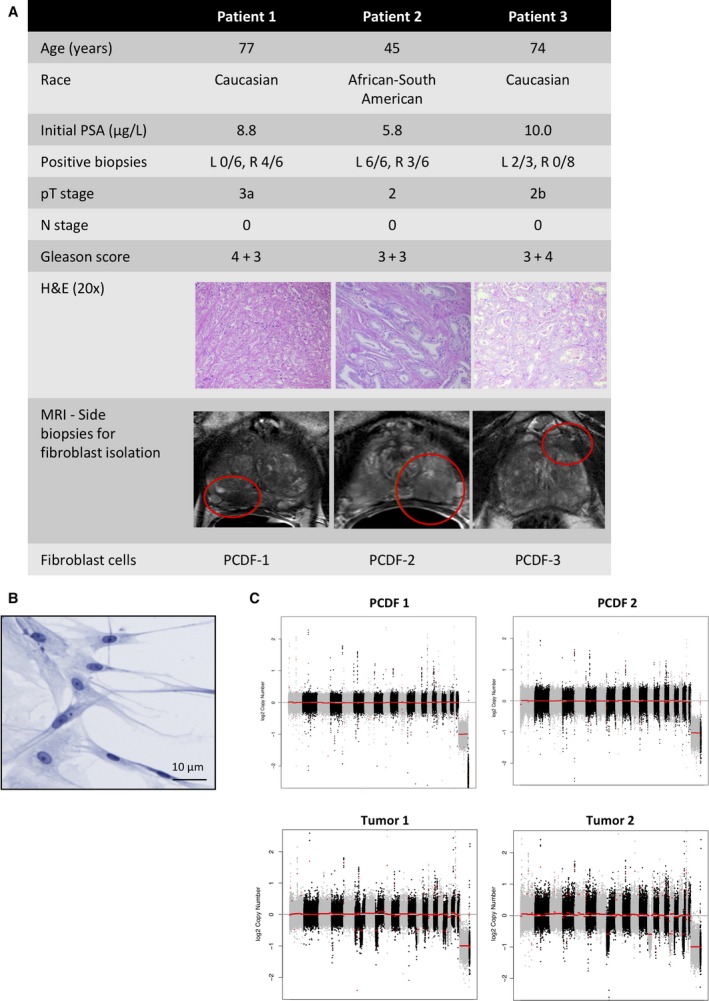
Fibroblasts are abundantly present in the prostate tumor microenvironment (TME), including cancer-associated fibroblasts (CAFs) which play a key role in cancer development. Androgen receptor (AR) signaling is the main driver of prostate cancer (PCa) progression, and stromal cells in the TME also express AR. High-grade tumor and poor clinical outcome are associated with low AR expression in the TME, which suggests a protective role of AR signaling in the stroma against PCa development. However, the mechanism of this relation is not clear. In this study, we isolated AR-expressing CAF-like cells. Testosterone (R1881) exposure did not affect CAF-like cell morphology, proliferation, or motility. PCa cell growth was not affected by culturing in medium from R1881-exposed CAF-like cells; however, migration of PCa cells was inhibited. AR chromatin immune precipitation sequencing (ChIP-seq) was performed and motif search suggested that AR in CAF-like cells bound the chromatin through AP-1-elements upon R1881 exposure, inducing enhancer-mediated AR chromatin interactions. The vast majority of chromatin binding sites in CAF-like cells were unique and not shared with AR sites observed in PCa cell lines or tumors. AR signaling in CAF-like cells decreased expression of multiple cytokines; most notably CCL2 and CXCL8 and both cytokines increased migration of PCa cells. These results suggest direct paracrine regulation of PCa cell migration by CAFs through AR signaling.
Keywords: CCL2; CXCL8; EMT; androgen receptor; cancer cell migration; cancer-associated fibroblasts; prostate cancer.
© 2018 The Authors. Published by FEBS Press and John Wiley & Sons Ltd.
Figures



References
-
- Araki S, Omori Y, Lyn D, Singh RK, Meinbach DM, Sandman Y, Lokeshwar VB and Lokeshwar BL (2007) Interleukin‐8 is a molecular determinant of androgen independence and progression in prostate cancer. Cancer Res 67, 6854–6862. - PubMed
-
- Armstrong CW, Maxwell PJ, Ong CW, Redmond KM, McCann C, Neisen J, Ward GA, Chessari G, Johnson C, Crawford NT et al (2016) PTEN deficiency promotes macrophage infiltration and hypersensitivity of prostate cancer to IAP antagonist/radiation combination therapy. Oncotarget 7, 7885–7898. - PMC - PubMed
-
- Chawla S, Wang S, Kim S, Sheriff S, Lee P, Rengan R, Lin A, Melhem E, Maudsley A and Poptani H (2013) Radiation injury to the normal brain measured by 3D‐echo‐planar spectroscopic imaging and diffusion tensor imaging: initial experience. J Neuroimaging, 25, 97–104. - PubMed
-
- Cunha GR, Hayward SW, Dahiya R and Foster BA (1996) Smooth muscle‐epithelial interactions in normal and neoplastic prostatic development. Acta Anat (Basel) 155, 63–72. - PubMed
Publication types
MeSH terms
Substances
LinkOut - more resources
Full Text Sources
Other Literature Sources
Medical
Molecular Biology Databases
Research Materials
