


Cannibalism in temporary waters: Simulations and laboratory experiments revealed the role of spatial shape in the mosquito Aedes albopictus
- PMID: 29813108
- PMCID: PMC5973580
- DOI: 10.1371/journal.pone.0198194
Cannibalism in temporary waters: Simulations and laboratory experiments revealed the role of spatial shape in the mosquito Aedes albopictus
Abstract
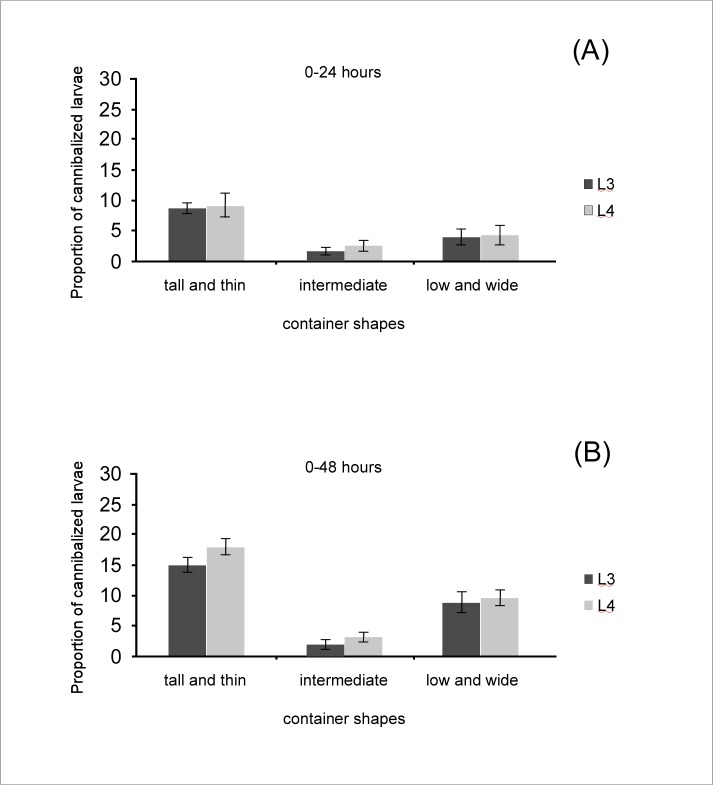
Cannibalism is a commonly observed phenomenon in arthropod species having relevant consequences for population dynamics and individual fitness. It is a context-dependent behaviour and an understanding of the factors affecting cannibalism rate is crucial to highlight its ecological relevance. In mosquitoes, cannibalism between larval stages has been widely documented, and the role of density, food availability and length of contact between individuals also ascertained. However, although mosquitoes can develop in temporary water habitats with very heterogeneous topologies, the role of the site shape where cannibals and victims co-occur has been instead overlooked. In this paper, we investigated this issue by using a simulation approach and laboratory cannibalism experiments between old (third- and fourth-instars) and young (first-instar) larvae of the tiger mosquito Aedes albopictus. Three virtual spaces with different shapes were simulated and the number of larval encounters was estimated in each one to assess whether the spatial shape affected the number of encounters between cannibal and victims. Then, experimental trials in containers with similar shapes to those used in the simulations were performed, and the cannibalism rate was estimated at 24 and 48h. Our results showed that the spatial shape plays a role on cannibalism interactions, affecting the number of encounters between individuals. Indeed, in the experimental trials performed, we observed the highest cannibalism rate in the container with the highest number of encounters predicted by the simulations. Interestingly, we found also that spatial shape can affect cannibalism not only by affecting the number of encounters, but also the number of encounters "favorable" for cannibalistic events. Temporary waters are inhabited by several species other than mosquitoes. Our results, showing an influence of the spatial shape on cannibalism in Ae. albopictus larvae, add a new critical factor to those affecting ecological interactions in these habitats.
Conflict of interest statement
The authors have declared that no competing interests exist.
Figures
References
-
- Fox LR. Cannibalism in natural populations. Annu Rev Ecol Syst. 1975; 6:87–106.
-
- Polis GA. The evolution and dynamics of intraspecific predation. Annu Rev Ecol Syst. 1981;12: 225–51.
-
- Elgar MA, Crespi BJ. Cannibalism: ecology and evolution among diverse taxa. Oxford: Oxford University Press; 1992.
-
- Richardson ML, Mitchell RF, Reagel PF, Hanks LM. Causes and consequences of cannibalism in non-carnivorous insects. Ann Rev Entomol. 2010;55: 39–53. - PubMed
-
- Santana AFK, Roselino AC, Cappelari AF, Zucoloto FS. Cannibalism in insects In: Panizzi AR, Parra JLP, editors. Insect bioecology and nutrition for integrated pest management. Boca Raton: CRC Press; 2012. p. 177–194.
MeSH terms
LinkOut - more resources
Full Text Sources
Other Literature Sources
