Review
. 2018 May 28;10(6):164.
doi: 10.3390/cancers10060164.

Development of an Experimental Model for Analyzing Drug Resistance in Colorectal Cancer

Affiliations
Review

Development of an Experimental Model for Analyzing Drug Resistance in Colorectal Cancer

Mohamed Elbadawy et al. Cancers (Basel). .

Abstract

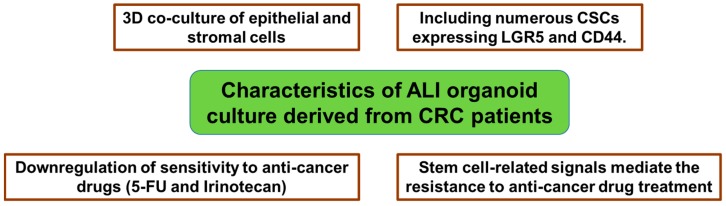
Colorectal cancer (CRC) is one of the most common cancers, for which combination treatment of chemotherapy is employed. However, most patients develop drug resistance during the course of treatment. To clarify the mechanisms of drug resistance, various research models have been developed. Recently, we established a human CRC patients-derived three-dimensional (3D) culture system using an air-liquid interface organoid method. It contained numerous cancer stem cells and showed resistance to 5-fluorouracil and Irinotecan. In this review, we introduce conventional and our established models for studying drug resistance in CRC.

Keywords: 3D cell culture; cancer stem cells; colorectal cancer; drug resistance.


Conflict of interest statement

The authors declare no conflicts of interest.

Figures
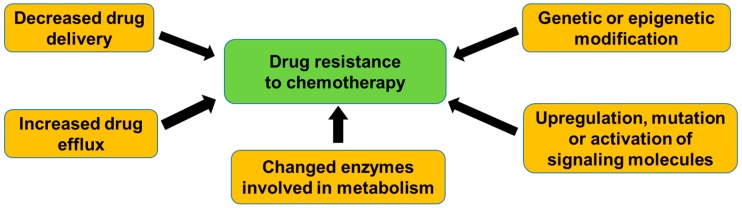
Figure 1
Figure 1
General mechanisms of drug resistance in colorectal cancer (CRC). Drug resistance is caused by multiple mechanisms, such as the decrease in delivery of drug to cancer cells, increase in an efflux out of the cells mediated by ATP-dependent transporters, decrease in uptake into the cells, change in enzymes involved in metabolism, genetic, or epigenetic modifications in the cells, and upregulation, mutation, or activation of downstream of signaling molecules.
Figure 2
Figure 2
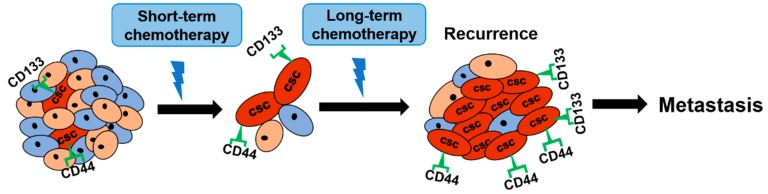
Regulation of drug resistance by cancer stem cells (CSCs). Short-term chemotherapy is effective to most cancer cells but not CSCs. During long-term chemotherapy, CSCs expressing cell surface markers (CD44, CD133) are gradually increased, which might cause tumor recurrence and metastasis.
Figure 3
Figure 3
Characteristics of air-liquid interface (ALI) organoid culture derived from CRC patients.

References

    1. Ragnhammar P., Hafström L., Nygren P., Glimelius B. A systematic overview of chemotherapy effects in colorectal cancer. Acta Oncol. 2001;40:282–308. doi: 10.1080/02841860151116367. - DOI - PubMed
    1. Gill S., Thomas R.R., Goldberg R.M. Review article: Colorectal cancer chemotherapy. Aliment Pharmacol. Ther. 2003;18:683–692. doi: 10.1046/j.1365-2036.2003.01735.x. - DOI - PubMed
    1. Cartwright T.H. Treatment decisions after diagnosis of metastatic colorectal cancer. Clin. Colorectal Cancer. 2012;11:155–166. doi: 10.1016/j.clcc.2011.11.001. - DOI - PubMed
    1. Siegel R., Naishadham D., Jemal A. Cancer statistics, 2013. CA Cancer J. Clin. 2013;63:11–30. doi: 10.3322/caac.21166. - DOI - PubMed
    1. Li C.J., Zhang X., Fan G.W. Updates in colorectal cancer stem cell research. J. Cancer Res. Ther. 2014;10:233–239. - PubMed