


Transcriptional Profiles of SmWRKY Family Genes and Their Putative Roles in the Biosynthesis of Tanshinone and Phenolic Acids in Salvia miltiorrhiza
- PMID: 29843472
- PMCID: PMC6032325
- DOI: 10.3390/ijms19061593
Transcriptional Profiles of SmWRKY Family Genes and Their Putative Roles in the Biosynthesis of Tanshinone and Phenolic Acids in Salvia miltiorrhiza
Abstract
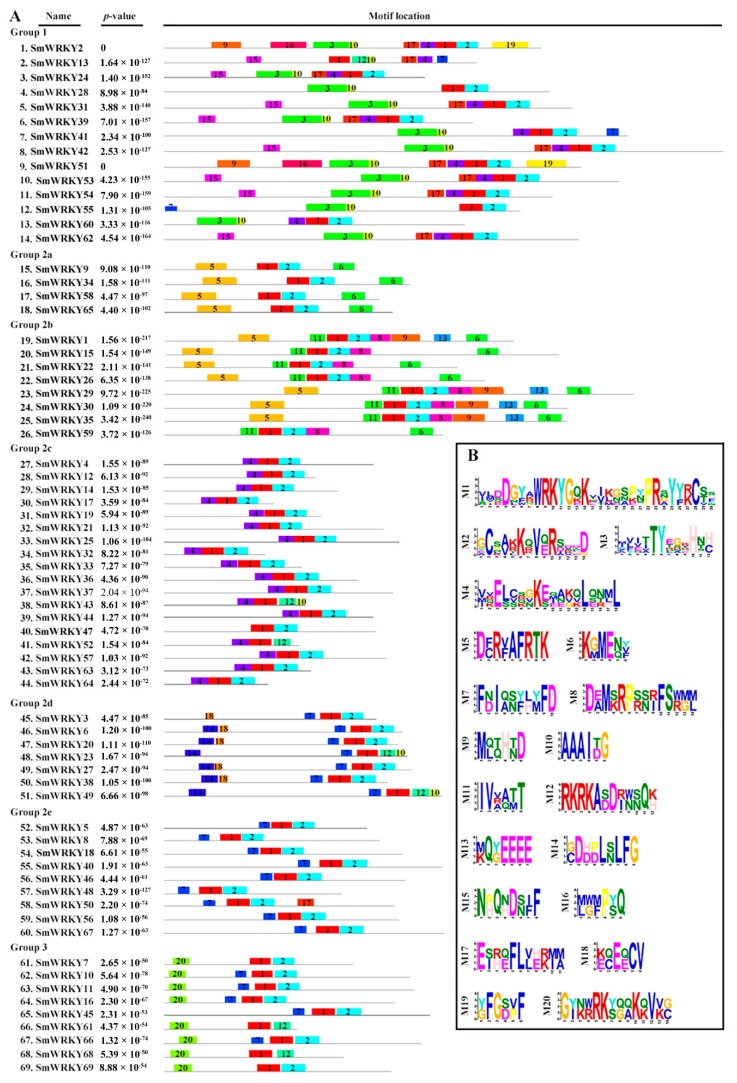
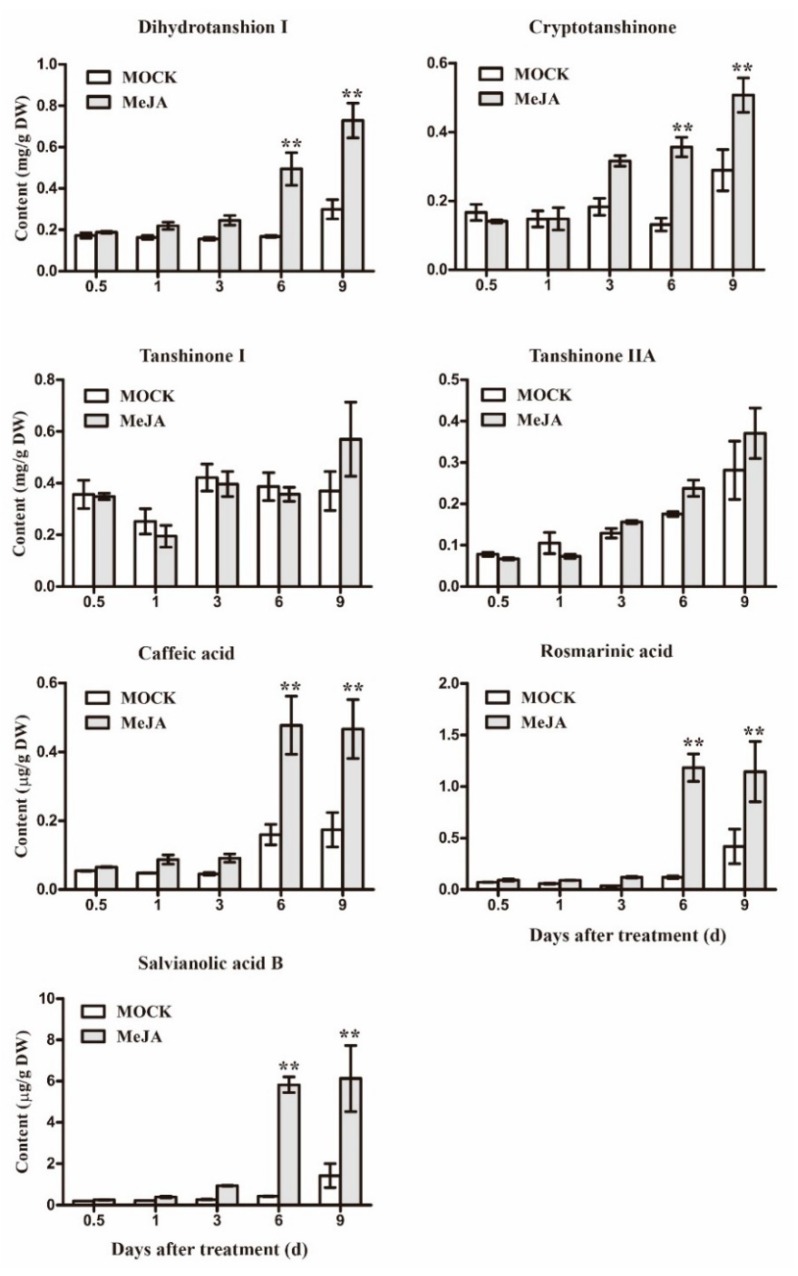
Salvia miltiorrhiza Bunge is a Chinese traditional herb for treating cardiovascular and cerebrovascular diseases, and tanshinones and phenolic acids are the dominated medicinal and secondary metabolism constituents of this plant. WRKY transcription factors (TFs) can function as regulators of secondary metabolites biosynthesis in many plants. However, studies on the WRKY that regulate tanshinones and phenolics biosynthesis are limited. In this study, 69 SmWRKYs were identified in the transcriptome database of S. miltiorrhiza, and phylogenetic analysis indicated that some SmWRKYs had closer genetic relationships with other plant WRKYs, which were involved in secondary metabolism. Hairy roots of S. miltiorrhiza were treated by methyl jasmonate (MeJA) to detect the dynamic change trend of SmWRKY, biosynthetic genes, and medicinal ingredients accumulation. Base on those date, a correlation analysis using Pearson's correlation coefficient was performed to construct gene-to-metabolite network and identify 9 SmWRKYs (SmWRKY1, 7, 19, 29, 45, 52, 56, 58, and 68), which were most likely to be involved in tanshinones and phenolic acids biosynthesis. Taken together, this study has provided a significant resource that could be used for further research on SmWRKY in S. miltiorrhiza and especially could be used as a cue for further investigating SmWRKY functions in secondary metabolite accumulation.
Keywords: Salvia miltiorrhiza; SmWRKY; phenolic acid; secondary metabolites; tanshinones.
Conflict of interest statement
The authors declare no conflict of interest.
Figures



References
-
- Han J.-Y., Fan J.-Y., Horie Y., Miura S., Cui D.-H., Ishii H., Hibi T., Tsuneki H., Kimura I. Ameliorating effects of compounds derived from Salvia miltiorrhiza root extract on microcirculatory disturbance and target organ injury by ischemia and reperfusion. Pharmacol. Ther. 2008;117:280–295. doi: 10.1016/j.pharmthera.2007.09.008. - DOI - PubMed
-
- Xu Z., Peters R.J., Weirather J., Luo H., Liao B., Zhang X., Zhu Y., Ji A., Zhang B., Hu S., et al. Full-length transcriptome sequences and splice variants obtained by a combination of sequencing platforms applied to different root tissues of Salvia miltiorrhiza and tanshinone biosynthesis. Plant J. 2015;82:951–961. doi: 10.1111/tpj.12865. - DOI - PubMed
MeSH terms
Substances
LinkOut - more resources
Full Text Sources
Other Literature Sources
