


Changes in ovarian cancer survival during the 20 years before the era of targeted therapy
- PMID: 29843633
- PMCID: PMC5975501
- DOI: 10.1186/s12885-018-4498-z
Changes in ovarian cancer survival during the 20 years before the era of targeted therapy
Abstract
Background: The survival of patients with ovarian cancer has improved because of surgery and chemotherapy. This study aimed to estimate the changes in survival rates among Korean women with ovarian cancer prior to the introduction of targeted therapy for ovarian cancer.
Methods: Data were obtained from the Korea Central Cancer Registry regarding patients who were diagnosed with epithelial ovarian cancer between 1995 and 2014. The relative survival rates were calculated for 5-year periods using the Ederer II method. Cox proportional hazard models were created to assess the associations of demographic and clinicopathological factors with ovarian cancer survival.
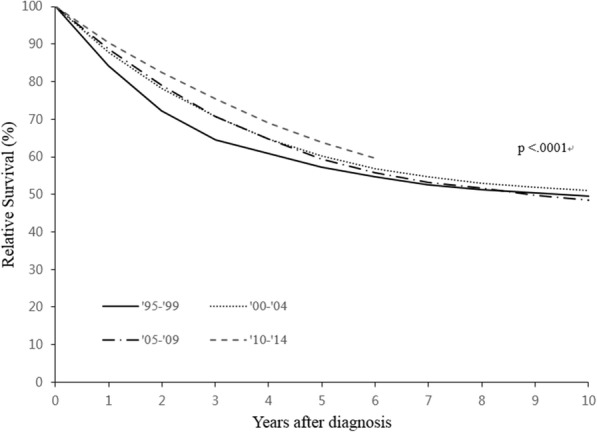
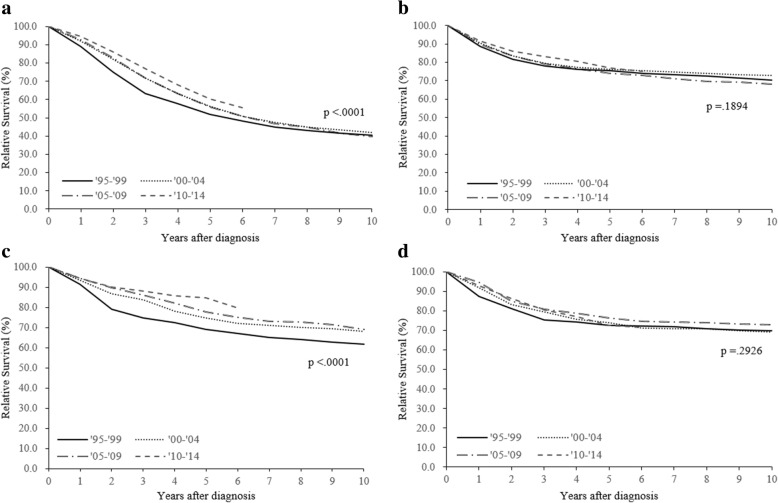
Results: During the study period, 22,880 women were diagnosed with epithelial ovarian cancer. The 5-year relative survival rate improved from 57.2% during 1995-1999 to 63.8% during 2010-2014 (P < 0.001). Survival outcomes improved between 1995 and 1999 and 2010-2014 for the serous and endometrioid carcinoma subtypes (P < 0.001). However, no improvements were observed for the mucinous and clear cell carcinoma subtypes (P = 0.189 and P = 0.293, respectively). Multivariate analysis revealed that younger age, early stage, recent diagnosis, primary surgical treatment, and non-serous histological subtype were favorable prognostic factors.
Conclusion: Survival outcomes have improved for serous and endometrioid epithelial ovarian cancer in the last 20 years. However, no improvement was observed for patients with mucinous and clear cell carcinoma subtypes.
Keywords: Chemotherapy; Histology; Korea; Ovarian cancer; Surgery; Survival.
Conflict of interest statement
Ethics approval and consent to participate
Ethical approval for the research protocol was provided by the institutional review board of the National Cancer Center (NCC2017–0168) which waived the requirement for informed consent. The authorization for data processing was obtained from the National ‘Cancer Control Act’.
Competing interests
The authors declare that they have no competing interests.
Publisher’s Note
Springer Nature remains neutral with regard to jurisdictional claims in published maps and institutional affiliations.
Figures
References
MeSH terms
Grants and funding
LinkOut - more resources
Full Text Sources
Other Literature Sources
Medical
