


Correlation of subfoveal choroidal thickness with axial length, refractive error, and age in adult highly myopic eyes
- PMID: 29843668
- PMCID: PMC5975694
- DOI: 10.1186/s12886-018-0791-5
Correlation of subfoveal choroidal thickness with axial length, refractive error, and age in adult highly myopic eyes
Abstract
Background: Subfoveal choroidal thickness (SFCT) in highly myopic eyes was found to be correlated with increasing age, refractive error (spherical equivalent), and axial length. Which factor is the most significant predictor of SFCT remains controversial.
Methods: A hospital-based cohort of highly myopic eyes (with spherical equivalent equal to or over 6.00 diopter) were retrospectively screened. Data from only right eye in those bilateral high myopia, and unilateral high myopia in any eye, were used for analysis. Correlations among the four biometric factors were analyzed. Linear correlation was performed to analyze the predictors of SFCT.
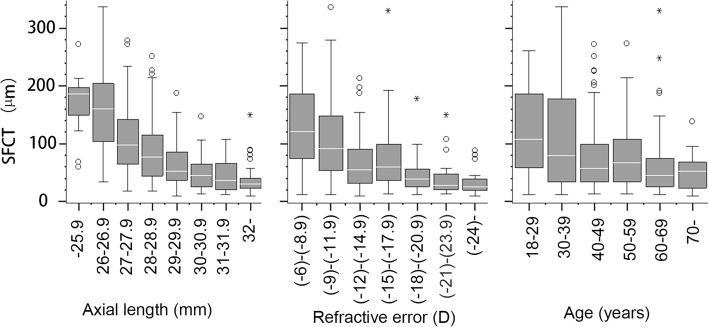
Results: A cohort of 312 eyes from 312 adults (98 men) was enrolled. Statistical analysis showed that axial length (R = - 0.592), spherical equivalent (R = - 0.471), and age (R = - 0.296) were significantly correlated with SFCT (P < 0.001). No significant correlation was found between age and axial length, or age and spherical equivalent. Partial correlation with controlled age confirmed that axial length (R = - 0.628) was a more significant predictor of SFCT than spherical equivalent (R = - 0.507).
Conclusions: SFCT was inversely correlated with increasing age, spherical equivalent and axial length, with axial length as the most significant predictor of SFCT, in adult highly myopic eyes.
Keywords: Age; Axial length; Correlation analysis; High myopia; Refractive error; Subfoveal choroidal thickness.
Conflict of interest statement
Ethics approval and consent to participate
The study was conducted in compliance with the principles of the Declaration of Helsinki and approved by the Ethics Committee of Zhongshan Ophthalmic Center. An informed consent was obtained from all of the included subjects.
Competing interests
The authors declare that they have no competing interests.
Publisher’s Note
Springer Nature remains neutral with regard to jurisdictional claims in published maps and institutional affiliations.
Figures
References
-
- Williams KM, Bertelsen G, Cumberland P, Wolfram C, Verhoeven VJ, Anastasopoulos E, Buitendijk GH, Cougnard-Gregoire A, Creuzot-Garcher C, Erke MG, et al. Increasing prevalence of myopia in Europe and the impact of education. Ophthalmology. 2015;122(7):1489–1497. doi: 10.1016/j.ophtha.2015.03.018. - DOI - PMC - PubMed
MeSH terms
Grants and funding
LinkOut - more resources
Full Text Sources
Other Literature Sources
Medical
