


Why Is DNA Double Stranded? The Discovery of DNA Excision Repair Mechanisms
- PMID: 29844089
- PMCID: PMC5972412
- DOI: 10.1534/genetics.118.300958
Why Is DNA Double Stranded? The Discovery of DNA Excision Repair Mechanisms
Abstract
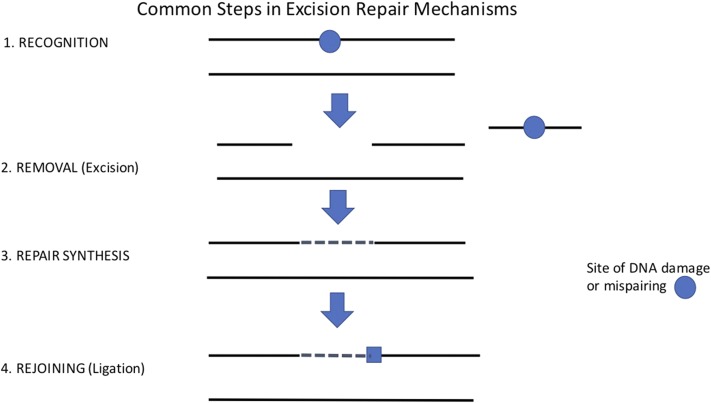
The persistence of hereditary traits over many generations testifies to the stability of the genetic material. Although the Watson-Crick structure for DNA provided a simple and elegant mechanism for replication, some elementary calculations implied that mistakes due to tautomeric shifts would introduce too many errors to permit this stability. It seemed evident that some additional mechanism(s) to correct such errors must be required. This essay traces the early development of our understanding of such mechanisms. Their key feature is the cutting out of a section of the strand of DNA in which the errors or damage resided, and its replacement by a localized synthesis using the undamaged strand as a template. To the surprise of some of the founders of molecular biology, this understanding derives in large part from studies in radiation biology, a field then considered by many to be irrelevant to studies of gene structure and function. Furthermore, genetic studies suggesting mechanisms of mismatch correction were ignored for almost a decade by biochemists unacquainted or uneasy with the power of such analysis. The collective body of results shows that the double-stranded structure of DNA is critical not only for replication but also as a scaffold for the correction of errors and the removal of damage to DNA. As additional discoveries were made, it became clear that the mechanisms for the repair of damage were involved not only in maintaining the stability of the genetic material but also in a variety of biological phenomena for increasing diversity, from genetic recombination to the immune response.
Keywords: DNA excision repair; base excision repair; double stranded; double-strand break repair; mismatch repair.
Copyright © 2018 by the Genetics Society of America.
Figures
References
-
- Auerbach C., Robson J. M., 1947. The production of mutations by chemical substances. Proc. R. Soc. Edinb. Biol. 62: 271–283. - PubMed
-
- Avery O. T., Macleod C. M., McCarty M., 1944. Studies on the chemical nature of the substance inducing transformation of pneumococcal types: induction of transformation by a desoxyribonucleic acid fraction isolated from pneumococcus type III. J. Exp. Med. 79: 137–158. 10.1084/jem.79.2.137 - DOI - PMC - PubMed
Publication types
MeSH terms
Substances
LinkOut - more resources
Full Text Sources
Other Literature Sources
Research Materials
