. 2018 May 29;9(3):e00785-18.
doi: 10.1128/mBio.00785-18.

Fungal Isocyanide Synthases and Xanthocillin Biosynthesis in Aspergillus fumigatus

Affiliations

Fungal Isocyanide Synthases and Xanthocillin Biosynthesis in Aspergillus fumigatus

Fang Yun Lim et al. mBio. .

Abstract

Microbial secondary metabolites, including isocyanide moieties, have been extensively mined for their repertoire of bioactive properties. Although the first naturally occurring isocyanide (xanthocillin) was isolated from the fungus Penicillium notatum over half a century ago, the biosynthetic origins of fungal isocyanides remain unknown. Here we report the identification of a family of isocyanide synthases (ICSs) from the opportunistic human pathogen Aspergillus fumigatus Comparative metabolomics of overexpression or knockout mutants of ICS candidate genes led to the discovery of a fungal biosynthetic gene cluster (BGC) that produces xanthocillin (xan). Detailed analysis of xanthocillin biosynthesis in A. fumigatus revealed several previously undescribed compounds produced by the xan BGC, including two novel members of the melanocin family of compounds. We found both the xan BGC and a second ICS-containing cluster, named the copper-responsive metabolite (crm) BGC, to be transcriptionally responsive to external copper levels and further demonstrated that production of metabolites from the xan BGC is increased during copper starvation. The crm BGC includes a novel type of fungus-specific ICS-nonribosomal peptide synthase (NRPS) hybrid enzyme, CrmA. This family of ICS-NRPS hybrid enzymes is highly enriched in fungal pathogens of humans, insects, and plants. Phylogenetic assessment of all ICSs spanning the tree of life shows not only high prevalence throughout the fungal kingdom but also distribution in species not previously known to harbor BGCs, indicating an untapped resource of fungal secondary metabolism.IMPORTANCE Fungal ICSs are an untapped resource in fungal natural product research. Their isocyanide products have been implicated in plant and insect pathogenesis due to their ability to coordinate transition metals and disable host metalloenzymes. The discovery of a novel isocyanide-producing family of hybrid ICS-NRPS enzymes enriched in medically and agriculturally important fungal pathogens may reveal mechanisms underlying pathogenicity and afford opportunities to discover additional families of isocyanides. Furthermore, the identification of noncanonical ICS BGCs will enable refinement of BGC prediction algorithms to expand on the secondary metabolic potential of fungal and bacterial species. The identification of genes related to ICS BGCs in fungal species not previously known for secondary metabolite-producing capabilities (e.g., Saccharomyces spp.) contributes to our understanding of the evolution of BGC in fungi.

Keywords: Aspergillus fumigatus; copper; isocyanide synthase; melanocin; xanthocillin.


Figures

FIG 1
FIG 1
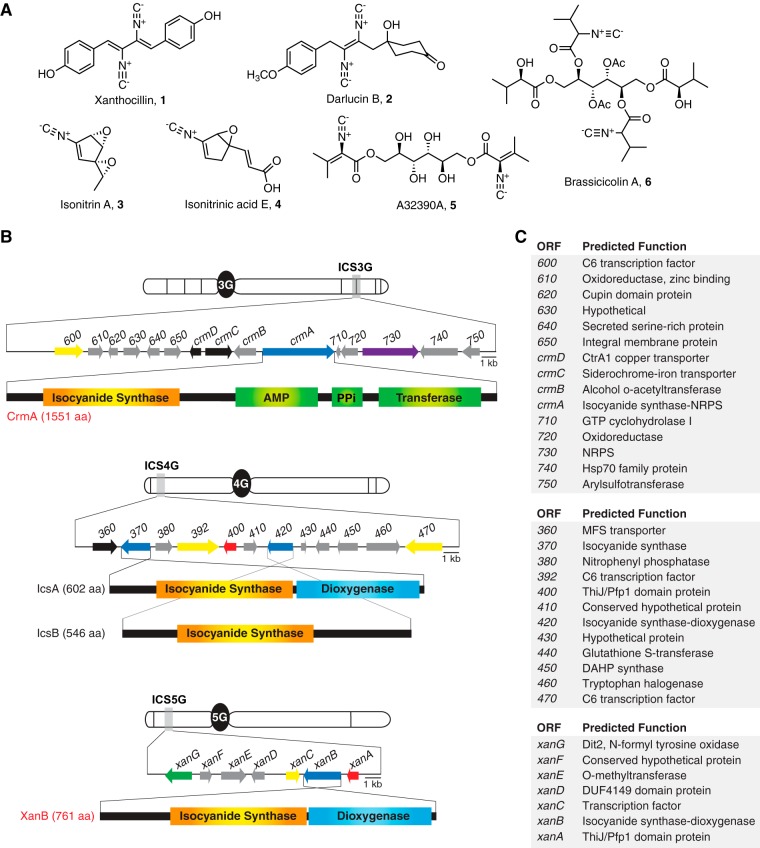
Isocyanides identified from fungi and architecture of isocyanide synthase-containing gene clusters in A. fumigatus. (A) Examples of isocyanides identified from fungi, including xanthocillin (compound 1), darlucin B (compound 2), isonitrin A (compound 3), isonitrinic acid E (compound 4), A32390A (compound 5), and brassicicolin A (compound 6). (B) The crm gene cluster contains a novel multidomain ICS-NRPS hybrid enzyme. The 4G gene cluster contains two ICS domain genes, icsA and icsB. The xan gene cluster contains an ICS domain gene, xanB. Isocyanide synthases are depicted in blue. Fungal C6 transcription factors are depicted in yellow. Transporters are depicted in black. ThiJ/Pfp1 domain proteins with homology to isocyanide hydratases are depicted in red. P450 monooxygenases are depicted in green. (C) Predicted function of open reading frames (ORFs) within A. fumigatus isocyanide gene clusters.
FIG 2
FIG 2
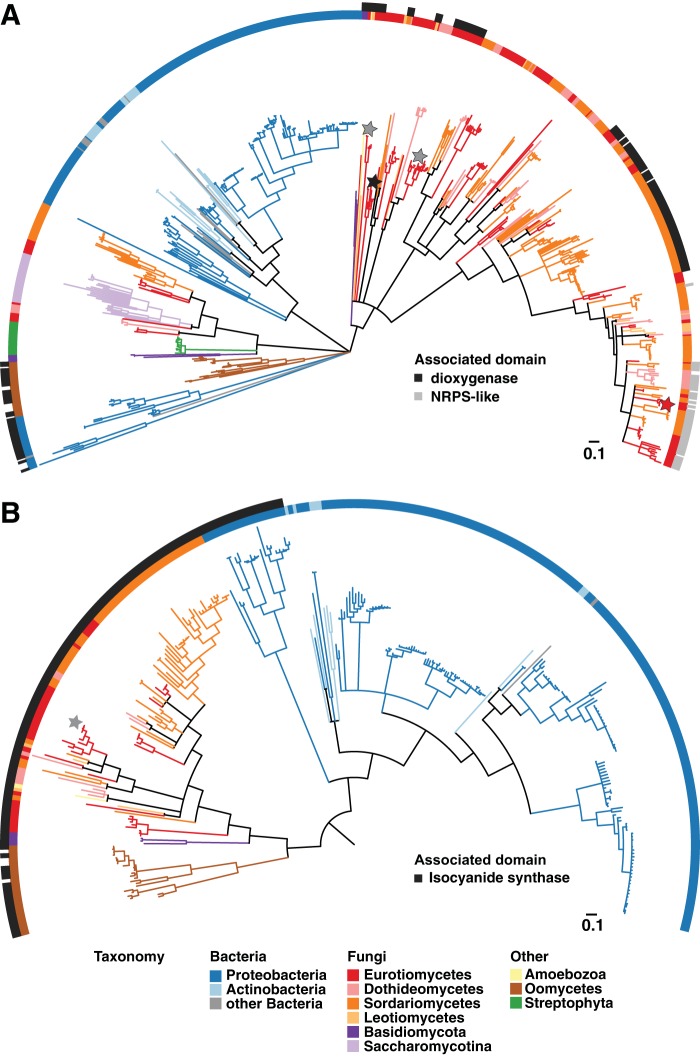
Evolutionary relationship of isocyanide synthase and dioxygenase domain proteins across the tree of life. (A) Maximum likelihood phylogeny of the isocyanide synthase (PF05141) domain proteins. Color strips along the tree perimeter correspond to taxonomy (inner strip) and the presence of additional Pfam domains (outer strip): taurine catabolism dioxygenase, PF02668 (black); and NRPS-like, PF00501 and PF02458 (gray). The four A. fumigatus AF293 proteins in the tree are starred: one protein consists of just the isocyanide synthase (PF05141) domain (black star), two proteins contain an additional dioxygenase (PF02668) domain (gray stars), and one protein contains additional NRPS (PF00501 and PF02458) domains (red star). (B) Maximum likelihood (53) phylogeny of taurine catabolism dioxygenase (PF02668) domain proteins. Color strips along the tree perimeter correspond to taxonomy (inner strip) and the presence of an isocyanide synthase domain, PF05141 (black). The two A. fumigatus AF293 proteins in the tree are starred (gray); both contain a PF05141 domain. The trees were midpoint rooted and visualized using iTOL version 3.0. Branches with bootstrap support of less than 50 were collapsed using TREECOLLAPSERCL4 version 4.0 (http://emmahodcroft.com/TreeCollapseCL.html).
FIG 3
FIG 3
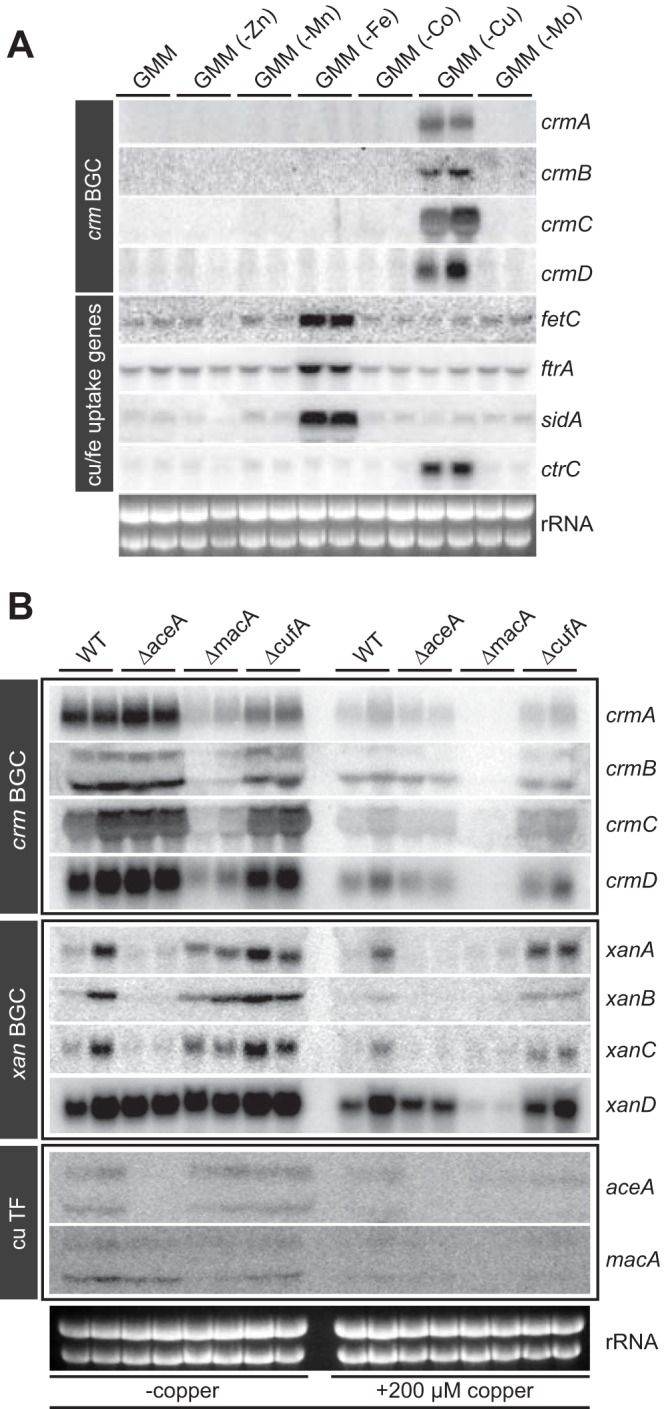
Copper-responsive expression of the crm gene cluster. (A) Northern analysis showing mRNA expression of crmA to -D of the wild-type fungus grown on GMM and GMM deprived of various components of the trace elements. Expression of known iron (fetC, ftrA, and sidA)- and copper (ctrC)-responsive genes was assessed. (B) Northern analysis showing mRNA expression of crmA to -D and xanA to -D in the copper-fist transcription factor mutant ΔaceA, ΔmacA, and ΔcufA strains under copper-depleted conditions and 1 h posttreatment with 200 µM copper sulfate. Expression of both macA and aceA was also assessed under these conditions.
FIG 4
FIG 4
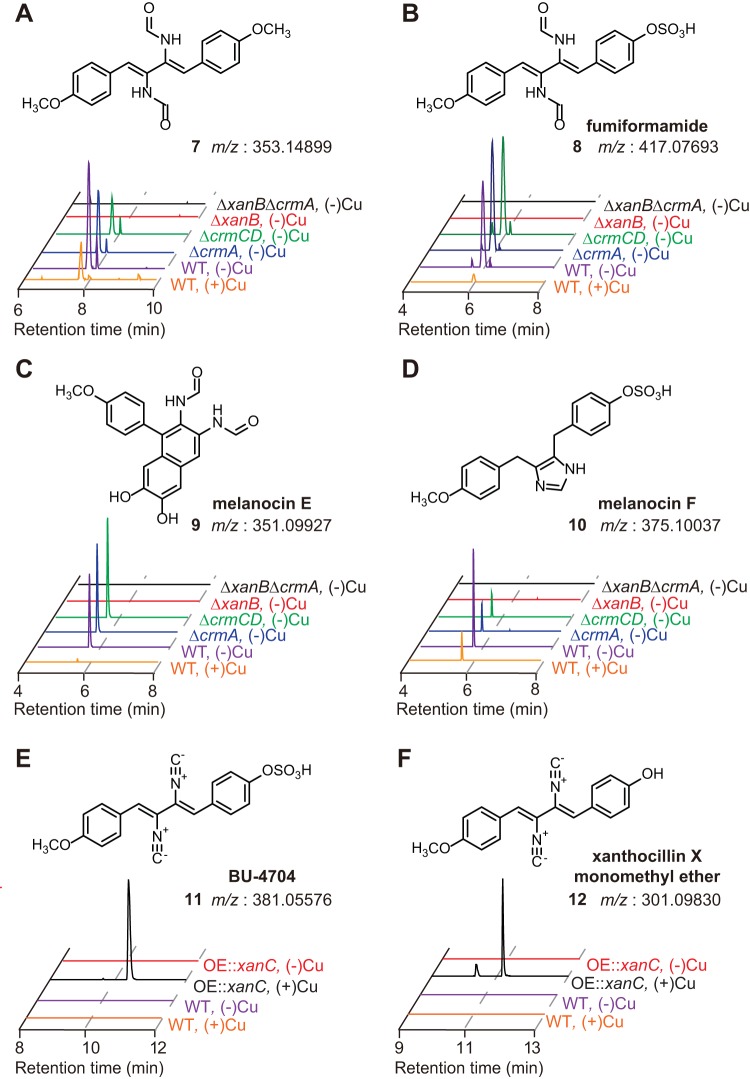
HRMS-based comparative metabolomics of AF293 (wild type [WT]) and A. fumigatus ICS mutants. (A to F) Extracted-ion chromatograms (EICs) corresponding to compounds 7 to 12 in the wild type grown with or without copper (orange and purple lines, respectively), in the ΔxanB, ΔcrmA, and ΔcrmCD mutants (blue, green, and red lines, respectively), the ΔxanB ΔcrmA double mutant under the copper-depleted condition (black lines), and the OE::xanC mutant with or without copper (black and red lines, respectively).
FIG 5
FIG 5
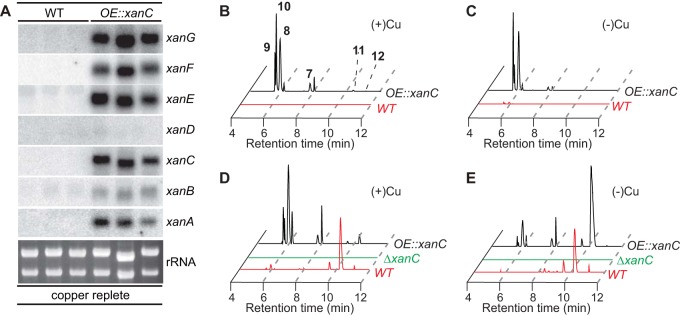
xanC regulates xan cluster gene expression and metabolite production. (A) Northern analysis depicting expression of xanA to -G in the both the wild type and OE::xanC mutant grown under copper-replete conditions. (B and C) Extracted-ion chromatograms (EICs) corresponding to compounds 7 to 12 in the wild type grown with or without copper (red lines) and the OE::xanC mutant with or without copper (black lines) in liquid shake culture. (D and E) EICs corresponding to compounds 7 to 12 in the wild type grown with or without copper (red lines), the OE::xanC mutant with or without copper (black lines), and the ΔxanC mutant (green lines) in a solid plate culture.
FIG 6
FIG 6
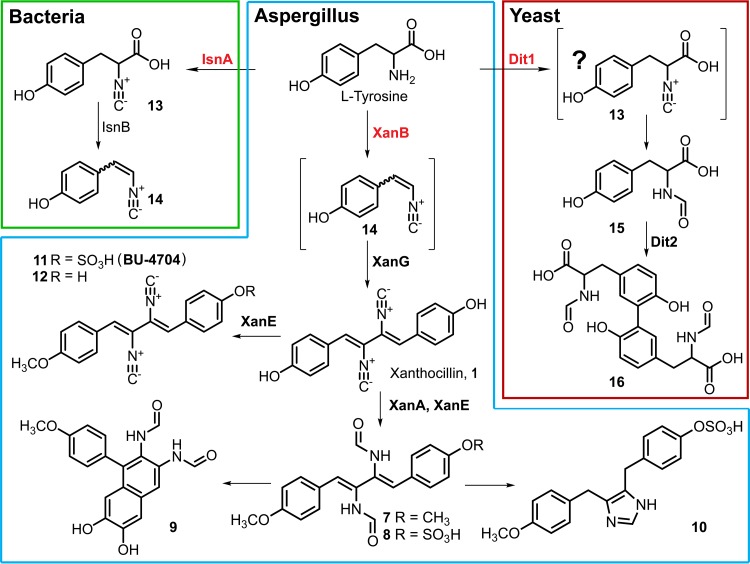
Putative biosynthesis of xanthocillin derivatives in A. fumigatus and related pathways in the bacterium Xenorhabdus nematophila (5) and yeast Saccharomyces cerevisiae (36). Tyrosine is converted into intermediate compound 14 by XanB, which is then converted by XanG into xanthocillin. N-Formyl and methyl moieties in xanthocillin derivatives are introduced by XanA and XanE, respectively. Fumiformamide (compound 8) is converted into melanocins E (compound 9) and F (compound 10) by oxidative and reductive cyclization, respectively. In yeast, tyrosine is converted into N-formyl tyrosine (compound 15) by Dit1, followed by dimerization via Dit2 to form N,N-bisformyl dityrosine (compound 16). The presence of isocyanide (compound 13) in yeast has not been established.
FIG 7
FIG 7
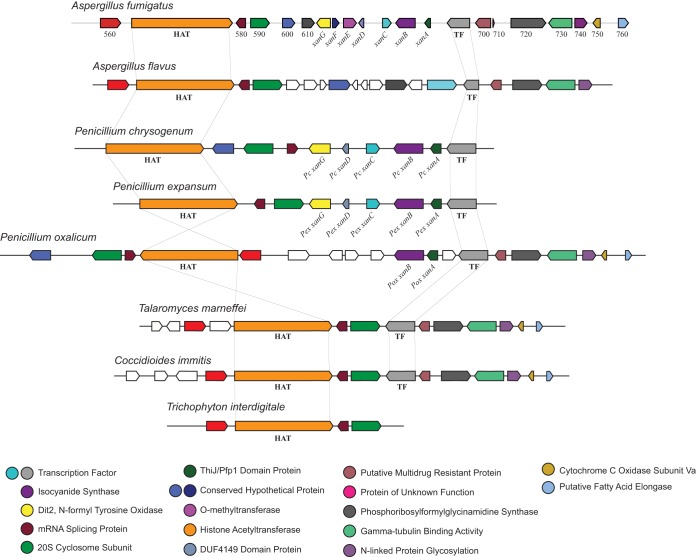
Comparison of the A. fumigatus xan BGC with xan-like BGCs in various other fungi. Genes showing similar homology are shaded with an identical color and listed with their corresponding function. Genes that do not show homology to genes found in the xan BGC are shown in white.

References

    1. Rothe W. 1954. The new antibiotic xanthocillin. Dtsch Med Wochenschr 79:1080–1081. doi: 10.1055/s-0028-1119307. - DOI - PubMed
    1. Emsermann J, Kauhl U, Opatz T. 2016. Marine isonitriles and their related compounds. Mar Drugs 14:16. doi: 10.3390/md14010016. - DOI - PMC - PubMed
    1. Schnermann MJ, Shenvi RA. 2015. Syntheses and biological studies of marine terpenoids derived from inorganic cyanide. Nat Prod Rep 32:543–577. doi: 10.1039/c4np00109e. - DOI - PMC - PubMed
    1. Manzo E, Ciavatta ML, Gavagnin M, Mollo E, Guo YW, Cimino G. 2004. Isocyanide terpene metabolites of Phyllidiella pustulosa, a nudibranch from the South China Sea. J Nat Prod 67:1701–1704. doi: 10.1021/np0400961. - DOI - PubMed
    1. Crawford JM, Portmann C, Zhang X, Roeffaers MB, Clardy J. 2012. Small molecule perimeter defense in entomopathogenic bacteria. Proc Natl Acad Sci U S A 109:10821–10826. doi: 10.1073/pnas.1201160109. - DOI - PMC - PubMed

Publication types