. 2018 May 29;8(1):8315.
doi: 10.1038/s41598-018-26592-1.

Asymmetric distribution of biomolecules of maternal origin in the Xenopus laevis egg and their impact on the developmental plan

Affiliations

Asymmetric distribution of biomolecules of maternal origin in the Xenopus laevis egg and their impact on the developmental plan

Radek Sindelka et al. Sci Rep. .

Abstract

Asymmetric cell division is a ubiquitous feature during the development of higher organisms. Asymmetry is achieved by differential localization or activities of biological molecules such as proteins, and coding and non-coding RNAs. Here, we present subcellular transcriptomic and proteomic analyses along the animal-vegetal axis of Xenopus laevis eggs. More than 98% of the maternal mRNAs could be categorized into four localization profile groups: animal, vegetal, extremely vegetal, and a newly described group of mRNAs that we call extremely animal, which are mRNAs enriched in the animal cortex region. 3'UTRs of localized mRNAs were analyzed for localization motifs. Several putative motifs were discovered for vegetal and extremely vegetal mRNAs, while no distinct conserved motifs for the extremely animal mRNAs were identified, suggesting different localization mechanisms. Asymmetric profiles were also found for proteins, with correlation to those of corresponding mRNAs. Based on unexpected observation of the profiles of the homoeologous genes exd2 we propose a possible mechanism of genetic evolution.


Conflict of interest statement

The authors declare no competing interests.

Figures

Figure 1
Figure 1
Classification of the studied biomolecules into localization categories based on their intracellular profiles. Experimental scheme (A). Classification of 15005 mRNAs (B), classification of 3409 proteins (C) and classification of 247 long noncoding RNAs (D).
Figure 2
Figure 2
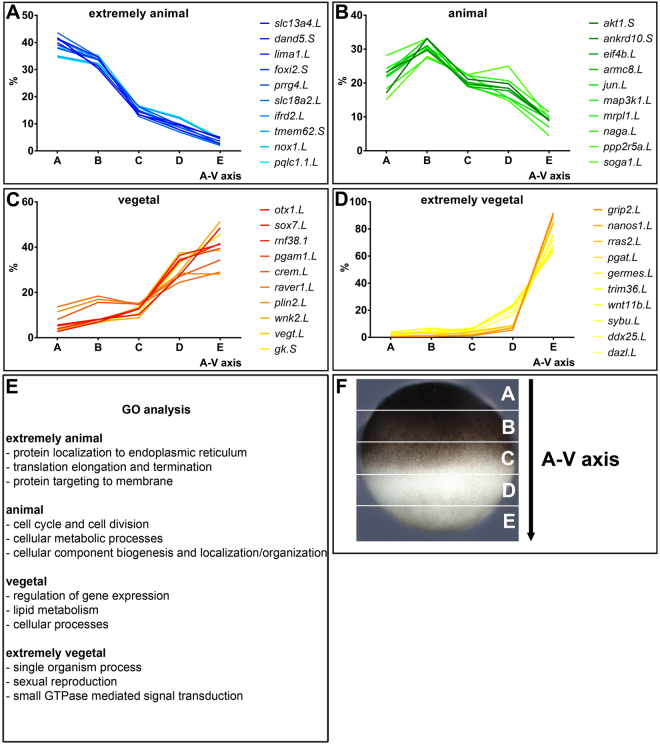
Intracellular profiles for selected extremely animal (A), animal (B), vegetal (C) and extremely vegetal (D) mRNAs. Predicted functions based on gene ontology (GO) analysis (E). Scheme of A-V sectioning (F).
Figure 3
Figure 3
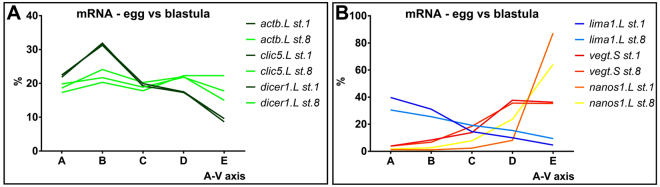
Animal mRNAs become evenly distributed along the A-V axis at blastula stage (A), while extremely animal, vegetal, and extremely vegetal mRNAs remain asymmetrically distributed at blastula stage (B).
Figure 4
Figure 4
Scheme for the identification of localization motifs (A). Cluster analysis of the animal localization motifs identified using MEME (A1M-A27M) and GIBBS (A3G-A26G). Heatmap indicates the proportion of motifs and the numbers the percentage of the 3′UTRs that contains the motifs (B).
Figure 5
Figure 5
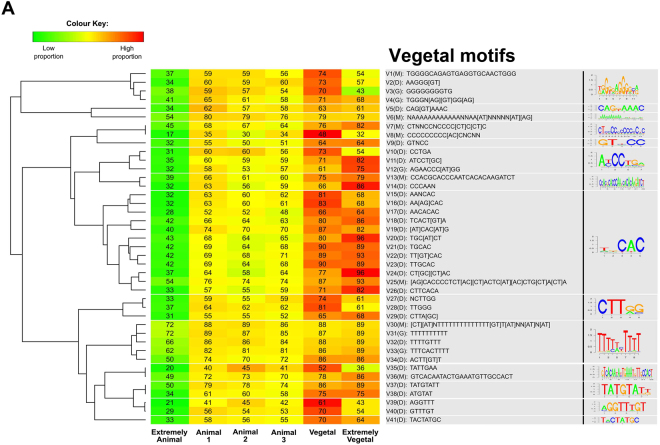
Cluster analysis and motif validation for the motifs behind vegetal localization identified using MEME (V1M-V36M), GIBBS (V3G-V33G) and DREME (V2D-V41D). Heatmap indicates proportion of motifs and numbers reflect percentage of 3′UTRs containing at least one copy of a motif (B).
Figure 6
Figure 6
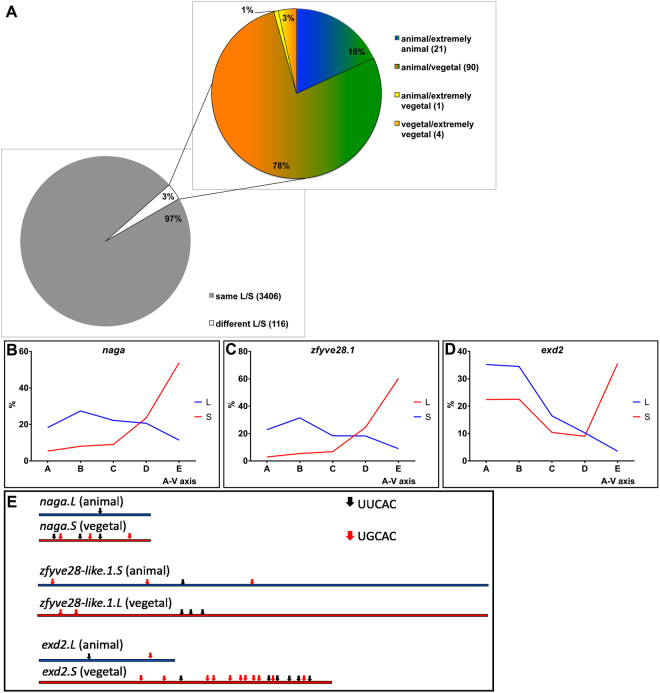
Analysis of homoeologous genes that show contrasting polarization. Out of more than 3500 homoeologous maternally expressed genes less than 100 showed different localization of its L and S versions. (A) Localization profiles of the L and S versions of naga, zfyve28 and exd2 (BD). Presence of vegetal localization motifs UUCAC and UGCAC in the 3′UTRs of naga, zfyve28 and exd2 (E).
Figure 7
Figure 7
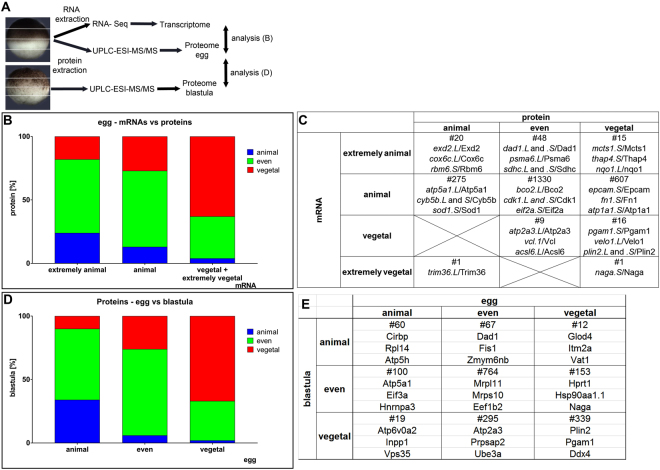
Proteome profiling along the A-V axis of Xenopus laevis eggs. Schematic showing the experimental design (A). Protein localization and comparison with mRNA (B). Selected candidates with similar/different localization at mRNA/protein levels with known interesting biological functions (C). Comparison of protein localization at egg and blastula (D). Examples of egg and blastula specific proteins (E).
Figure 8
Figure 8
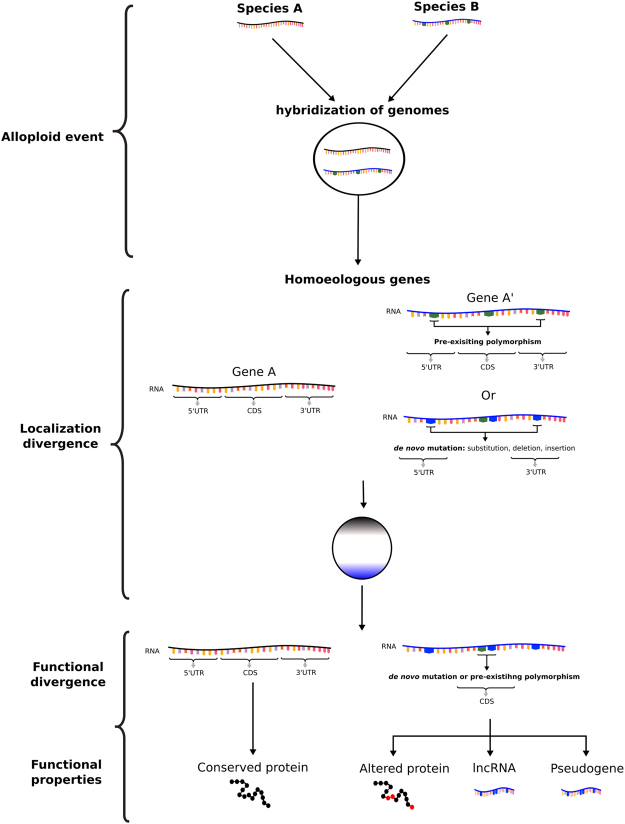
Scheme proposing altered gene function development based on species hybridization followed by asymmetric localization and modification of coding sequence.

References

    1. Macdonald PM, Struhl G. cis-acting sequences responsible for anterior localization of bicoid mRNA in Drosophila embryos. Nature. 1988;336(6199):595–8. doi: 10.1038/336595a0. - DOI - PubMed
    1. St Johnston D, Beuchle D, Nüsslein-Volhard C. Staufen, a gene required to localize maternal RNAs in the Drosophila egg. Cell. 1991;66(1):51–63. doi: 10.1016/0092-8674(91)90138-O. - DOI - PubMed
    1. Weil TT, Forrest KM, Gavis ER. Localization of bicoid mRNA in late oocytes is maintained by continual active transport. Dev Cell. 2006;11(2):251–62. doi: 10.1016/j.devcel.2006.06.006. - DOI - PubMed
    1. Rebagliati MR, Weeks DL, Harvey RP, Melton DA. Identification and cloning of localized maternal RNAs from Xenopus eggs. Cell. 1985;42(3):769–77. doi: 10.1016/0092-8674(85)90273-9. - DOI - PubMed
    1. Melton DA. Translocation of a localized maternal mRNA to the vegetal pole of Xenopus oocytes. Nature. 1987;328(6125):80–2. doi: 10.1038/328080a0. - DOI - PubMed

Publication types

Substances