Review
. 2018 Sep 12;118(17):8242-8284.
doi: 10.1021/acs.chemrev.8b00083. Epub 2018 May 30.

The Experimental Evidence in Support of Glycosylation Mechanisms at the SN1-SN2 Interface

Affiliations
Review

The Experimental Evidence in Support of Glycosylation Mechanisms at the SN1-SN2 Interface

Philip Ouma Adero et al. Chem Rev. .

Abstract

A critical review of the state-of-the-art evidence in support of the mechanisms of glycosylation reactions is provided. Factors affecting the stability of putative oxocarbenium ions as intermediates at the SN1 end of the mechanistic continuum are first surveyed before the evidence, spectroscopic and indirect, for the existence of such species on the time scale of glycosylation reactions is presented. Current models for diastereoselectivity in nucleophilic attack on oxocarbenium ions are then described. Evidence in support of the intermediacy of activated covalent glycosyl donors is reviewed, before the influences of the structure of the nucleophile, of the solvent, of temperature, and of donor-acceptor hydrogen bonding on the mechanism of glycosylation reactions are surveyed. Studies on the kinetics of glycosylation reactions and the use of kinetic isotope effects for the determination of transition-state structure are presented, before computational models are finally surveyed. The review concludes with a critical appraisal of the state of the art.


Figures

Figure 1
Figure 1
Carbenium and Resonance Stabilized Oxocarbenium Ions
Figure 2
Figure 2
The σ-π and τ Bond Models for Oxocarbenium Ions
Figure 3
Figure 3
Relative Rates of Solvolysis of 1-Adamantanyl Tosylate and 2-Oxa-1-adamantanyl Tosylate
Figure 4
Figure 4
Stable α-Oxa Triflates
Figure 5
Figure 5
Retardation of Relative Rates of Solvolysis by β-C-O Bonds
Figure 6
Figure 6
Structure and Preferred Conformations of 1-Alkoxyoxocarbenium Ions as a Function of the Substituent
Figure 7
Figure 7
Plot of the Negative Logarithm of the Rate Constant for Spontaneous Hydrolysis of 2,4-Dinitrophenyl Glycosides versus the Sum of Stereoelectronic Constants for the Substrate
Figure 8
Figure 8
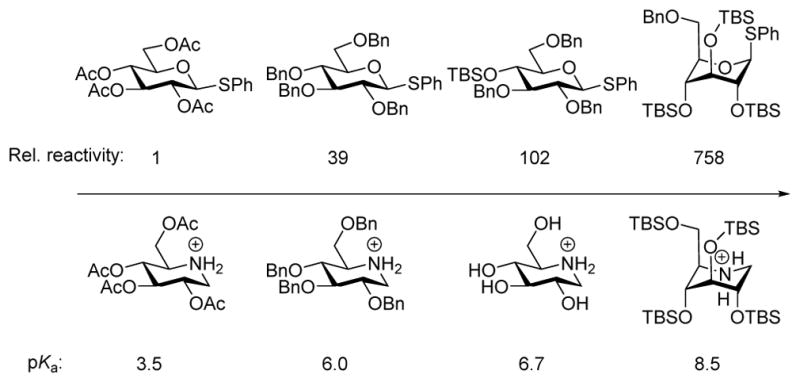
Comparison of the Relative Reactivity of Glycosyl Donors with the pKa of the Corresponding Piperidinium Ions
Figure 9
Figure 9
Dominant Solution Conformations of the 2,3-Dideoxy-4,6-di-O-benzyl-1-ethoxy, 2-Deoxy-3,4,6-tri-O-benzyl-1-ethoxy glucopyranosyl, and 1-Ethoxy-5-Benzyloxymethyltetrahydropyranosyl Oxocarbenium Ions with Emphasis on the Side Chain Conformation
Figure 10
Figure 10
Influence of C7 Configuration on Reactivity and Selectivity in the Sialic Acids
Figure 11
Figure 11
Enforced gg Conformation Reduces Equatorial Selectivity in Mannopyranosylation
Figure 12
Figure 12
Crystallographically Established Structures of Bicyclic Glycosyl Sulfonium Ions
Figure 13
Figure 13
Reactivity Sequence of a Series of Thioglycosides Toward Activation by N-Iodosuccinimide and Trimethylsilyl Triflate
Figure 14
Figure 14
Relative Reactivity Order of Two NMR Characterized Glycosyl Sulfonium Ions
Figure 15
Figure 15
Glycosyl Nitrilium Ions Characterized by NMR Spectroscopy
Figure 16
Figure 16
Three Component Transition State with Dual Function of the Phosphoric Acid
Figure 17
Figure 17
Hypothetical Four-component Transition State Accounting for the Roles of a Thiourea and a Phosphoric Acid in Organocatalyzed Glycosylation with a Trichloroacetiomidate Donor
Figure 18
Figure 18
Computationally Derived Transition State for Macrocyclic Bisthiourea Promoted SN2-Like Galactosylation,
Figure 19
Figure 19
Correlation of Anomeric Selectivity and Specific Rotation of the Solution in an Arabinofuranosylation Reaction
Figure 20
Figure 20
Computed Methanol Adducts with the 4,6-O-Benzylidene Protected Manno- and Glucopyranosyl Oxocarbenium Ions Including Donor-Acceptor Hydrogen Bonds
Figure 21
Figure 21
Computationally-Located Transition State for the SN2-Like Opening of a Bicyclic Sulfonium Ion Reveals a Key Hydrogen Bond to the O3 Carboxylate
Figure 22
Figure 22
Kinetics-Derived Associative Transition State for the Reaction of Acetobromoglucose with Alcohols and an Insoluble Silver Salt.
Figure 23
Figure 23
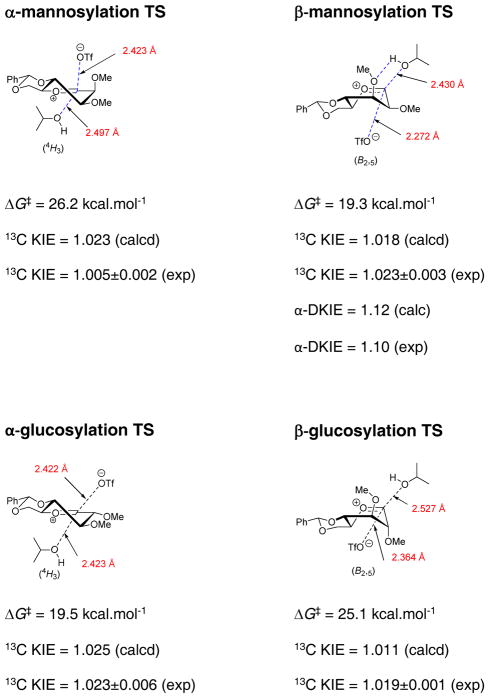
Experimental and Computed 13C Primary Kinetic Isotope Effects for the 4,6-O-Benzylidene Directed Manno- and Glucopyranosylation and an Experimental and Computed Secondary Deuterium KIE for β-Mannoside Formation
Figure 24
Figure 24
Plot of Mannoside to Cyclization Ratio vs Acceptor Concentration for Mannosylation Following Scheme 64.
Figure 25
Figure 25
Schematic Representation of the Change in the Per-O-methylmannopyranosyl Oxocarbenium Ion Conformation and Counterion Location with Solvent Dielectric Constant When ion Pair Collapse is Prevented
Figure 26
Figure 26
Computed Per-O-Methyl Glucopyranosyl Oxocarbenium Ion Pairs with Explicit Dichloromethane-Solvation
Scheme 1
Scheme 1
The Glycosylation Reaction
Scheme 2
Scheme 2
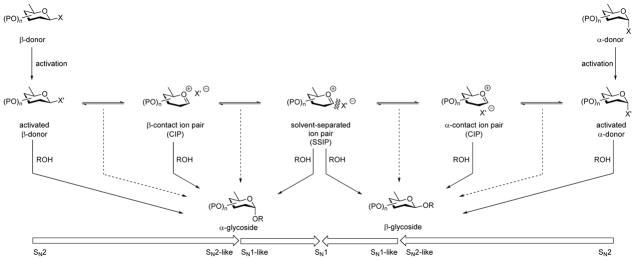
The Glycosylation Reaction with the Two Limiting Associative Mechanisms and the Central Dissociative Limiting Mechanism
Scheme 3
Scheme 3
Barrier to Rotation about the C-O π Bond in the 7-Methoxy-7-norbornyl Carbenium Ion Determined by VT NMR
Scheme 4
Scheme 4
Substitution of a Phenylthiomethyl Glycoside without Fragmentation
Scheme 5
Scheme 5
Hydrolysis of Isopropenyl Glycosides Does not Involve Glycosyl Oxocarbenium Ions
Scheme 6
Scheme 6
Generation of Glycosyl Oxocarbenium Ions in Superacidic Media
Scheme 7
Scheme 7
Preferential Loss of Protium over Deuterium from Two Diastereomeric Sialyl Thioglycosides Suggestive of Equilibrating Oxocarbenium Ions
Scheme 8
Scheme 8
Loss of the Pseudoaxial Deuterium from a Conformationally Locked System
Scheme 9
Scheme 9
Equilibration and Cyclization of a Transient Mannopyranosyl Oxocarbenium Ion in CH2Cl2 at −20 °C
Scheme 10
Scheme 10
Formation and Cyclization of a Transient Glucopyranosyl Oxocarbenium Ion in CH2Cl2 at −20 °C
Scheme 11
Scheme 11
trans-Selective Formation of a Bicyclic Acetal Indicative of Direct Displacement of an α-Triflate
Scheme 12
Scheme 12
Intramolecular Sialidation Reactions
Scheme 13
Scheme 13
Threshold ESI Cone Voltages for the Fragmentation of Sialyl Phosphates as a Function of O4 and N5 Protecting Groups and Their Dipoles
Scheme 14
Scheme 14
Formation of an Oxocarbenium Ion by Protonation of a Glycosylidene Carbene
Scheme 15
Scheme 15
Facial Selectivity in the Reaction of Allylsilane with Per-O-benzyl Lyxopyranosyl Acetate
Scheme 16
Scheme 16
Operation of Curtin Hammett-Type Kinetics in Nucleophilic Attack on the Gluco- and Mannopyranosyl Oxocarbenium Ions
Scheme 17
Scheme 17
Woerpel’s Inside Attack Model for the Reactions of Furanosyl Oxocarbenium Ions
Scheme 18
Scheme 18
1,2-cis-Selective Attack on the Lyxofuranosyl Oxocarbenium Iona aExperimental work employed benzyl ethers while computations were conducted with methyl ethers
Scheme 19
Scheme 19
tau-Bond Model for Nucleophilic Attack on the 4,6-O-Benzylidene-Protected Gluco and Mannopyranosyl Oxocarbenium Ions with Preferential Attack Antiperiplanar to the Lower Energy tau Bond (in Red)
Scheme 20
Scheme 20
Formation of 2-Chloro-2-deoxy-gluco- and Mannopyranosyl Perchlorates from the Corresponding Chlorides
Scheme 21
Scheme 21
Formation of a Glycosyl Toluenesulfonate by Metathesis with the Corresponding Bromide
Scheme 22
Scheme 22
Identification and Characterization of Glycosyl Triflates in the Mannopyranosyl Series
Scheme 23
Scheme 23
Formation and Characterization of Glycosyl Mesitylenesulfonates from Thioglycosides with Mesitylenesulfonyl Hydroxylamine
Scheme 24
Scheme 24
Formation and Characterization of Glycosyloxyphosphonium Salts
Scheme 25
Scheme 25
NMR Characterization of a cis-Fused Bicyclic Sulfonium Ion
Scheme 26
Scheme 26
Observation of a trans-Fused Bicyclic Sulfonium Ion as a Possible but not Necessary Intermediate in β-Selective Mannosylation with a 3,6-Mannuronolactone-Based Donor
Scheme 27
Scheme 27
Alternative Intermediates Tentatively Identified by NMR Spectroscopy in β-Selective Mannosylation with a 3,6-Mannuronolactone-Based Donor
Scheme 28
Scheme 28
Formation, Characterization and Displacement of a Glycosyl Isouronium Salt
Scheme 29
Scheme 29
The Lemieux Bromide Ion Catalysis Concept for the Synthesis of α-Glycosides
Scheme 30
Scheme 30
Equilibrating Furanosyl Bromides Identified by NMR Spectroscopy in the Synthesis of Nucleosides
Scheme 31
Scheme 31
Rates of In Situ Anomerization of Glycosyl Mesylates Determined by EXSY
Scheme 32
Scheme 32
Intermolecular Trapping of a Glycosyl Nitrilium Ion
Scheme 33
Scheme 33
Intramolecular Trapping of a Glycosyl Nitrilium Ion
Scheme 34
Scheme 34
Isolation of an N-Acetyl Sialyl N-glycoside Indicative of Intermediate Nitrilium Ion Formation
Scheme 35
Scheme 35
Hypothesis for the Selectivity of 4,6-O-Benzylidene-Directed Mannosylation Based on the Order of Mixing
Scheme 36
Scheme 36
β-Mannoside Formation in the Absence of Triflate with Trimethylsilyl Tetrakis(pentafluorophenyl)borate as Promotor
Scheme 37
Scheme 37
β-Mannoside Formation in the Presence of Only Catalytic Triflate or in the Presence of Perchlorate
Scheme 38
Scheme 38
Role of Lithium Triflate in Overcoming Fluoride Abstraction on Activation of a Mannosyl Trichloroacetimidate in the Presence of the Acceptor by Boron Trifluoride Etherate
Scheme 39
Scheme 39
Counterion Sensitive Outcome of a Gold-Catalyzed β-Mannosylation Reaction
Scheme 40
Scheme 40
Counterion Sensitive Outcome of a β-Mannosylation Reaction Employing β-Mannosyl Trichloroacetimidates as Donors
Scheme 41
Scheme 41
Identification of Counter-ion Dependent Divergent Mechanistic Pathways by Diffusion Ordered NMR Spectroscopy
Scheme 42
Scheme 42
Donor Configuration Dependent Selectivity in Glycosylation Reactions of 2,6-Mannuronolactone Based Donors
Scheme 43
Scheme 43
Counterion Dependent Selectivity in Glucosylation Reactions
Scheme 44
Scheme 44
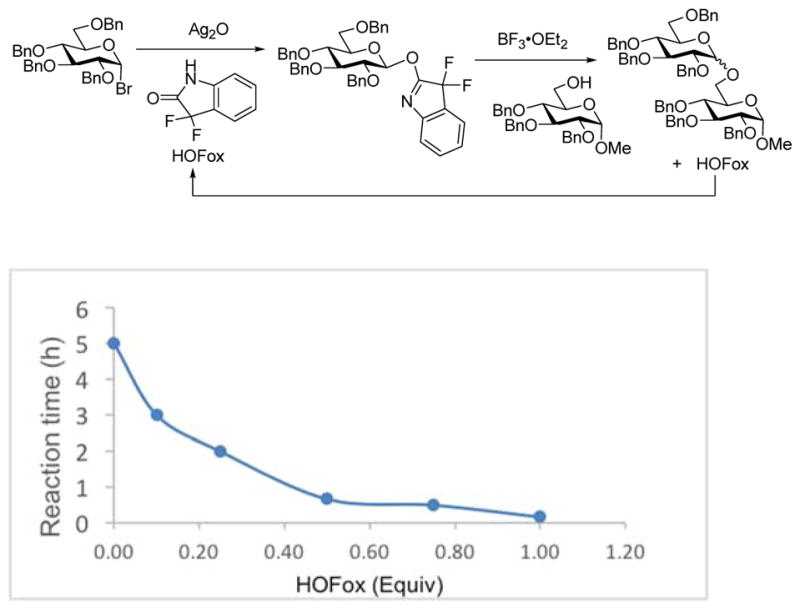
Dependence of Reaction Time on the Concentration of the Nucleophilic 3,3-Difluoro-2-oxindole Additive Suggestive of the Formation of a Covalent Intermediate
Scheme 45
Scheme 45
Dependence of Selectivity on the Absolute Configuration of an Added Phosphoric Acid
Scheme 46
Scheme 46
Regioselective Polyol Glycosylation with Formation of an Intermediate Glycosyl Phosphate
Scheme 47
Scheme 47
Concerted Cyclization of a Tethered Alcohol onto a Glycal in the Presence of a Chiral Phosphoric Acid
Scheme 48
Scheme 48
Use of a 2-Deuteriogalactal to Probe the Selectivity of Addition and a Hypothetical Four-Component Transition State
Scheme 49
Scheme 49
Double Diastereodifferentiation in Glycosylation
Scheme 50
Scheme 50
Complete Kinetic Analysis of a Borinate-Catalyzed Heterogeneous Glycosylation Indicating an Associative Mechanism
Scheme 51
Scheme 51
Complete Kinetic Analysis of a Borinate-Catalyzed Homogeneous Glycosylation Indicating an Associative Mechanism (PMP = pentamethylpiperidine)
Scheme 52
Scheme 52
Boronic Acid Catalyzed β-Mannosylation of with a 1,2-Anhydromannopyranose Derivative
Scheme 53
Scheme 53
Influence of Solvent in the Formation of a Mannosyl Phosphate
Scheme 54
Scheme 54
Use of VT NMR Spectroscopy to Identify the Minimum Temperature for Clean Activation
Scheme 55
Scheme 55
Stereodirecting Donor-Acceptor Hydrogen Bonding Aided by the Presence of a Picolyl Group in the Donor
Scheme 56
Scheme 56
Kinetics Derived Early Depiction of the Application of Winstein’s Ion Pair Theory to Glycosylation
Scheme 57
Scheme 57
Bimolecular Displacement of Chloride from Acetochloroglucose by Chloride as Revealed by Isotopic Labelling and Kinetics
Scheme 58
Scheme 58
Early Ion Pair Mechanism for the Reactions of Glycosyl Sulfonates
Scheme 59
Scheme 59
Associative Mechanism for Cyclization of a 1-(2-Hydroxymethylphenyl)-1,2-Anhydro Sugar Requires Assistance from Two Molecules of Methanol as Revealed by Kinetic Analyses
Scheme 60
Scheme 60
Secondary Deuterium KIEs Reveal Associative Mechanisms for the Formation of α- and β-Mannosides from Mannosyl Iodides
Scheme 61
Scheme 61
DKIE-Supported Transition State for the Formation of a β-Mannoside from the Corresponding α-Mannosyl Chloride on Promotion by a Macrocyclic Bisthiourea
Scheme 62
Scheme 62
Experimental and Computational Primary and Secondary KIEs Supporting an Exploded SNi Mechanism for the Boronic Acid-Catalyzed Glycosylation of a Polyol by a 1,2-Anhydroglucopyranose
Scheme 63
Scheme 63
Deuterium Kinetic Isotope Effects Support the Intermediacy of an Oxocarbenium Ion in Furanosylation with a 2,3-Anhydro Furanosyl Thioglycoside
Scheme 64
Scheme 64
The Cation Clock Concept
Scheme 65
Scheme 65
Dependence of Selectivity in an Arabinofuranosylation on Donor Concentration

References

    1. For an excellent summary of the seminal works in the field and a exempliary study of nucleophilic substitution of benzhydryl systems see: Phan TB, Nolte C, Kobayashi S, Ofial AR, Mayr H. Can One Predict Changes from SN1 to SN2 Mechanisms? J Am Chem Soc. 2009;131:11392–11401.

    1. NB. In the absence of further substituents on the electrophile, the glycosylation reaction is nothing more than the protection of an alcohol as a tetrahydropyranyl ether.

    1. Rhind-Tutt AJ, Vernon CA. Nucleophilic Substitution in 2,3,4,6-Tetra-O-Methyl Glycopyranosyl Chlorides. J Chem Soc. 1960:4637–4644.
    1. Eby R, Schuerch C. The Use of 1-O-Tosyl-D-Glucopyranose Derivatives in α-D-Glucoside Synthesis. Carbohydr Res. 1974;34:79–90.
    1. Lucas TJ, Schuerch C. Methanolysis as a Model Reaction for Oligosaccharide Synthesis of Some 6-Substituted 2,3,4-Tri-O-Benzyl-D-Galactopyranosyl Derivatives. Carbohydr Res. 1975;39:39–45.

Publication types