Review
. 2018 Aug;9(4):535-547.
doi: 10.1007/s13244-018-0624-3. Epub 2018 May 30.

Clinical applications of diffusion weighted imaging in neuroradiology

Affiliations
Review

Clinical applications of diffusion weighted imaging in neuroradiology

Marta Drake-Pérez et al. Insights Imaging. 2018 Aug.

Abstract

Diffusion-weighted imaging (DWI) has revolutionised stroke imaging since its introduction in the mid-1980s, and it has also become a pillar of current neuroimaging. Diffusion abnormalities represent alterations in the random movement of water molecules in tissues, revealing their microarchitecture, and occur in many neurological conditions. DWI provides useful information, increasing the sensitivity of MRI as a diagnostic tool, narrowing the differential diagnosis, providing prognostic information, aiding in treatment planning and evaluating response to treatment. Recently, there have been several technical improvements in DWI, leading to reduced acquisition time and artefacts and enabling the development of diffusion tensor imaging (DTI) as a tool for assessing white matter. We aim to review the main clinical uses of DWI, focusing on the physiological mechanisms that lead to diffusion abnormalities. Common pitfalls will also be addressed.

Teaching points: • DWI includes EPI, TSE, RESOLVE or EPI combined with reduced volume excitation. • DWI is the most sensitive sequence in stroke diagnosis and provides information about prognosis. • DWI helps in the detection of intramural haematomas (arterial dissection). • In diffusion imaging, ADC is inversely proportional to tumour cellularity. • DWI and DTI derived parameters can be used as biomarkers in different pathologies.

Keywords: DWI; Infection; Inflammation; MRI; Stroke.


Figures
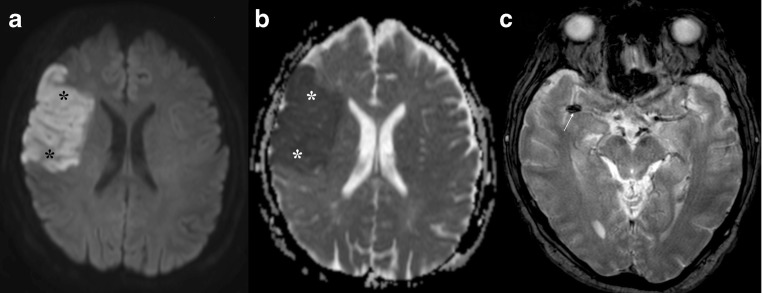
Fig. 1
Fig. 1
Acute stroke. a Increased signal intensity on DWI in the territory of the right middle cerebral artery (MCA), which corresponds to an area of low ADC value in b (asterisks), representing the extension of an acute ischaemic stroke. c A clot as the aetiology, presenting as a linear hypointense abnormality in the MCA on T2*WI (arrow)
Fig. 2
Fig. 2
Spinal cord ischaemia. High T2 signal abnormality in the conus medullaris with diffusion restriction on DWI (arrows) compatible with an ischaemic lesion
Fig. 3
Fig. 3
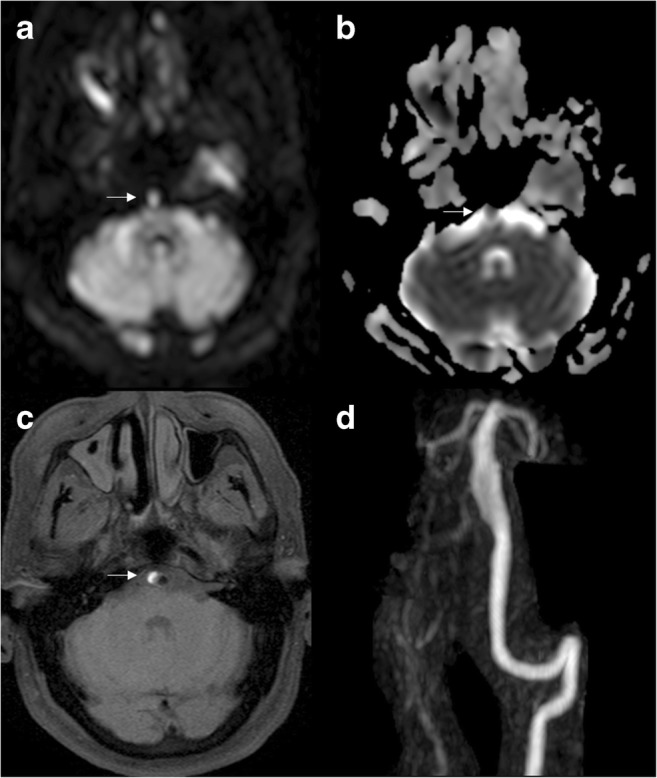
Arterial dissection. DWI (a), ADC (b), non-contrast FAT SAT T1 (c) and coronal MIP reconstruction of the basilar artery (d) demonstrate a dissection with mural haematoma represented by the “crescent sign” (arrows), which shows restricted diffusion and hyperintensity on T1WI
Fig. 4
Fig. 4
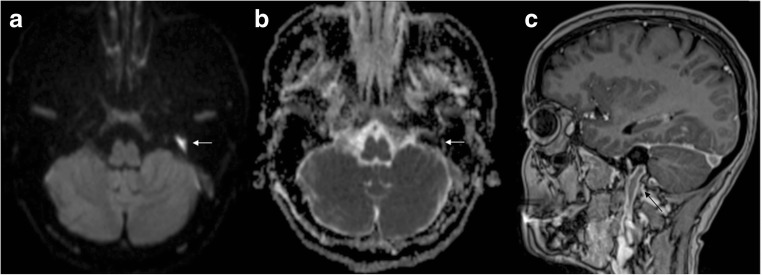
Venous thrombosis. DWI (a), ADC map (b) and sagittal reconstruction of T1 3D with gadolinium (c) show thrombosis of the left jugular vein (arrows), presenting with restricted diffusion and a filling defect in the vessel after contrast administration
Fig. 5
Fig. 5
Primary CNS lymphoma. Left frontal periventricular lesion showing prominent diffusion restriction, presenting with hyperintensity on DWI (a), low ADC value (b) and mild hyperintensity on T2WI (c), all typical features of this type of hypercellular tumour. T1WI post gadolinium (d) shows homogeneous and intense contrast enhancement
Fig. 6
Fig. 6
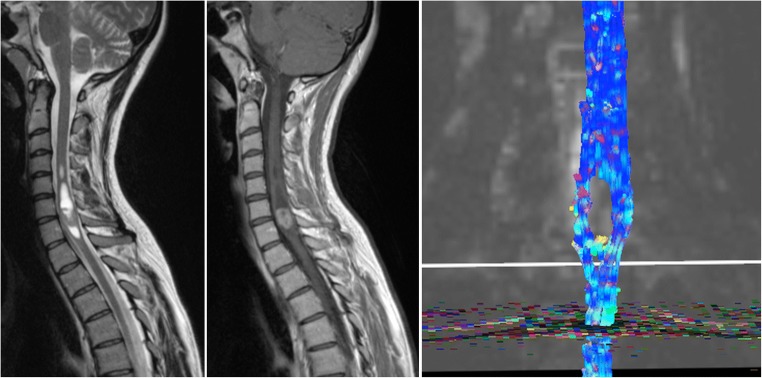
DTI for surgical planning. Patient with an ependymoma in the lower cervical spinal cord with areas of high T2 signal (a) and enhancement after gadolinium administration (b). DTI shows displacement of the fibres (c), which is usually consistent with a slow-growing lesion
Fig. 7
Fig. 7
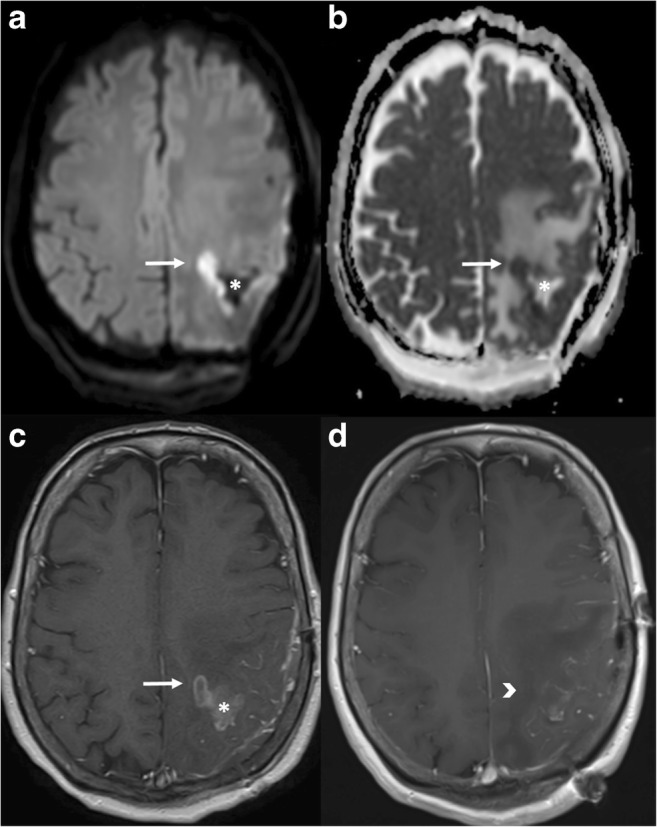
Post-surgical ischaemia. Immediate follow-up MRI in a patient who underwent surgery for resection of a suspicious enhancing mass. In the medial aspect of the resection cavity (asterisk) there is an enhancing area on the T1 post-contrast sequence (c, arrow). This finding alone could represent residual tumour, but the presence of restricted diffusion with high signal on DWI (a) and a low ADC value (b) meant that a small area of peri-surgical ischaemia was more likely. Three-month follow-up T1 post-gadolinium MRI (d) shows absence of enhancement in the same region (arrowhead), confirming this diagnosis
Fig. 8
Fig. 8
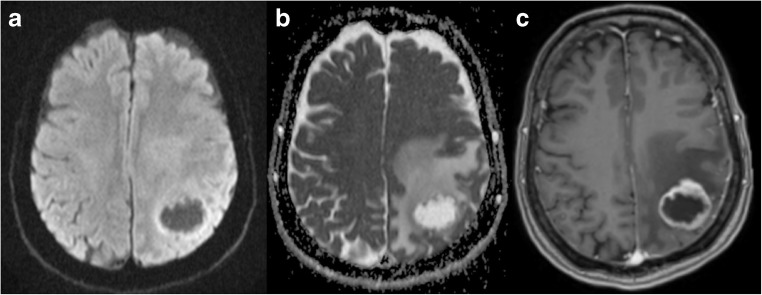
GBM. Left parieto-occipital lesion with peripheral vasogenic oedema. DWI and ADC (a and b, respectively) show a clear area of increased diffusion within the core, corresponding to a necrotic centre. On T1 3D post gadolinium the mass shows ring enhancement
Fig. 9
Fig. 9
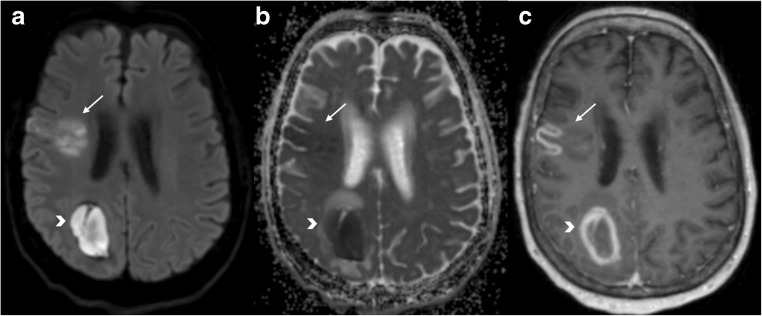
Subacute haematoma. Right parietal mass (arrowhead) showing diffusion restriction within the core on DWI and ADC maps (a and b, respectively) and a ring-enhancing pattern on T1 post gadolinium (c). This was a subacute haematoma. Clinical context is important to differentiate haemorrhage from abscess. There is also a subacute ischaemic lesion in the inferior right frontal lobe (arrows) that shows early pseudonormalisation of the ADC and gyriform enhancement post gadolinium
Fig. 10
Fig. 10
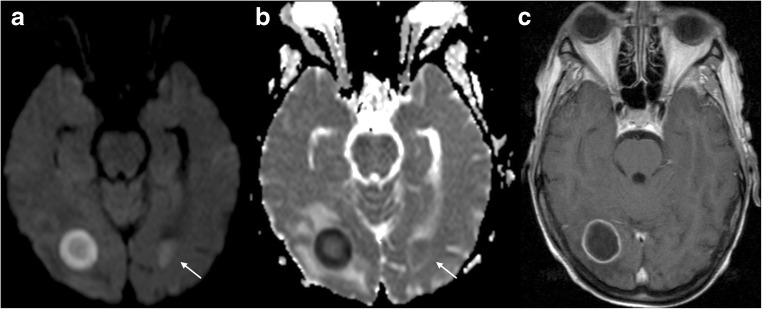
Abscess. Right occipital mass showing marked diffusion restriction within the core on DWI and ADC maps (a and b, respectively) and a peripheral enhancing pattern on T1 post gadolinium (c). DWI helps to differentiate ring-enhancing lesions because restricted diffusion in the centre of the mass is characteristic of pyogenic abscesses. In this case, diffusion-based sequences also helped to identify ventriculitis (arrows)
Fig. 11
Fig. 11
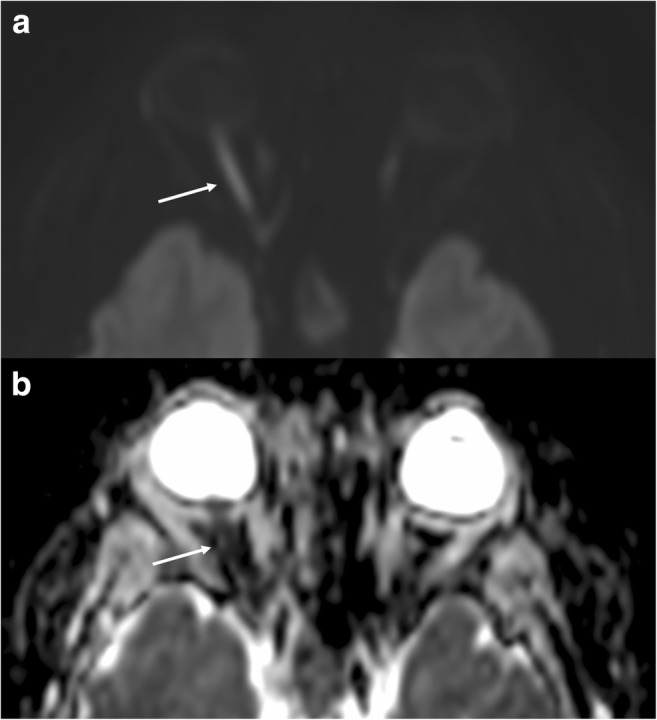
Optic neuritis. High DWI signal (a) and low ADC value (b) representing restricted diffusion in the right optic nerve in a patient with non-specific optic neuritis

References

    1. Le Bihan D, Breton E, Lallemand D, Grenier P, Cabanis E, Laval-Jeantet M. MR imaging of intravoxel incoherent motions: application to diffusion and perfusion in neurologic disorders. Radiology. 1986;161(2):401–407. doi: 10.1148/radiology.161.2.3763909. - DOI - PubMed
    1. Wu W, Miller KL. Image formation in diffusion MRI: a review of recent technical developments. J Magn Reson Imaging. 2017;46(3):646–662. doi: 10.1002/jmri.25664. - DOI - PMC - PubMed
    1. Thian YL, Xie W, Porter DA, Weileng Ang B. Readout-segmented echo-planar imaging for diffusion-weighted imaging in the pelvis at 3T-A feasibility study. Acad Radiol. 2014;21(4):531–537. doi: 10.1016/j.acra.2014.01.005. - DOI - PubMed
    1. Viallon M, Cuvinciuc V, Delattre B, Merlini L, Barnaure-Nachbar I, Toso-Patel S, Becker M, Lovblad KO, Haller S. Erratum to: state-of-the-art MRI techniques in neuroradiology: principles, pitfalls, and clinical applications. Neuroradiology. 2015;57(10):1075. doi: 10.1007/s00234-015-1548-y. - DOI - PubMed
    1. Liney GP, Holloway L, Al Harthi TM, Sidhom M, Moses D, Juresic E, Rai R, Manton DJ. Quantitative evaluation of diffusion-weighted imaging techniques for the purposes of radiotherapy planning in the prostate. Br J Radiol. 2015;88(1049):20150034. doi: 10.1259/bjr.20150034. - DOI - PMC - PubMed

LinkOut - more resources