


Differences in Cognitive Function Between Women and Men With HIV
- PMID: 29847476
- PMCID: PMC6092201
- DOI: 10.1097/QAI.0000000000001764
Differences in Cognitive Function Between Women and Men With HIV
Abstract
Background: Women may be more vulnerable to HIV-related cognitive dysfunction compared with men because of sociodemographic, lifestyle, mental health, and biological factors. However, studies to date have yielded inconsistent findings on the existence, magnitude, and pattern of sex differences. We examined these issues using longitudinal data from 2 large, prospective, multisite, observational studies of US women and men with and without HIV.
Setting: The Women's Interagency HIV Study (WIHS) and Multicenter AIDS Cohort Study (MACS).
Methods: HIV-infected (HIV+) and uninfected (HIV-) participants in the Women's Interagency HIV Study and Multicenter AIDS Cohort Study completed tests of psychomotor speed, executive function, and fine motor skills. Groups were matched on HIV status, sex, age, education, and black race. Generalized linear mixed models were used to examine group differences on continuous and categorical demographically corrected T-scores. Results were adjusted for other confounding factors.
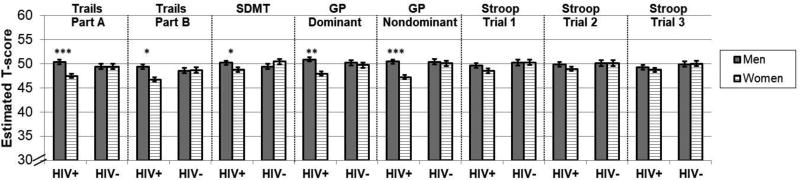
Results: The sample (n = 1420) included 710 women (429 HIV+) and 710 men (429 HIV+) (67% non-Hispanic black; 53% high school or less). For continuous T-scores, sex by HIV serostatus interactions were observed on the Trail Making Test parts A & B, Grooved Pegboard, and Symbol Digit Modalities Test. For these tests, HIV+ women scored lower than HIV+ men, with no sex differences in HIV- individuals. In analyses of categorical scores, particularly the Trail Making Test part A and Grooved Pegboard nondominant, HIV+ women also had a higher odds of impairment compared with HIV+ men. Sex differences were constant over time.
Conclusions: Although sex differences are generally understudied, HIV+ women vs men show cognitive disadvantages. Elucidating the mechanisms underlying these differences is critical for tailoring cognitive interventions.
Conflict of interest statement
Conflicts of Interest: For the remaining authors none were declared.
Figures
References
-
- Prevention H. Monitoring Selected National HIV Prevention and Care Objectives by Using HIV Surveillance Data - PubMed
-
- Women U. [Accessed December 7];Facts and Figures: HIV and AIDS [online]
Publication types
MeSH terms
Grants and funding
- U01 AI035042/AI/NIAID NIH HHS/United States
- U01 AI103397/AI/NIAID NIH HHS/United States
- U01 AI031834/AI/NIAID NIH HHS/United States
- UL1 TR001079/TR/NCATS NIH HHS/United States
- U01 AI035004/AI/NIAID NIH HHS/United States
- U01 AI034989/AI/NIAID NIH HHS/United States
- U01 AI035041/AI/NIAID NIH HHS/United States
- UM1 AI035043/AI/NIAID NIH HHS/United States
- U01 AI034994/AI/NIAID NIH HHS/United States
- U01 AI103401/AI/NIAID NIH HHS/United States
- U01 AI035040/AI/NIAID NIH HHS/United States
- U01 AI103390/AI/NIAID NIH HHS/United States
- U01 AI034993/AI/NIAID NIH HHS/United States
- U01 AI103408/AI/NIAID NIH HHS/United States
- U01 AI035039/AI/NIAID NIH HHS/United States
- U01 HD032632/HD/NICHD NIH HHS/United States
- U01 AI042590/AI/NIAID NIH HHS/United States
LinkOut - more resources
Full Text Sources
Other Literature Sources
Medical
Miscellaneous
