


Feasibility of controlling CD38-CAR T cell activity with a Tet-on inducible CAR design
- PMID: 29847570
- PMCID: PMC5976165
- DOI: 10.1371/journal.pone.0197349
Feasibility of controlling CD38-CAR T cell activity with a Tet-on inducible CAR design
Abstract
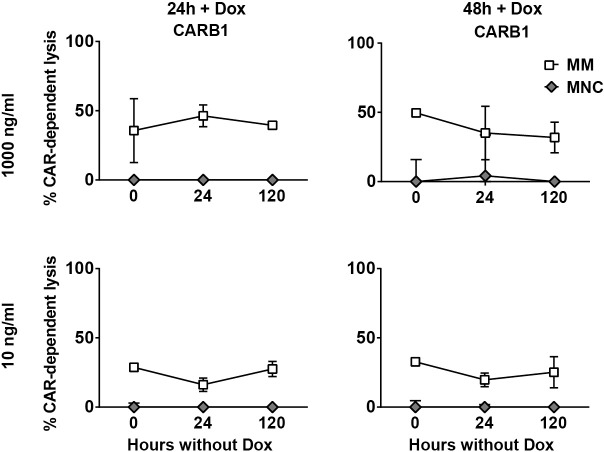
Recent clinical advances with chimeric antigen receptor (CAR) T cells have led to the accelerated clinical approval of CD19-CARs to treat acute lymphoblastic leukemia. The CAR T cell therapy is nevertheless associated with toxicities, especially if the CARs are not entirely tumor-specific. Therefore, strategies for controlling the CAR T cell activity are required to improve their safety profile. Here, by using the multiple myeloma (MM)-associated CD38 molecule as target molecule, we tested the feasibility and utility of a doxycycline (DOX) inducible Tet-on CD38-CAR design to control the off-target toxicities of CAR T cells. Using CARs with high affinity to CD38, we demonstrate that this strategy allows the proper induction of CD38-CARs and CAR-mediated T cell cytotoxicity in a DOX-dose dependent manner. Especially when the DOX dose was limited to 10ng/ml, its removal resulted in a relatively rapid decay of CAR- related off-tumor effects within 24 hours, indicating the active controllability of undesired CAR activity. This Tet-on CAR design also allowed us to induce the maximal anti-MM cytotoxic activity of affinity-optimized CD38-CAR T cells, which already display a low toxicity profile, hereby adding a second level of safety to these cells. Collectively, these results indicate the possibility to utilize this DOX inducible CAR-design to actively regulate the CAR-mediated activities of therapeutic T cells. We therefore conclude that the Tet-on system may be more advantageous above suicide-genes to control the potential toxicities of CAR T cells without the need to destroy them permanently.
Conflict of interest statement
Tuna Mutis, Henk Lokhorst and Niels van de Donk received project grant support from Genmab, Janssen and Celgene. However, for this specific study there is no conflict of interest.
Figures
References
-
- Brentjens RJ, Rivière I, Park JH, Davila ML, Wang X, Stefanski J, et al. Safety and persistence of adoptively transferred autologous CD19-targeted T cells in patients with relapsed or chemotherapy refractory B-cell leukemias. Blood. 2011;118: 4817–4828. doi: 10.1182/blood-2011-04-348540 - DOI - PMC - PubMed
-
- Brentjens RJ, Davila ML, Riviere I, Park J, Wang X, Cowell LG, et al. CD19-targeted T cells rapidly induce molecular remissions in adults with chemotherapy-refractory acute lymphoblastic leukemia. Sci Transl Med. 2013;5: 177ra38 doi: 10.1126/scitranslmed.3005930 - DOI - PMC - PubMed
-
- Kochenderfer JN, Dudley ME, Feldman S a, Wilson WH, Spaner DE, Maric I, et al. B-cell depletion and remissions of malignancy along with cytokine-associated toxicity in a clinical trial of anti-CD19 chimeric-antigen-receptor-transduced T cells. Blood. 2012;119: 2709–2720. doi: 10.1182/blood-2011-10-384388 - DOI - PMC - PubMed
-
- Maude SL, Barrett D, Teachey DT, Grupp SA. Managing cytokine release syndrome associated with novel T cell-engaging therapies. Cancer J. 2014;20: 119–122. doi: 10.1097/PPO.0000000000000035 - DOI - PMC - PubMed
-
- Kalos M, Levine BL, Porter DL, Katz S, Grupp SA, Bagg A, et al. T cells with chimeric antigen receptors have potent antitumor effects and can establish memory in patients with advanced leukemia. Sci Transl Med. 2011;3: 95ra73 doi: 10.1126/scitranslmed.3002842 - DOI - PMC - PubMed
Publication types
MeSH terms
Substances
LinkOut - more resources
Full Text Sources
Other Literature Sources
Research Materials
