


Estimating the completeness of death registration: An empirical method
- PMID: 29847573
- PMCID: PMC5976169
- DOI: 10.1371/journal.pone.0197047
Estimating the completeness of death registration: An empirical method
Abstract
Introduction: Many national and subnational governments need to routinely measure the completeness of death registration for monitoring and statistical purposes. Existing methods, such as death distribution and capture-recapture methods, have a number of limitations such as inaccuracy and complexity that prevent widespread application. This paper presents a novel empirical method to estimate completeness of death registration at the national and subnational level.
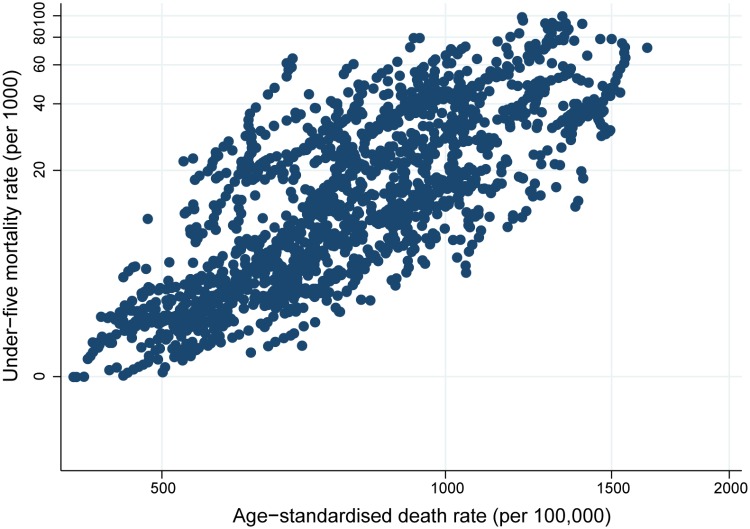
Methods: Random-effects models to predict the logit of death registration completeness were developed from 2,451 country-years in 110 countries from 1970-2015 using the Global Burden of Disease 2015 database. Predictors include the registered crude death rate, under-five mortality rate, population age structure and under-five death registration completeness. Models were developed separately for males, females and both sexes.
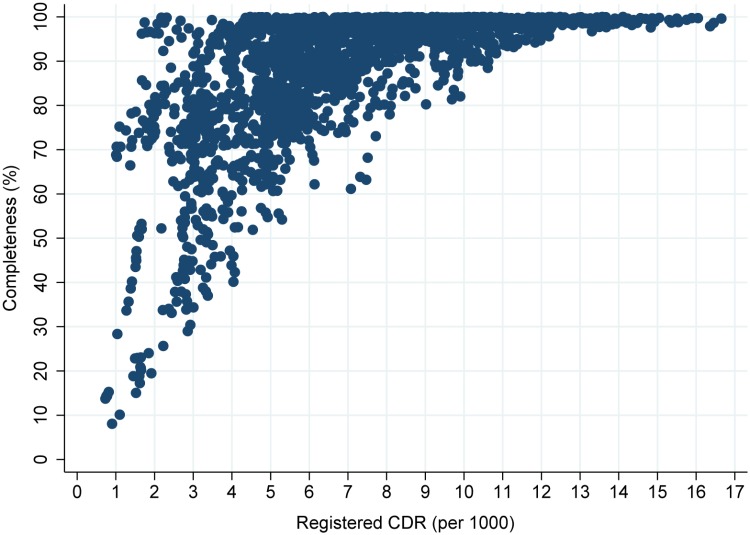
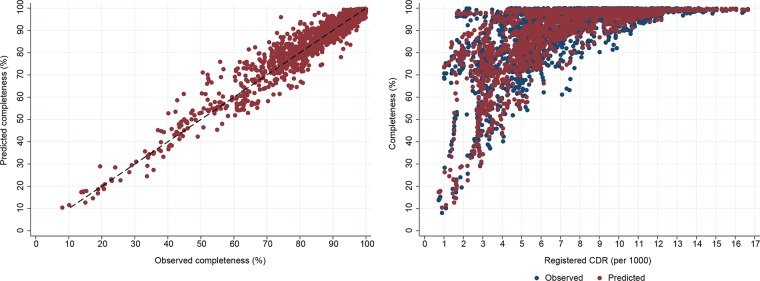
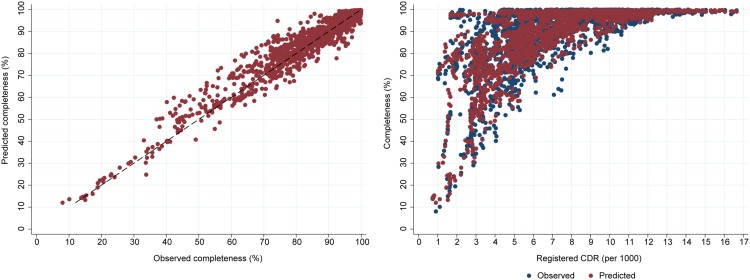
Findings: All variables are highly significant and reliably predict completeness of registration across a wide range of registered crude death rates (R-squared 0.85). Mean error is highest at medium levels of observed completeness. The models show quite close agreement between predicted and observed completeness for populations outside the dataset. There is high concordance with the Hybrid death distribution method in Brazilian states. Uncertainty in the under-five mortality rate, assessed using the dataset and in Colombian departmentos, has minimal impact on national level predicted completeness, but a larger effect at the subnational level.
Conclusions: The method demonstrates sufficient flexibility to predict a wide range of completeness levels at a given registered crude death rate. The method can be applied utilising data readily available at the subnational level, and can be used to assess completeness of deaths reported from health facilities, censuses and surveys. Its utility is diminished where the adult mortality rate is unusually high for a given under-five mortality rate. The method overcomes the considerable limitations of existing methods and has considerable potential for widespread application by national and subnational governments.
Conflict of interest statement
The authors have declared that no competing interests exist.
Figures
References
-
- AbouZahr C, de Savigny D, Mikkelsen L, Setel PW, Lozano R, Nichols E, et al. Civil registration and vital statistics: progress in the data revolution for counting and accountability. Lancet. 2015; 386: 1373–1385. doi: 10.1016/S0140-6736(15)60173-8 - DOI - PMC - PubMed
-
- Health Metrics Network. Strengthening civil registration and vital statistics for births, deaths and causes of death: Resource Kit. Geneva: World Health Organization; 2013.
-
- Timaeus I, Dorrington R, Hill K. Introduction to adult mortality analysis In: Moultrie T, Dorrington R, Hill A, Hill K, Timaeus I, Zaba B. Tools for demographic estimation. Paris: IUSSP; 2013. pp. 191–194. http://demographicestimation.iussp.org.
-
- Murray CJL, Rajaratnam JK, Marcus J, Laakso T, Lopez AD. What can we conclude from death registration? Improved methods for evaluating completeness. PLoS Medicine. 2010; 7: e1000262 Available from: http://journals.plos.org/plosmedicine/article?id=10.1371/journal.pmed.10.... - PMC - PubMed
-
- Brass W. Methods for estimating fertility and mortality from limited and defective data. Chapel Hill: University of North Carolina; 1975.
Publication types
MeSH terms
Associated data
LinkOut - more resources
Full Text Sources
Other Literature Sources
Medical
