. 2018 May 30;8(1):8412.
doi: 10.1038/s41598-018-26840-4.

Combinatorial Drug Testing in 3D Microtumors Derived from GBM Patient-Derived Xenografts Reveals Cytotoxic Synergy in Pharmacokinomics-informed Pathway Interactions

Affiliations

Combinatorial Drug Testing in 3D Microtumors Derived from GBM Patient-Derived Xenografts Reveals Cytotoxic Synergy in Pharmacokinomics-informed Pathway Interactions

Ashley N Gilbert et al. Sci Rep. .

Abstract

Glioblastoma multiforme (GBM), the most common form of primary malignant brain cancer in adults, is a devastating disease for which effective treatment has remained elusive for over 75 years. One reason for the minimal progress during this time is the lack of accurate preclinical models to represent the patient's tumor's in vivo environment, causing a disconnect in drug therapy effectiveness between the laboratory and clinic. While patient-derived xenografts (PDX's or xenolines) are excellent human tumor representations, they are not amenable to high throughput testing. Therefore, we developed a miniaturized xenoline system (microtumors) for drug testing. Nineteen GBM xenolines were profiled for global kinase (kinomic) activity revealing actionable kinase targets associated with intracranial tumor growth rate. Kinase inhibitors for these targets (WP1066, selumetinib, crizotinib, and cediranib) were selected for single and combination therapy using a fully human-derived three-dimensional (3D) microtumor model of GBM xenoline cells embedded in HuBiogel for subsequent molecular and phenotype assays. GBM microtumors closely resembled orthotopically-implanted tumors based on immunohistochemical analysis and displayed kinomic and morphological diversity. Drug response testing could be reproducibly performed in a 96-well format identifying several synergistic combinations. Our findings indicate that 3D microtumors can provide a suitable high-throughput model for combination drug testing.


Conflict of interest statement

A.N.G., R.S.S., and R.S. were employed at one time by Vivo Biosciences, Inc. R.S. is currently employed by LifeNet Health, Inc. and C.D.W. is a scientific consultant for LifeNet Health, Inc.

Figures
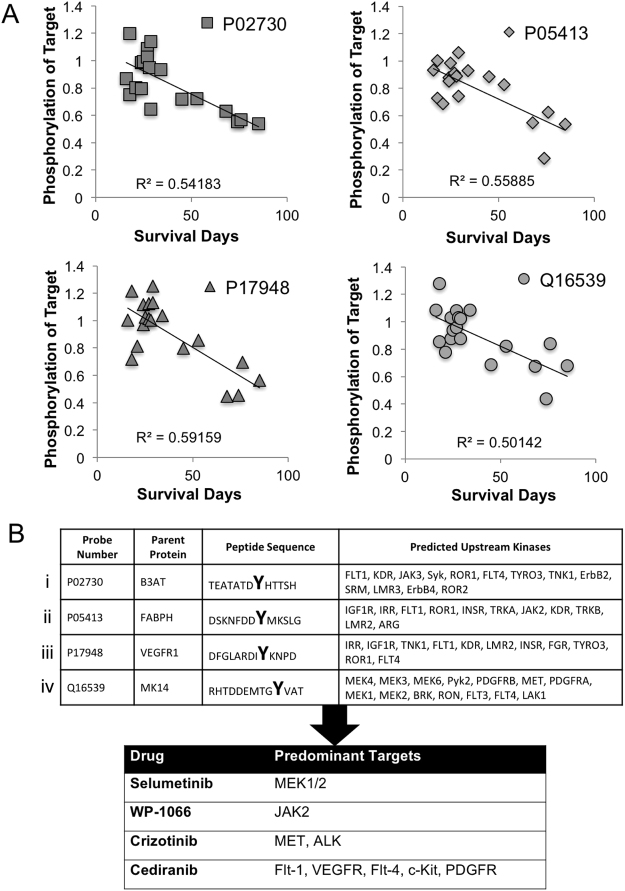
Figure 1
Figure 1
Kinomic profiling of GBM xenolines identify actionable kinase targets for testing. (A) Kinomic probes for showing inverse correlation between phospho-peptide intensity and intracranial survival in days for 19 GBM PDX. Correlation (R2) is indicated for each peptide probe. (B) Probe Number (UniProt ID) and corresponding phosphorylatable peptide sequence with tyrosine residue indicated with bold large font are shown. Predicted upstream kinases for phosphopeptide sequences are indicated (See Materials and Methods for upstream kinase identification strategy). Selected drugs for subsequent characterization are shown with predominant kinase targets.
Figure 2
Figure 2
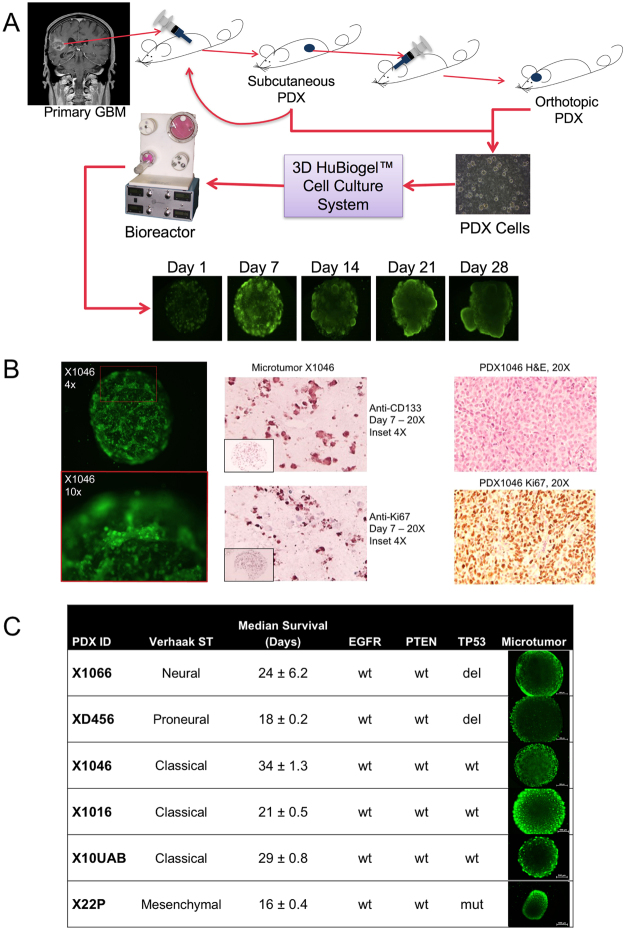
3D xenoline microtumors as model of GBM. (A) Schematic for 3D microtumor production from PDX tumor cells. (B) Microtumor Calcein-AM live cell staining and IHC compared to PDX tumor. Microtumor characterization using Calcein-AM live cell staining (left 2 panels) and IHC staining of stem cell (CD-133) and proliferation (Ki-67) markers (middle two panels) is shown at low and high magnification to mimic in vivo tumors (H&E and Ki-67 staining shown for murine implanted tumors (right two panels) (magnification is indicated). (C) Selected PDX tumors with Verhaak et al. molecular subtype, median survival, EGFR, PTEN and TP53 status as well as Calcein-AM imaging of Microtumor beads in Neurobasal medium at Day 7 at 4x magnification and 250 ms exposure. Scale bar is 500 µm.
Figure 3
Figure 3
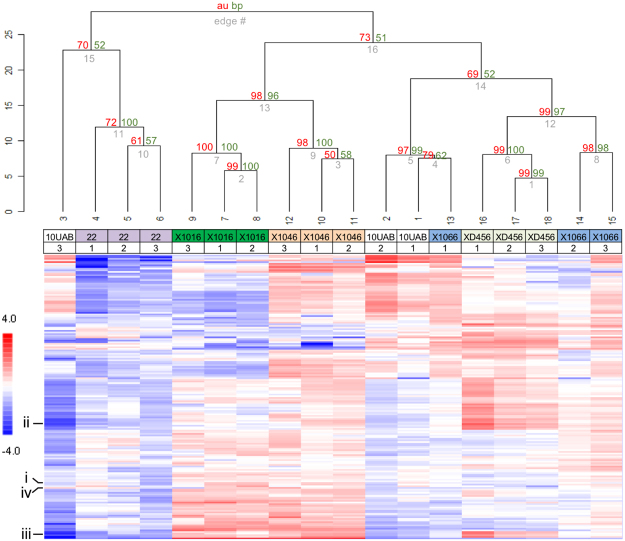
Kinomic profiling showing molecular diversity of GBM xenoline microtumors. Kinomic heatmap of combined PTK and STK chip analyses with triplicates of each microtumor xenoline at Day 7. The GBM xenoline identity is labeled with biological replicate number indicated below the xenoline. Each cell is a phosphopeptide probe displayed as log-transformed change from peptide mean as higher (red) or lower (blue) than the average signal per peptide. Bootstrap resampling probability testing of clustering robustness using pvclust (R script). approximately unbiased (AU) score is shown in red and a normal bootstrap probability value (BP) is shown in green at the dendrogram hinges. AU values ≥95 indicate that the data highly supports the clustering. The 4 peptides shown in Fig. 1B are indicated.
Figure 4
Figure 4
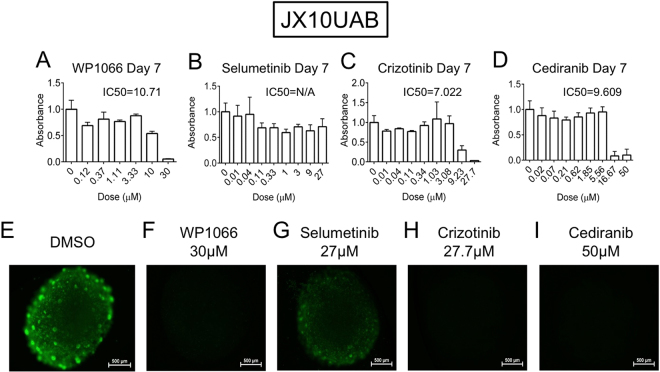
Dose response of JX10UAB to WP1066, Selumetinib, Crizotinib, and Cediranib at Day 7. Raw MTT absorbance of (A) WP1066, (B) Selumetinib, (C) Crizotinib and (D) Cediranib are shown with DMSO control representing the 0 µM dose with calculated IC50 indicated (N/A = not applicable). (EI) Calcein-AM imaging of DMSO or highest doses of each drug (30 µM, 27 µM, 27.7 µM, and 50 µM, respectively) at Day 7 at 4x magnification and 250 ms exposure. Scale bar is 500 µm.
Figure 5
Figure 5
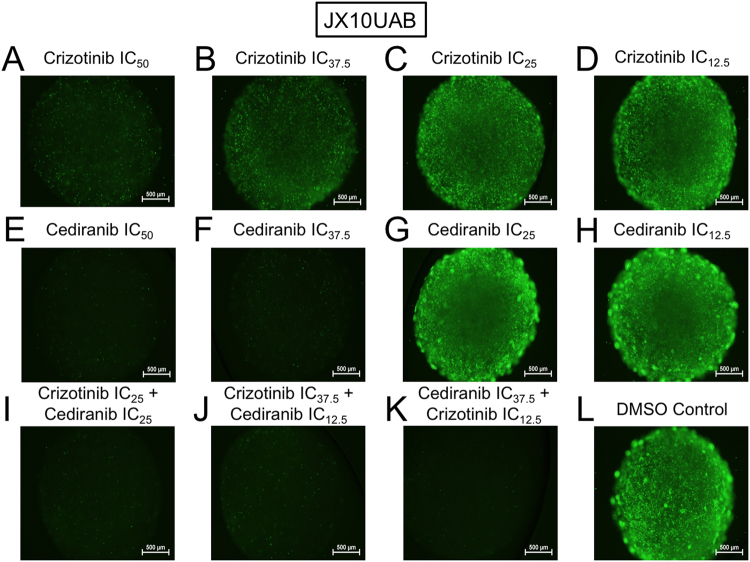
Calcein-AM imaging of drug combinations in GBM xenoline microtumors. Calcein-AM imaging of (AH) single and (IK) combination drug screening of Crizotinib and Cediranib and (L) DMSO control of the JX10UAB xenoline at Day 7 at 4x magnification and 250 ms exposure. Scale bar is 500 µm.

References

    1. Stupp R, et al. Radiotherapy plus concomitant and adjuvant temozolomide for glioblastoma. N Engl J Med. 2005;352:987–996. doi: 10.1056/NEJMoa043330. - DOI - PubMed
    1. Kamoun WS, et al. Edema control by cediranib, a vascular endothelial growth factor receptor-targeted kinase inhibitor, prolongs survival despite persistent brain tumor growth in mice. J Clin Oncol. 2009;27:2542–2552. doi: 10.1200/JCO.2008.19.9356. - DOI - PMC - PubMed
    1. Martinho O, et al. In Vitro and In Vivo Analysis of RTK Inhibitor Efficacy and Identification of Its Novel Targets in Glioblastomas. Transl Oncol. 2013;6:187–196. doi: 10.1593/tlo.12400. - DOI - PMC - PubMed
    1. Batchelor TT, et al. Phase III randomized trial comparing the efficacy of cediranib as monotherapy, and in combination with lomustine, versus lomustine alone in patients with recurrent glioblastoma. J Clin Oncol. 2013;31:3212–3218. doi: 10.1200/JCO.2012.47.2464. - DOI - PMC - PubMed
    1. Yang, M. Y. et al. An innovative three-dimensional gelatin foam culture system for improved study of glioblastoma stem cell behavior. Journal of biomedical materials research. Part B, Applied biomaterials, 10.1002/jbm.b.33214 (2014). - PubMed

Publication types

Substances