


Can improved specialty access moderate emergency department overuse?: Effect of neurology appointment delays on ED visits
- PMID: 29849236
- PMCID: PMC5964823
- DOI: 10.1212/CPJ.0000000000000295
Can improved specialty access moderate emergency department overuse?: Effect of neurology appointment delays on ED visits
Abstract
Background: Delayed access to specialty care may increase inappropriate emergency department (ED) visits. However, the details of this relationship after referral to a specialist are unknown.
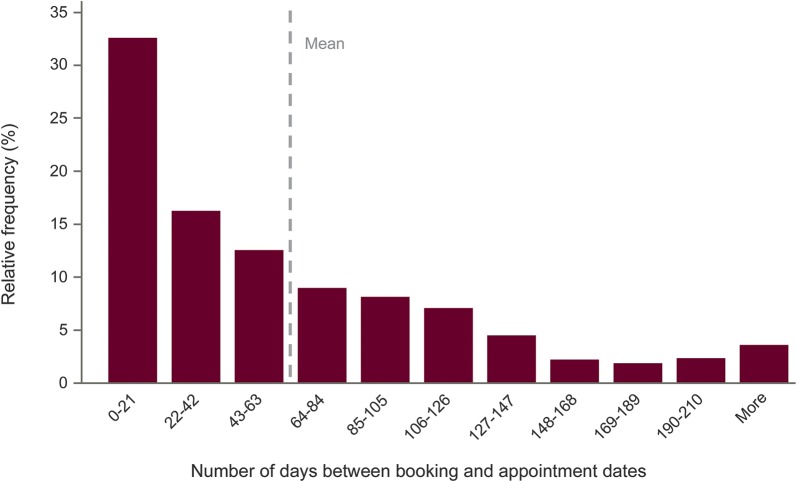
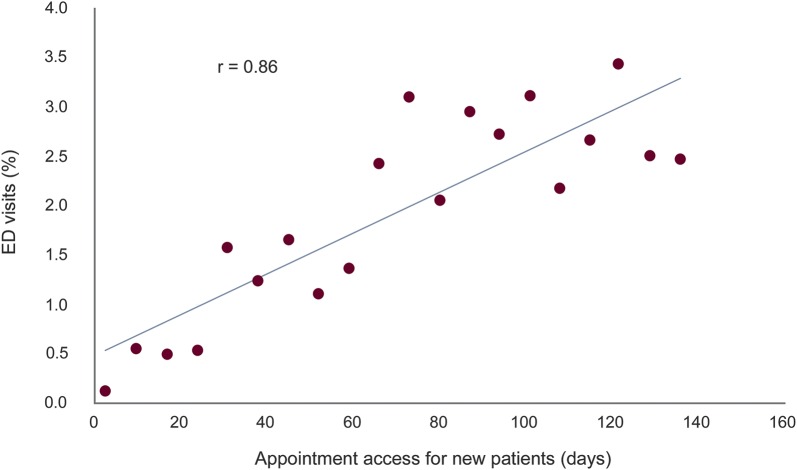
Methods: The correlations in an academic medical center between time to new neurology patient appointments and nonurgent ED use are explored in this study. Access was measured as the number of days between the scheduling and outpatient appointment dates. A series of statistical analyses including correlation analysis, regressions, and hypothesis tests were conducted to investigate possible associations between delayed access to specialty care and ED visits, as well as the effect of ED visits on specialty care cancellation and no-show rates.
Results: Of 19,505 new neurology patients, 310 visited an ED prior to their appointment, 95.2% (295) of whom had poor access (defined here as exceeding 21 days). Patients with access >21 days for new visits were 6.6 times more likely to visit the ED before their appointment date, 19% within the first week after scheduling. Patients who visited the ED between their booking and appointment dates were 2.3 times more likely to cancel or fail to attend their appointment.
Conclusion: These results suggest that long access delays in specialty referrals can significantly increase ED costs and congestion. Further studies in other specialties to explore this relationship are warranted.
Figures
Comment in
- Neurol Clin Pract. 6(6):472.
References
-
- Institute of Medicine. Transforming Health Care Scheduling and Access: Getting to Now. Washington, DC: The National Academies Press; 2015. - PubMed
-
- Kaplan GS. Health care scheduling and access: a report from the IOM. JAMA 2015;314:1449–1450. - PubMed
-
- Weiss AJ, Wier LM, Stocks C, Blanchard J. Overview of emergency department visits in the United States, 2011. In: Hcup Statistical Brief #174. Agency for Healthcare Research and Quality. Rockville, MD; 2014. Available at: hcup-us.ahrq.gov/reports/statbriefs/sb174-Emergency-Department-Visits-Ov.... Accessed June 28, 2016. - PubMed
-
- Petersen LA, Burstin HR, O'Neil AC, Orav EJ, Brennan TA. Nonurgent emergency department visits: the effect of having a regular doctor. Med Care 1998;36:1249–1255. - PubMed
-
- Northington WE, Brice JH, Zou B. Use of an emergency department by nonurgent patients. Am J Emerg Med 2005;23:131–137. - PubMed
LinkOut - more resources
Full Text Sources
Other Literature Sources