Guideline
. 2018 Apr 10:2018:3541807.
doi: 10.1155/2018/3541807. eCollection 2018.

GRP78 Promotes Neural Stem Cell Antiapoptosis and Survival in Response to Oxygen-Glucose Deprivation (OGD)/Reoxygenation through PI3K/Akt, ERK1/2, and NF- κ B/p65 Pathways

Affiliations
Guideline

GRP78 Promotes Neural Stem Cell Antiapoptosis and Survival in Response to Oxygen-Glucose Deprivation (OGD)/Reoxygenation through PI3K/Akt, ERK1/2, and NF- κ B/p65 Pathways

Qian Liu et al. Oxid Med Cell Longev. .

Abstract

When brain injury happens, endogenous neural stem cells (NSCs) located in the adult subventricular zone (SVZ) and subgranular zone (SGZ) are attacked by ischemia/reperfusion to undergo cellular apoptosis and death before being induced to migrate to the lesion point and differentiate into mature neural cells for damaged cell replacement. Although promoting antiapoptosis and NSC survival are critical to neuroregeneration, the mechanism has yet been elucidated clearly. Here in this study, we established an in vitro oxygen-glucose deprivation (OGD)/reoxygenation model on NSCs and detected glucose-regulated protein 78 (GRP78) involved in apoptosis, while in the absence of GRP78 by siRNA transfection, OGD/reoxygenation triggered PI3K/Akt, ERK1/2, and NF-κB/p65 activation, and induced NSC apoptosis was attenuated. Further investigation, respectively, with the inhibitor of PI3K/Akt or ERK1/2 demonstrated a blockage on GRP78 upregulation, while the inhibition of NF-κB rarely affected GRP78 induction by OGD/reoxygenation. The results indicated the bidirectional regulations of GRP78-PI3K/Akt and GRP78-ERK1/2 and the one-way signalling transduction through GRP78 to NF-κB/p65 on NSC survival from OGD/reoxygenation. In conclusion, we found that GRP78 mediated the signalling cross talk through PI3K/Akt, ERK1/2, and NF-κB/p65, which leads to antiapoptosis and NSC survival from ischemic stroke. Our finding gives a new evidence of GRP78 in NSCs as well as a new piece of signalling mechanism elucidation to NSC survival from ischemic stroke.


Figures
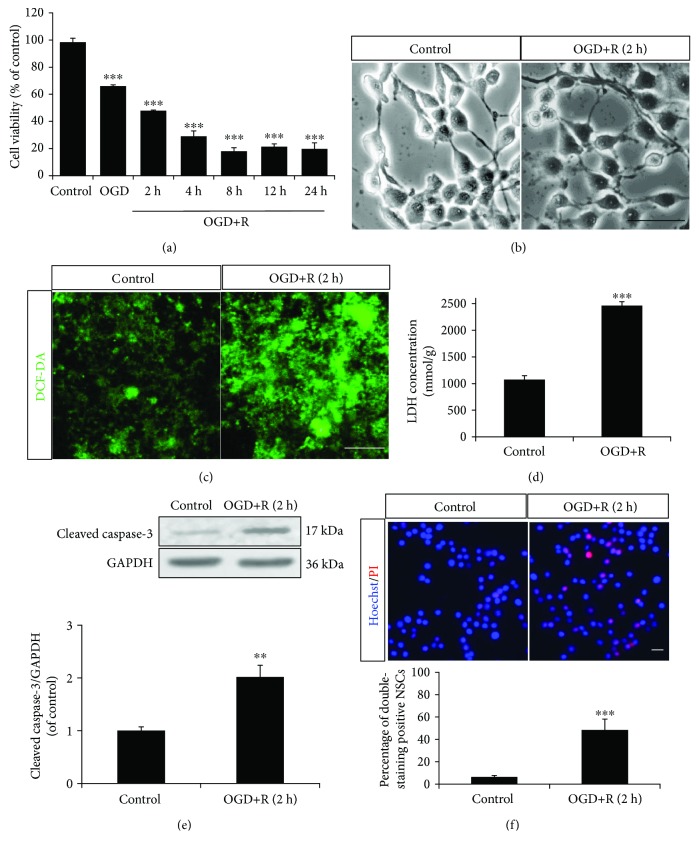
Figure 1
Figure 1
OGD/reoxygenation-induced NSC apoptosis. The NSCs cultured in the monolayer were subjected to OGD for 2 hours and reoxygenation for 2, 4, 8, 12, and 24 hours of induction. (a) Cell viability decreased relating to the duration of OGD/reoxygenation treatment through MTT assay. (b) The NSCs displayed an unhealthy morphology following OGD/reoxygenation induction. (c) The NSCs produced extra ROS with OGD/reoxygenation induction, according to DCF-DA fluorescence probe labelling. (d) The LDH of NSCs increased with OGD/reoxygenation induction, according to cellular LDH detection. (e) The protein expression of cleaved caspase-3 in NSCs was upregulated with OGD/reoxygenation induction, according to Western blotting. (f) OGD/reoxygenation treatment increased apoptosis of NSCs (Hoechst 33342/PI, double staining positive cells). ∗∗P < 0.01 and ∗∗∗P < 0.001 were considered to be significantly different between control and OGD or control and OGD+R groups. n = 3. Scale bar: 20 μm.
Figure 2
Figure 2
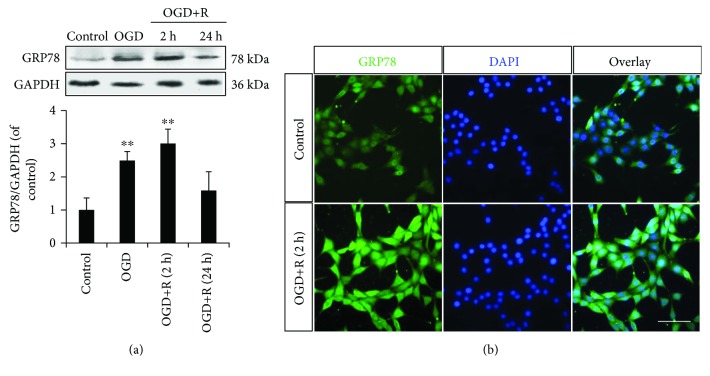
OGD/reoxygenation triggered GRP78 in NSCs. (a) The protein expression of GRP78 in NSCs was upregulated with OGD (2 h)/reoxygenation (2 h, 4 h), according to Western blotting. (b) Induced cytoplasm distribution of GRP78 around the nuclei in NSCs with OGD/reoxygenation treatment. ∗∗P < 0.01 was considered to be significantly different between control and OGD or control and OGD+R groups. n = 3. Scale bar: 20 μm.
Figure 3
Figure 3
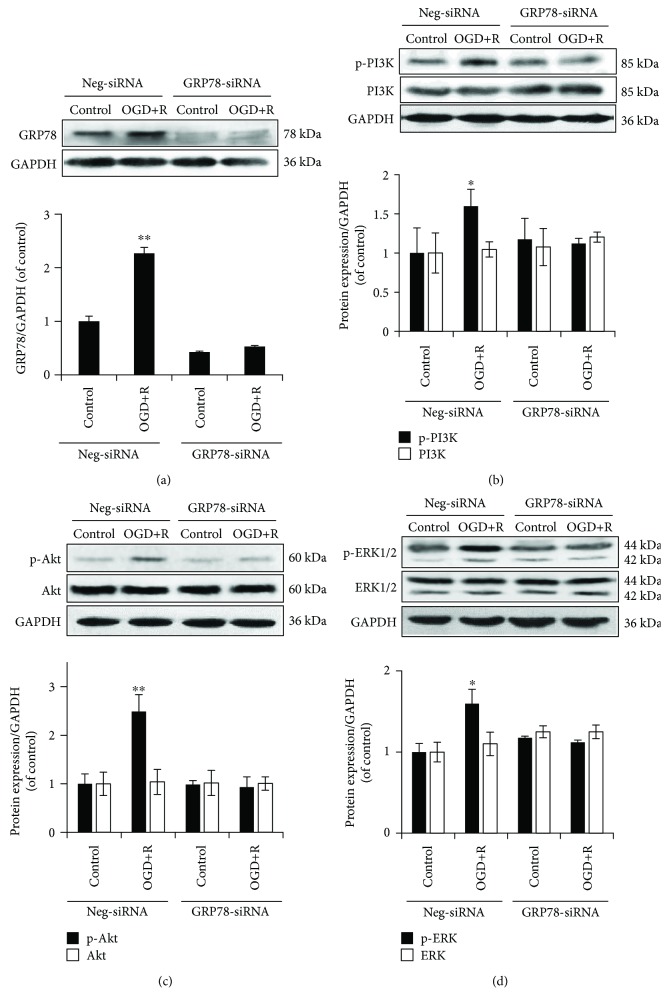
Role for GRP78 in OGD/reoxygenation-induced PI3K/Akt and ERK1/2 activations. (a) Protein expression of GRP78 in GRP78 knocked-down NSCs with OGD/reoxygenation induction, for siRNA transfecting efficiency determination. (b–d) Abolished phosphorylation of PI3K, Akt, and ERK1/2 by OGD+R induction in GRP78 knocked-down NSCs. GAPDH was used as an internal loading control. P < 0.05 and ∗∗P < 0.01 were considered to be significantly different in Neg-siRNA-control versus Neg-siRNA-OGD+R, Neg-siRNA-control versus GRP78-siRNA-control, and GRP78-siRNA-control and GRP78-siRNA-OGD+R groups. n = 3.
Figure 4
Figure 4
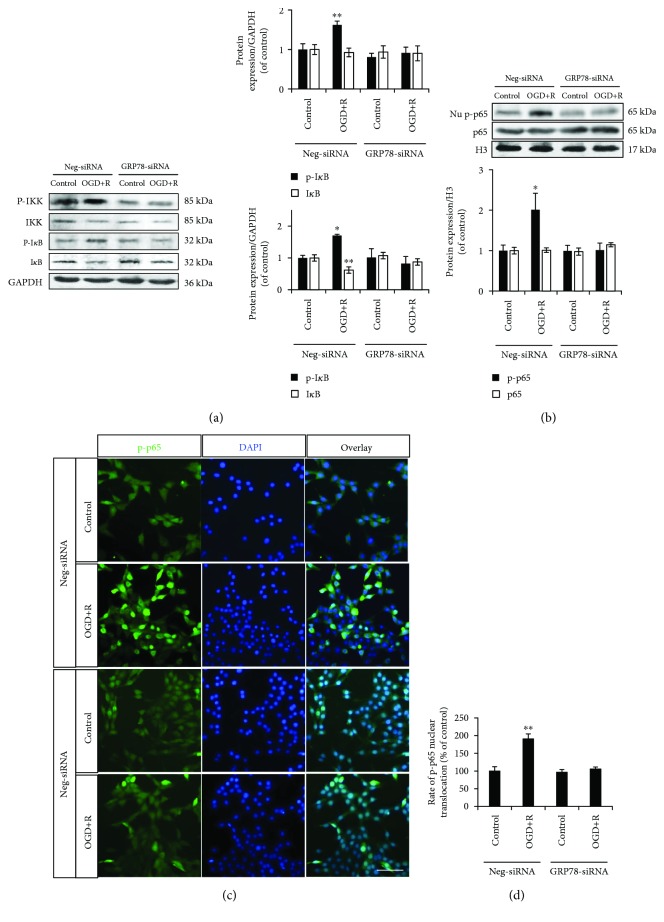
Role of GRP78 in OGD/reoxygenation-induced NF-κB/p65 activations. (a, b) Abolished phosphorylation of IKK, IκB, and p65 by OGD+R induction in GRP78 knocked-down NSCs. GAPDH was used as an internal loading control in whole cell lysate protein expression; H3 was used as an internal loading control in nuclear protein expression. (c, d) Abolished nuclear translocation of phospho-p65 by OGD+R induction in GRP78 knocked-down NSCs. P < 0.05 and ∗∗P < 0.01 was considered to be significantly different in Neg-siRNA-control versus Neg-siRNA-OGD+R, Neg-siRNA-control versus GRP78-siRNA-control, and GRP78-siRNA-control and GRP78-siRNA-OGD+R groups. n = 3. Scale bar: 20 μm.
Figure 5
Figure 5
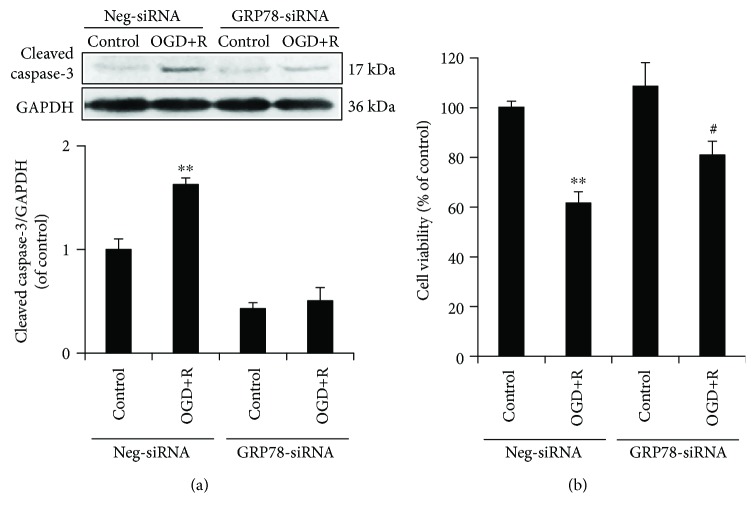
Role of GRP78 in OGD/reoxygenation-induced NSCs. (a) Abolished upregulation of cleaved caspase-3 by OGD+R in GRP78 knocked-down NSCs. (b) Attenuated cellular injury by OGD+R in GRP78 knocked-down NSCs. ∗∗P < 0.01 was considered to be significantly different between Neg-siRNA-control and Neg-siRNA-OGD+R groups; #P < 0.05 was considered to be significantly different between GRP78-siRNA-control versus GRP78-siRNA-OGD+R groups. n = 3.
Figure 6
Figure 6
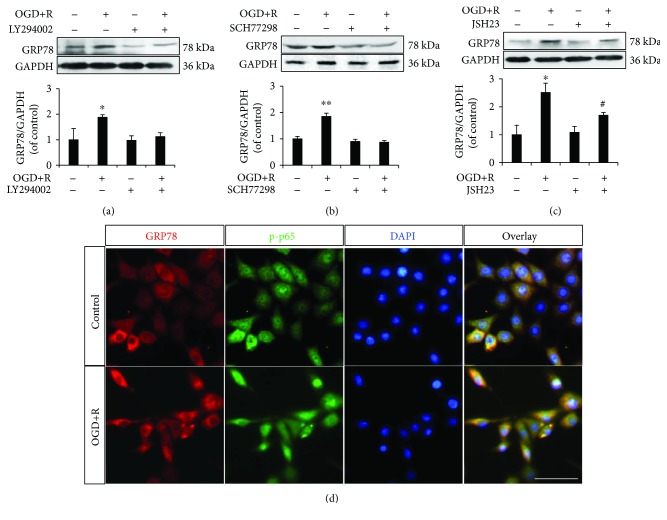
Role of PI3K/Akt, ERK1/2, and NF-κB/p65 in OGD/reoxygenation-triggered GRP78 upregulation. (a) Abolished upregulation of GRP78 by OGD+R in LY294002-treated NSCs; (b) abolished upregulation of GRP78 by OGD+R in SCH77298-treated NSCs; (c) upregulated GRP78 by OGD+R in either control or JSH23-pretreated NSCs; (d) cellular distribution and coactivation of GRP78 and phospho-p65 in OGD+R-induced NSCs. P < 0.05 and ∗∗P < 0.01 were considered to be significantly different between control and OGD+R groups; #P < 0.05 was considered to be significantly different between JSH23 and JSH23+OGD+R groups. n = 3. Scale bar: 20 μm.
Figure 7
Figure 7
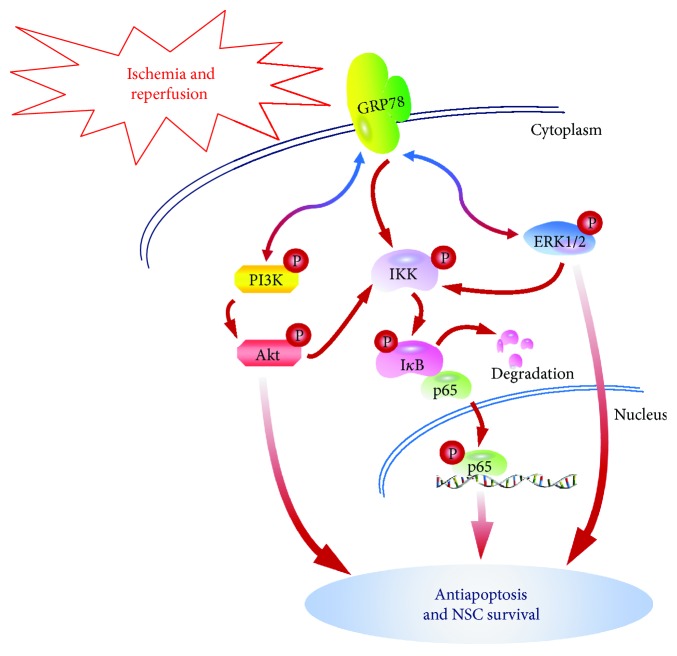
Diagram of GRP78-mediated NSC survival from OGD/reoxygenation-induced apoptosis through PI3K/Akt, ERK1/2, and NF-κB/p65. GRP78 in NSCs is triggered by OGD/reoxygenation. The signalling is transmitted through PI3K/Akt, ERK1/2, and NF-κB/p65 to cellular antiapoptosis and survival. Meanwhile, the activated PI3K/Akt and ERK1/2 in turn improve GRP78 upregulation. In summary, the bidirectional signalling transductions of GRP78-PI3K/Akt and GRP78-ERK1/2 and the one-way signalling transductions through GRP78 to NF-κB/p65 would contribute essentially to NSC survival from OGD/reoxygenation-induced apoptosis.

References

    1. Clarke D. L., Johansson C. B., Wilbertz J., et al. Generalized potential of adult neural stem cells. Science. 2000;288(5471):1660–1663. doi: 10.1126/science.288.5471.1660. - DOI - PubMed
    1. Zhang Z., Chopp M. Neural stem cells and ischemic brain. Journal of Stroke. 2016;18(3):267–272. doi: 10.5853/jos.2016.00206. - DOI - PMC - PubMed
    1. Ruddy R. M., Morshead C. M. Home sweet home: the neural stem cell niche throughout development and after injury. Cell and Tissue Research. 2018;371(1):125–141. doi: 10.1007/s00441-017-2658-0. - DOI - PubMed
    1. Song J., Cho K. J., Cheon S. Y., et al. Apoptosis signal-regulating kinase 1 (ASK1) is linked to neural stem cell differentiation after ischemic brain injury. Experimental & Molecular Medicine. 2013;45(12, article e69) doi: 10.1038/emm.2013.134. - DOI - PMC - PubMed
    1. Hetz C., Saxena S. ER stress and the unfolded protein response in neurodegeneration. Nature Reviews Neurology. 2017;13(8):477–491. doi: 10.1038/nrneurol.2017.99. - DOI - PubMed

Publication types

LinkOut - more resources