Review
. 2018 Apr 12:2018:8275256.
doi: 10.1155/2018/8275256. eCollection 2018.

The Role of Saikosaponins in Therapeutic Strategies for Age-Related Diseases

Affiliations
Review

The Role of Saikosaponins in Therapeutic Strategies for Age-Related Diseases

Byeong Mo Kim. Oxid Med Cell Longev. .

Abstract

As life expectancy increases, elderly populations tend to spend an increasing number of years in poor health, with chronic age-related diseases and disability. Therefore, the development of therapeutic strategies to treat or prevent multiple pathophysiological conditions in the elderly may improve health-adjusted life expectancy and alleviate the potential economic and social burdens arising from age-related diseases. Bioactive natural products might represent promising new drug candidates for the treatment of many chronic age-related diseases, including cancer, Alzheimer's disease, cardiovascular disease, obesity, and liver disease. Here, we discuss a therapeutic option using saikosaponins, which are triterpene saponins isolated from Bupleurum, against a variety of age-related diseases. Understanding the underlying mechanisms of natural products like saikosaponins in the treatment of age-related diseases may help in the development of diverse natural product-derived compounds that may be effective against a number of chronic health problems.


Figures
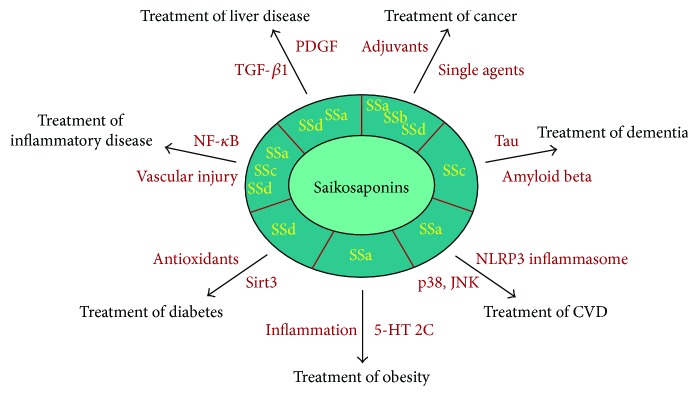
Figure 1
Figure 1
The use of saikosaponins and implications for age-related diseases. Several types of saikosaponins, such as saikosaponin a (SSa), saikosaponin b (SSb), saikosaponin c (SSc), and saikosaponin d (SSd), could be used to treat age-related diseases. SSa, SSb, and SSd may be used for the treatment of cancer as single anticancer or adjuvant agents. Inhibitory actions of saikosaponins against P-glycoprotein-mediated multidrug resistance are implicated in the ability of saikosaponins to sensitize cancer cells to chemotherapy or radiotherapy. SSc has dual effects on human Alzheimer's disease by targeting both tau and amyloid beta. SSa may slow or reverse the progression of atherosclerosis by inhibiting oxidized low-density lipoprotein-induced activation of p38 and the c-Jun N-terminal kinase mitogen-activated protein kinase pathway and assembly of the NLR family pyrin domain containing 3 inflammasome. SSa exerts antiobesity activity by acting as a 5-hydroxytryptamine 2C receptor agonist or by suppressing extracellular signal-regulated kinase/nuclear factor- (NF-) κB pathway-induced inflammation. SSd provides protection against diabetic nephropathy through the upregulation of Sirt3 followed by mitochondrial antioxidant enzymes like isocitrate dehydrogenase 2 and manganese-dependent superoxide dismutase. SSa, SSc, and SSd may be used for the treatment of inflammatory disorders, such as asthma, arthritis, and sepsis, by downregulating the NF-κB signaling pathway or inhibiting vascular injury/apoptosis. Lastly, SSa and SSd protect the liver against age-associated injury and fibrosis by suppressing cytokines, including platelet-derived growth factor and transforming growth factor-β1.

References

    1. Sakurai M. H., Matsumoto T., Kiyohara H., Yamada H. B-cell proliferation activity of pectic polysaccharide from a medicinal herb, the roots of Bupleurum falcatum L. and its structural requirement. Immunology. 1999;97(3):540–547. doi: 10.1046/j.1365-2567.1999.00774.x. - DOI - PMC - PubMed
    1. Yang Y. Y., Tang Y. Z., Fan C. L., Luo H. T., Guo P. R., Chen J. X. Identification and determination of the saikosaponins in Radix bupleuri by accelerated solvent extraction combined with rapid-resolution LC-MS. Journal of Separation Science. 2010;33(13):1933–1945. doi: 10.1002/jssc.201000100. - DOI - PubMed
    1. Bui T. T., Piao C. H., Song C. H., Shin H. S., Chai O. H. Bupleurum chinense extract ameliorates an OVA-induced murine allergic asthma through the reduction of the Th2 and Th17 cytokines production by inactivation of NFκB pathway. Biomedicine & Pharmacotherapy. 2017;91:1085–1095. doi: 10.1016/j.biopha.2017.04.133. - DOI - PubMed
    1. Ashour M. L., Wink M. Genus Bupleurum: a review of its phytochemistry, pharmacology and modes of action. Journal of Pharmacy and Pharmacology. 2011;63(3):305–321. doi: 10.1111/j.2042-7158.2010.01170.x. - DOI - PMC - PubMed
    1. Yang F., Dong X., Yin X., Wang W., You L., Ni J. Radix Bupleuri: a review of traditional uses, botany, phytochemistry, pharmacology, and toxicology. BioMed Research International. 2017;2017:22. doi: 10.1155/2017/7597596.7597596 - DOI - PMC - PubMed

MeSH terms

LinkOut - more resources
