Editorial
doi: 10.21037/jtd.2018.03.156.
APRV for ARDS: the complexities of a mode and how it affects even the best trials
Affiliations
- PMID: 29850185
- PMCID: PMC5949414
- DOI: 10.21037/jtd.2018.03.156
Item in Clipboard
Editorial
APRV for ARDS: the complexities of a mode and how it affects even the best trials
J Thorac Dis.
2018 Apr.
No abstract available
Conflict of interest statement
Conflicts of Interest: Eduardo Mireles-Cabodevila and Siddharth Dugar have no conflicts of interest to declare. Robert L. Chatburn is a consultant for IngMar Medical and Drive Medical.
Figures
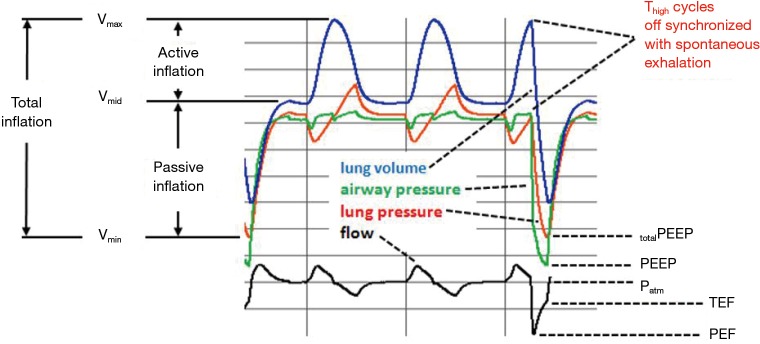
Spontaneous breaths superimposed on a mandatory breath during BiLevel mode with a PB 840 ventilator. When Thigh cycles off in synchrony with a spontaneous exhalation, actual Tlow becomes longer than set Tlow resulting in lower end expiratory lung volume and pressure. Patm, atmospheric pressure; TEF, terminal expiratory flow; PEF, peak expiratory flow.
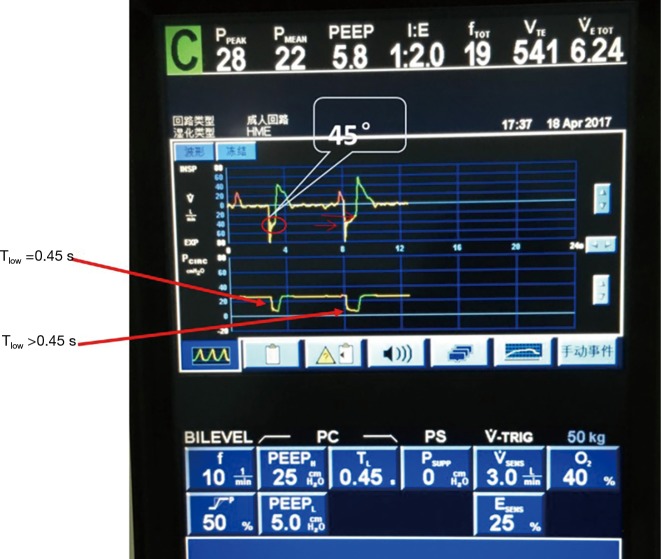
The supplemental material of the paper by Zhou et al. shows exactly this result as well (screen shot from supplemental material labeled as Figure S1 Case One). This screen shot of the PB 840 in BiLevel mode with ARPV settings shows the first breath has a Tlow set at 0.41 s, as indicated in the figure legend. However, the flow waveform for the second breath shows that due to synchrony of mandatory breath cycling with a spontaneous breath exhalation, the Tlow is considerably longer.
Comment on
-
Early application of airway pressure release ventilation may reduce the duration of mechanical ventilation in acute respiratory distress syndrome.Intensive Care Med. 2017 Nov;43(11):1648-1659. doi: 10.1007/s00134-017-4912-z. Epub 2017 Sep 22. Intensive Care Med. 2017. PMID: 28936695 Free PMC article.
References
Publication types
LinkOut - more resources
Full Text Sources
Other Literature Sources
Medical