


Lower limb blood flow and mean arterial pressure during standing and seated work: Implications for workplace posture recommendations
- PMID: 29850397
- PMCID: PMC5966524
- DOI: 10.1016/j.pmedr.2018.02.016
Lower limb blood flow and mean arterial pressure during standing and seated work: Implications for workplace posture recommendations
Abstract
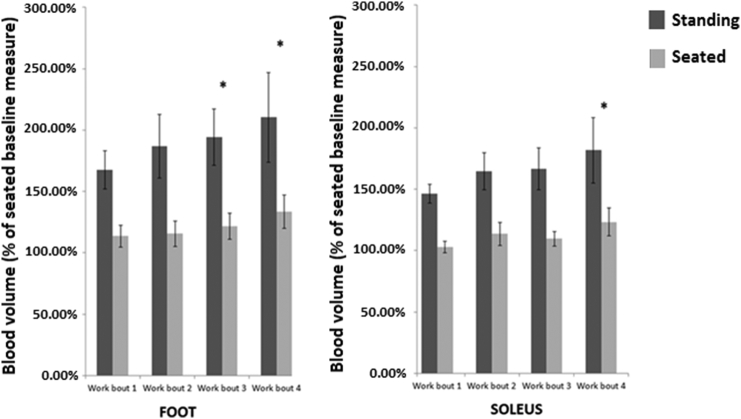
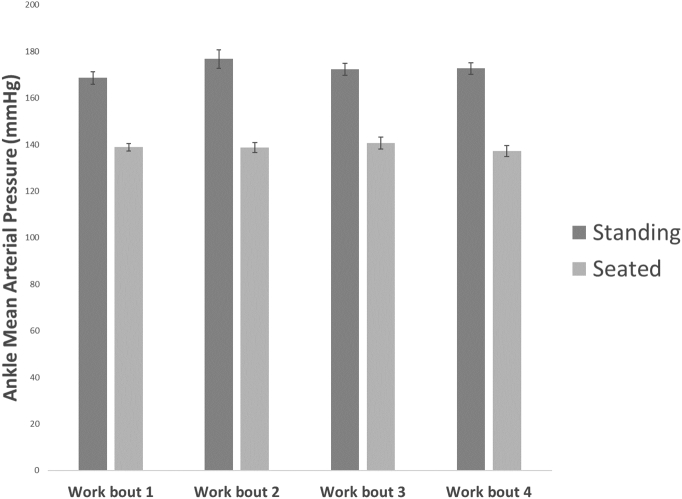
Sit-stand workstations are a popular workplace intervention. Organizations often require a medical professional's guidance for implementation. Therefore, it is important to understand potential negative outcomes associated with standing work, such as lower limb discomfort and peripheral vascular issues. The objective of this study was to compare changes in lower limb discomfort, blood pressure and blood flow accumulation during a light-load repetitive upper limb work task accomplished from seated and standing postures. At the Jewish Rehabilitation Hospital (Laval, Quebec, Canada), 16 participants were outfitted with Laser Doppler Flow (LDF) electrodes to measure blood flow in the lower limb, and a sphygmomanometer to measure lower limb mean arterial blood pressure (MAP). Participants completed simulated work over 34 min in standing and seated conditions. Repeated measures ANOVAs (Posture x Time) were used to assess the differences. There were significant effects for both Posture (p = 0.003) and Time (p = 0.007) for LDF-measured of blood flow accumulation in the soleus and the foot, with a mean increase of 77% blood flow over time in the standing posture, when compared to seated work. There was a significant 'Posture × Time' (p = 0.0034) interaction effect and a significant Posture (p = 0.0001) effect for MAP, with higher values in the standing posture by a mean of 37.2 mmHg. Posture had a significant effect (p < 0.001) on lower limb discomfort, with standing posture reporting higher levels. These results suggest that recommendations for using static standing work postures should be tempered, and physicians' guidance on workstation changes should consider the impacts on the lower limb.
Keywords: Lower limb discomfort; Sitting; Standing; Vascular outcomes; Work postures.
Figures
References
-
- Antle D.M., Côté J.N. Relationships between lower limb and trunk discomfort and vascular, muscular and kinetic outcomes during stationary standing work. Gait Posture. 2013;37:615–619. - PubMed
-
- Antle D.M., Vézina N., Côte J.N. Whistler Conference Centre; Whistler, BC, Canada: 2013. An Investigation of Vascular Outcomes and Reports of Discomfort in a Sit-Standing Work Posture, Association of Canadian Ergonomists 44th Annual Conference - From Sea to Sky: Expanding the Reach of Ergonomics.
-
- Antle D.M., Vézina N., Messing K., Côté J.N. Development of discomfort and vascular and muscular changes during a prolonged standing work task. Occup. Ergon. 2013;11:21–33.
-
- Antle D.M., Vézina N., Côté J.N. Comparing standing posture and use of a sit-stand stool: analysis of vascular, muscular and discomfort outcomes during simulated industrial work. Int. J. Ind. Ergon. 2015;45:98–106.
-
- Bergan J.J., Schmid-Schonbein G.W., Smith P.D.C., Nicolaides A.N., Boisseau M.R., Eklof B. Mechanisms of disease: chronic venous disease. N. Engl. J. Med. 2006;355:488–498. - PubMed
LinkOut - more resources
Full Text Sources
Other Literature Sources
