Review
. 2018 Apr;8(Suppl 1):S82-S96.
doi: 10.21037/cdt.2018.03.02.

Acute aortic syndromes and aortic emergencies

Affiliations
Review

Acute aortic syndromes and aortic emergencies

Vinit Baliyan et al. Cardiovasc Diagn Ther. 2018 Apr.

Abstract

Acute aortic syndrome (AAS) and emergencies are relatively uncommon but are considered as life threatening, potentially fatal conditions. Different forms of aortic emergencies/AAS are often clinically indiscernible. Prompt and accurate diagnosis of these entities significantly influences prognosis and guides therapy. We aim to elucidate the pertinent role that radiology plays in the management of acute aortic diseases, with contrast-enhanced computed tomography angiography (CTA) being the most rapid and robust imaging technique.

Keywords: Acute aortic syndrome (AAS); aortic aneurysm; aortic dissection (AD); aortic emergencies; aortic rupture.


Conflict of interest statement

Conflicts of Interest: The authors have no conflicts of interest to declare.

Figures
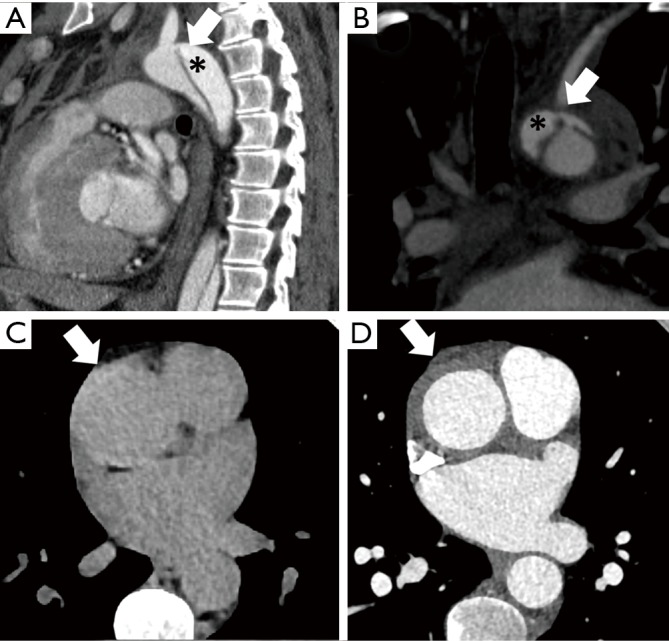
Figure 1
Figure 1
Terminology of AAS. (A,B) AAS starts with a tear in intima (arrows), when it leads to dissection of vascular media and distal reentry tears, the FL remains patent (asterisk) and is termed as classic dissection; (C,D) in absence of reentry tears, the dissecting blood may undergo complete thrombosis and form an intramural hematoma (arrows). AAS, acute aortic syndrome; FL, true lumen.
Figure 2
Figure 2
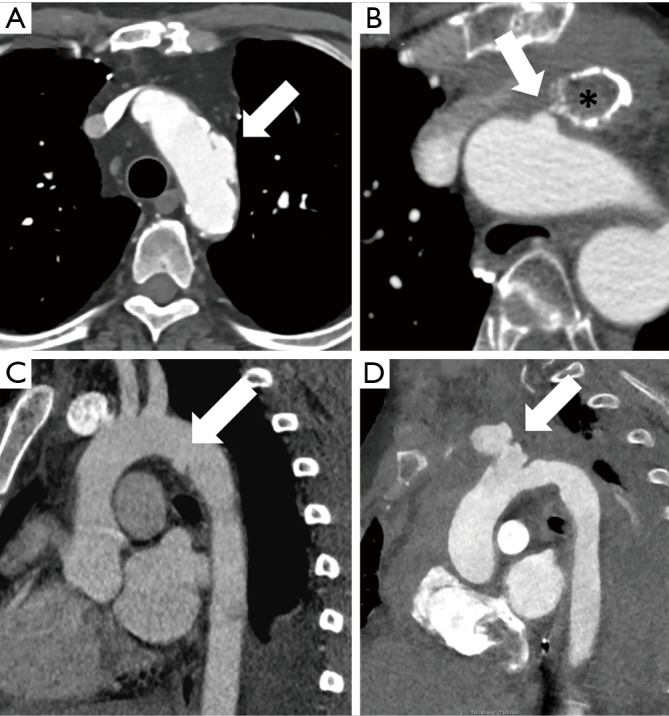
An intimal tear can remain localized and form a penetrating ulcer (A; arrow). Pseudo-aneurysm refers to a blood-filled sac arising from the vascular wall and lacks a tri-layer wall (B; arrow). It shows a contrast filled outpouching arising from the anterior aspect of aortic arch as a result of traumatic injury (displaced clavicle; asterisk). Focal dissection refers to an intimomedial tear without intramural separation (C; arrow). Aortic transection refers to trans-mural discontinuity of the aortic wall and is generally associated with a hematoma which can be contained (D; arrow) in the mediastinum or freely communicate with body cavities such as pleural or pericardial spaces.
Figure 3
Figure 3
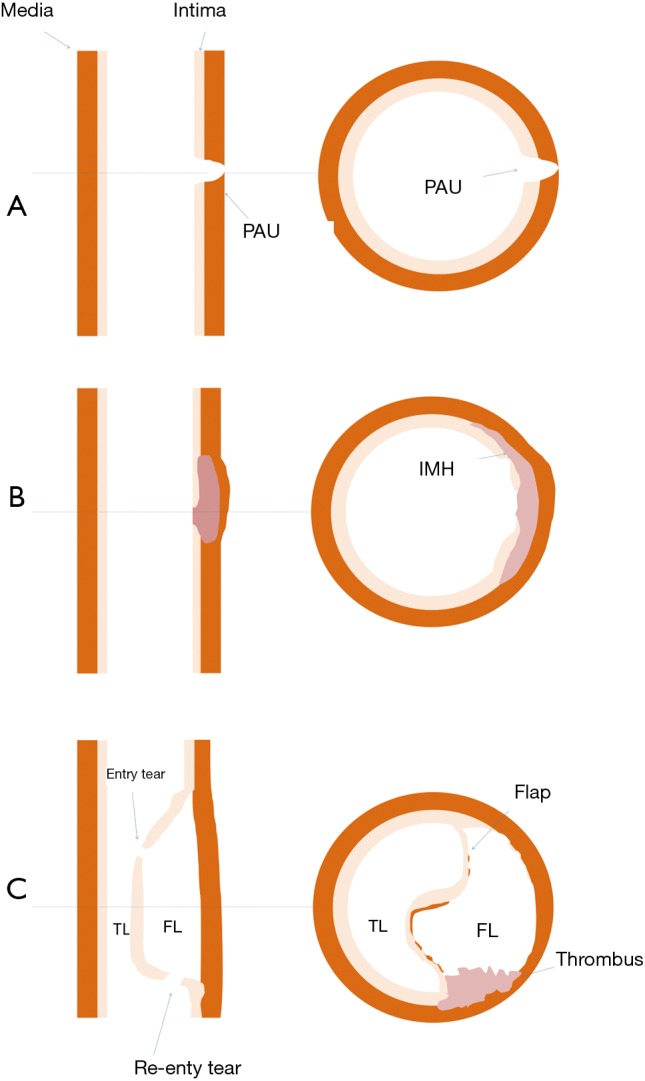
Illustrative demonstration of different types of AAS. Disruption of media layer of the aortic wall is a common feature to AD, IMH, PAU. (A) PAU is an ulcerated plaque that has extended into the vascular media. There is a common pathophysiologic mechanism between IMH (B) and AD (C). AD results from splitting of the layers of aortic wall with an entrance tear. An intimal flap separates the TL, which is continuous with the non-dissected aortic segment, from the FL. The only difference between the two being the presence of a re-entrance tear large enough to maintain the patency of a FL in AD. FL can have variable degree of thrombus depending on the flow dynamics. AAS, acute aortic syndrome; TL, true lumen; AD, aortic dissection; IMH, intramural hematoma; PAU, penetrating aortic ulcer; FL, true lumen.
Figure 4
Figure 4
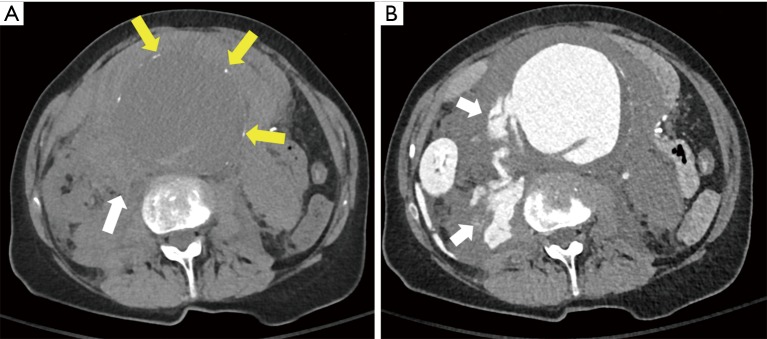
Axial non-contrast CT image (A) demonstrates a large abdominal aortic aneurysm with calcifications along the intima (yellow arrows) and indistinct surrounding fat planes (white arrow). Arterial phase image (B) shows a focal discontinuity in the aortic wall with frank extravasation of intravenous contrast into the retroperitoneum (arrows).
Figure 5
Figure 5
Detection of abdominal aortic aneurysm and dissection by ultrasound. Ultrasound images (A,B,C) in oblique sagittal planes demonstrate a dissection flap within the proximal abdominal aorta (arrows) that was confirmed on follow-up CTA (sagittal, D; arrow) and (axial, E; arrow). CTA, computed tomography angiography.
Figure 6
Figure 6
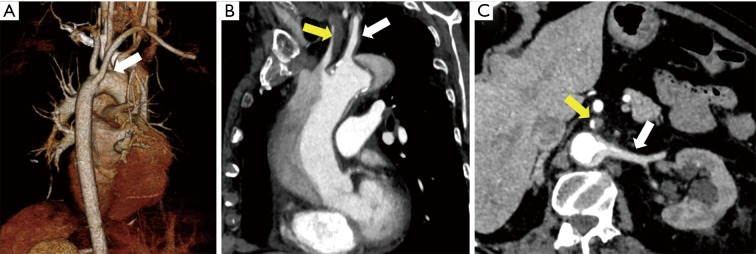
CTA is an excellent modality for delineating vascular anatomy and can depict normal variants or dissection flap extensions with sub-millimeter resolution. Volume rendered CT image (A) shows an aberrant right subclavian artery (arrow). Coronal oblique CTA image from a different patient (B) demonstrates a type A dissection starting from the aortic root and extending into the left common carotid (yellow arrow) and subclavian arteries (white arrow). It further (C) extends into the superior mesenteric artery (yellow arrow) causing moderate vascular stenosis. The left renal artery is arising from the FL (white arrow) causing hypoenhancing left kidney. CTA, computed tomography angiography; FL, true lumen.
Figure 7
Figure 7
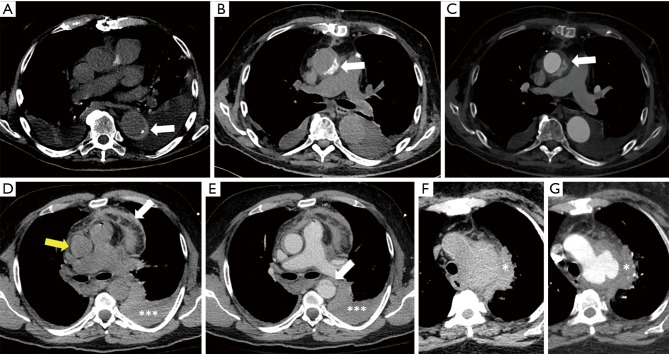
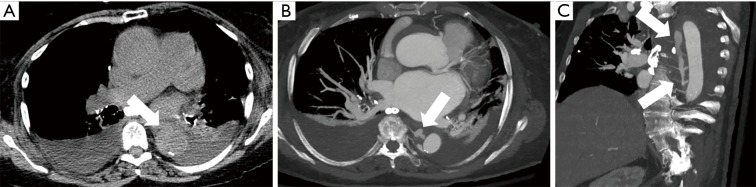
Utility of acquiring non-contrast CT for all patients with suspected AAS. It is valuable in detecting acute intramural hematomas that appear as crescentic hyperdensity with inward displacement of the medial calcification, when present (A; arrow). It is also helpful in discriminating hyper dense structures such as calcifications and surgical graft material (B,C; arrows) from contrast extravasation. On an arterial phase (C) alone, it can be mistaken as hyperdensity due to active contrast leak. Hyperdense acute intramural hematoma (D,E; yellow arrow), hemopericardium (D; white arrow), hemothorax (D,E; asterisks) and mediastinal hematoma (F,G; asterisk) also appear conspicuous on non-contrast images. AAS, acute aortic syndrome.
Figure 8
Figure 8
Delayed phase CT images are helpful in differentiating thrombus from slow flow. Axial arterial phase CTA image (A) shows hypo-enhancement within the FL (arrow), which shows homogeneous enhancement on delayed phase (B) suggesting slow flow hemodynamics (arrow). CTA, computed tomography angiography; FL, true lumen.
Figure 9
Figure 9
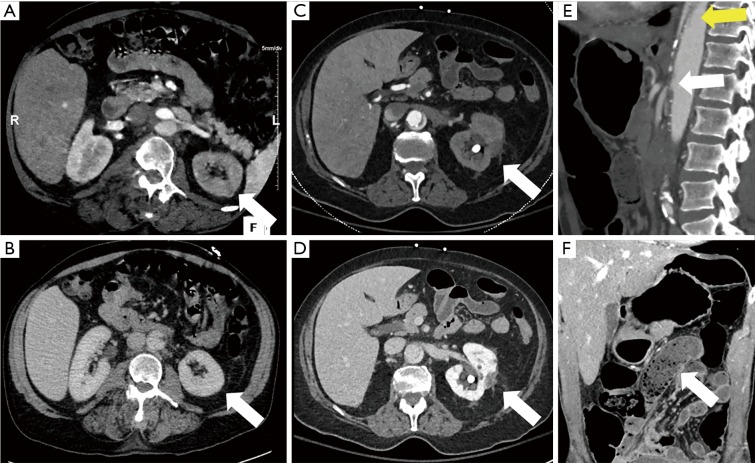
Delayed phase CT images are helpful in assessing end-organ perfusion. Axial arterial phase image (A) shows extension of dissection flap into the left renal artery with left renal parenchymal enhancement (arrow). The left kidney shows homogenous enhancement on delayed phase (B; arrow) similar to the right kidney indicating delayed perfusion. A few areas in the hypoperfused kidneys on arterial image (C; arrow) fail to enhance on delayed phase (D; arrow) suggestive of focal renal infarcts. Sagittal CTA image (E) demonstrates a severely compromised true lumen (yellow arrow) with compression and narrowing at SMA ostium (white arrow). Coronal venous phase image shows a dilated jejunal loop with hypoenhancing walls (F; arrow), suggestive of bowel ischemia. CTA, computed tomography angiography; FL, true lumen.
Figure 10
Figure 10
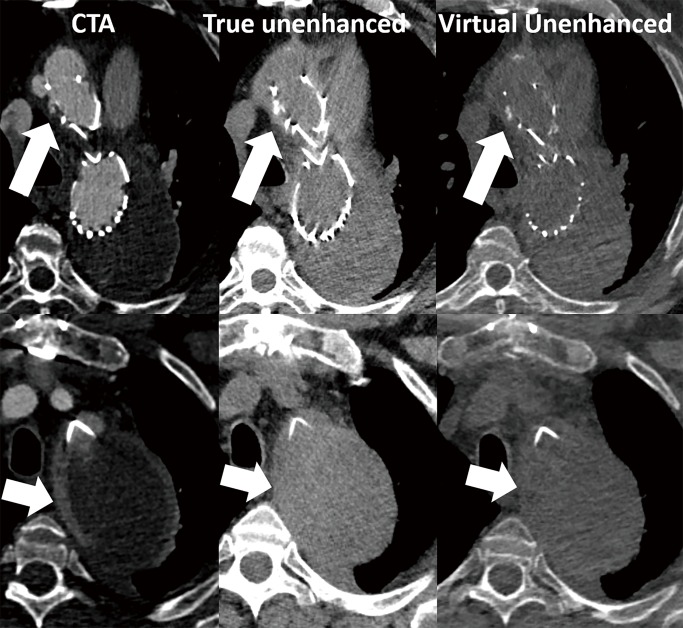
DECT angiography in a patient with endograft repair and type III endoleak. There is a small focus of hyper density in relation to the proximal landing zone, which could be mistaken for a type Ia endoleak/extravasation. The TNC images are helpful in differentiating the hyper density from contrast vs. calcification/graft material (top panel, arrows). The VNC and reconstruction images accurately identify the hyperdensity as non-iodine containing. VNC are also comparable to TNC in characterizing the hyper density in the FL as iodinated contrast (bottom panel, arrows). DECT, dual-energy computed tomography; TNC, true non-contrast; VNC, virtual non-contrast.
Figure 11
Figure 11
Axial non-contrast CT (A) shows a hyperdense crescentic IMH with displacement of medial calcification (arrow). There is intramural blood pool within the hematoma communicating with the intercostal arteries and aortic lumen (B,C; arrows). Ulcer-like out pouching and intramural blood pool suggest high risk for progression and its presence should be informed to physicians. IMH, intramural hematoma.
Figure 12
Figure 12
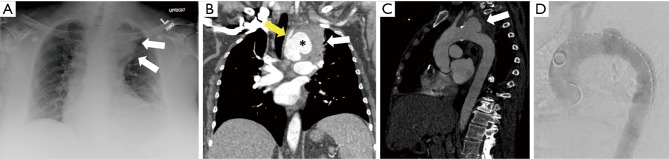
Radiograph of a 60-year-old female with a history of diabetes mellitus and hypertension and recent onset chest pain. Radiograph reveals mediastinal widening (A; arrows) and CTA reveals large aortic pseudoaneurysm (B; asterisk) distal to the origin of the left subclavian artery (B,C; arrows). Patient underwent an endovascular repair (D). CTA, computed tomography angiography.
Figure 13
Figure 13
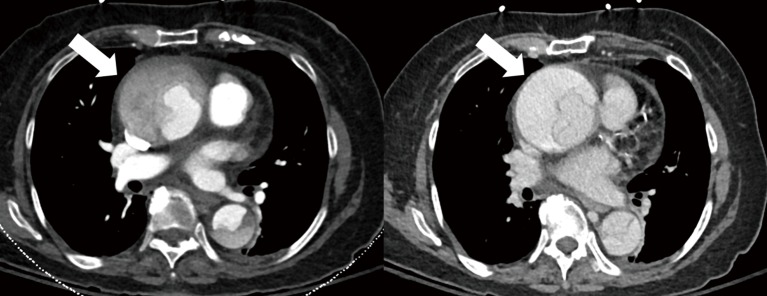
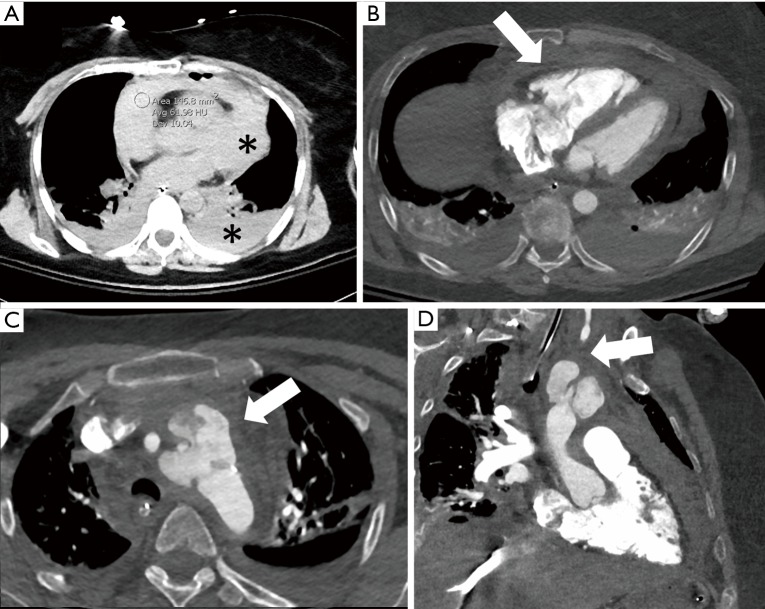
CT in a victim of high-velocity motor vehicle trauma demonstrates high density mediastinal hematoma with high density pleural and pericardial effusions (A; asterisks). Axial CTA image (B) reveals a dilated right ventricle that appears larger than left ventricle due to left-ward displacement of the interventricular septum suggestive of tamponade (arrow). There was a transected aortic arch (C,D) with surrounding contained pseudoaneurysm/hematoma (C; arrow), which was compressing the proximal left common carotid artery (D; arrow). CTA, computed tomography angiography.

References

    1. Morris JH, Mix D, Cameron SJ. Acute Aortic Syndromes: Update in Current Medical Management. Curr Treat Options Cardiovasc Med 2017;19:29. 10.1007/s11936-017-0523-9 - DOI - PubMed
    1. Lansman SL, Saunders PC, Malekan R, et al. Acute aortic syndrome. J Thorac Cardiovasc Surg 2010;140:S92-7. 10.1016/j.jtcvs.2010.07.062 - DOI - PubMed
    1. Howard DP, Banerjee A, Fairhead JF, et al. Population-based study of incidence and outcome of acute aortic dissection and premorbid risk factor control: 10-year results from the Oxford Vascular Study. Circulation 2013;127:2031-7. 10.1161/CIRCULATIONAHA.112.000483 - DOI - PMC - PubMed
    1. Mussa FF, Horton JD, Moridzadeh R, et al. Acute Aortic Dissection and Intramural Hematoma: A Systematic Review. JAMA 2016;316:754-63. 10.1001/jama.2016.10026 - DOI - PubMed
    1. Nienaber CA, Powell JT. Management of acute aortic syndromes. Eur Heart J 2012;33:26-35b. 10.1093/eurheartj/ehr186 - DOI - PubMed

LinkOut - more resources