


A framework for healthcare interventions to address maternal morbidity
- PMID: 29851114
- PMCID: PMC6001624
- DOI: 10.1002/ijgo.12469
A framework for healthcare interventions to address maternal morbidity
Abstract
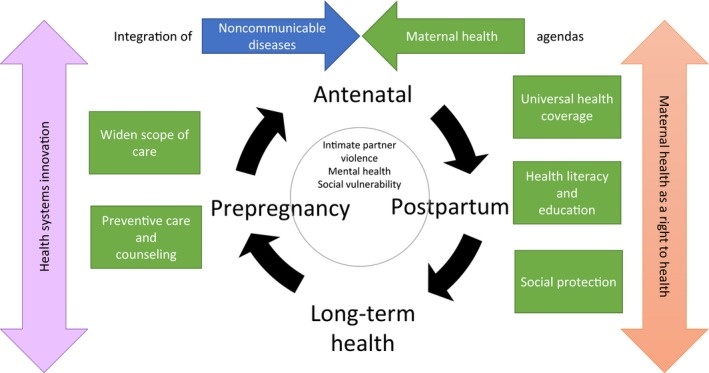
The maternal health agenda is undergoing a paradigm shift from preventing maternal deaths to promoting women's health and wellness. A critical focus of this trajectory includes addressing maternal morbidity and the increasing burden of chronic and noncommunicable diseases (NCD) among pregnant women. The WHO convened the Maternal Morbidity Working Group (MMWG) to improve the scientific basis for defining, measuring, and monitoring maternal morbidity. Based on the MMWG's work, we propose paradigms for conceptualizing maternal health and related interventions, and call for greater integration between maternal health and NCD programs. This integration can be synergistic, given the links between chronic conditions, morbidity in pregnancy, and long-term health. Pregnancy should be viewed as a window of opportunity into the current and future health of women, and offers critical entry points for women who may otherwise not seek or have access to care for chronic conditions. Maternal health services should move beyond the focus on emergency obstetric care, to a broader approach that encompasses preventive and early interventions, and integration with existing services. Health systems need to respond by prioritizing funding for developing integrated health programs, and workforce strengthening. The MMWG's efforts have highlighted the changing landscape of maternal health, and the need to expand the narrow focus of maternal health, moving beyond surviving to thriving.
Keywords: Healthcare interventions; Maternal morbidity; Noncommunicable diseases; Pregnancy complications.
© 2018 World Health Organization; licensed by John Wiley & Sons Ltd on behalf of International Federation of Gynecology and Obstetrics.
Figures
References
-
- World Health Organization, United Nations Children's Fund, United Nations Population Fund, World Bank Group . Trends in Maternal Mortality to 2015: Estimates by WHO, UNICEF, UNFPA. World Bank Group and the United Nations Population Division. Geneva: WHO; 1990:2015.
-
- Every Woman Every Child . Global Strategy for Women's, Children's and Adolescents’ Health, 2016–2030: Survive, Thrive, Transform. 2015. http://www.who.int/life-course/partners/global-strategy/ewec-globalstrat.... Accessed December 19, 2017.
-
- Souza JP, Tunçalp Ö, Vogel JP, et al. Obstetric transition: The pathway towards ending preventable maternal deaths. BJOG. 2014;121(Suppl.1):1–4. - PubMed
-
- World Health Organization . Global Status Report on Noncommunicable Diseases 2010. Geneva: WHO; 2011.
Publication types
MeSH terms
Grants and funding
LinkOut - more resources
Full Text Sources
Other Literature Sources
Medical
Miscellaneous
