


Diaphragmatic ultrasonography for predicting ventilator weaning: A meta-analysis
- PMID: 29851847
- PMCID: PMC6392953
- DOI: 10.1097/MD.0000000000010968
Diaphragmatic ultrasonography for predicting ventilator weaning: A meta-analysis
Abstract
Background: Weaning failure is common in mechanically ventilated patients. Whether ultrasound can predict weaning outcome remains controversial. This meta-analysis was performed to assess the accuracy of diaphragmatic ultrasonography for predicting reintubation within 48 hours of extubation.
Methods: Literature search was performed in PubMed, Embase, and Cochrane Library to identify all the relevant papers, published in English up to July 16, 2017. Eligible studies were included if data were in adequate details to rebuild 2 × 2 contingency tables. Methodological quality of the included studies was evaluated using the Quality Assessment of Diagnostic Accuracy Studies-2 (QUADAS-2) in Review Manager 5.3. The sensitivity, specificity, positive likelihood ratio (PLR), negative likelihood ratio (NLR), diagnostic odds ratio (DOR), and summary receiver operating characteristic (SROC) curve were pooled using the fixed or random effects model, meanwhile, the heterogeneity was evaluated using Cochran Q test and I statistics in Meta-DiSc 1.4. Publication bias was assessed using Deeks funnel plot in Stata 12.0.
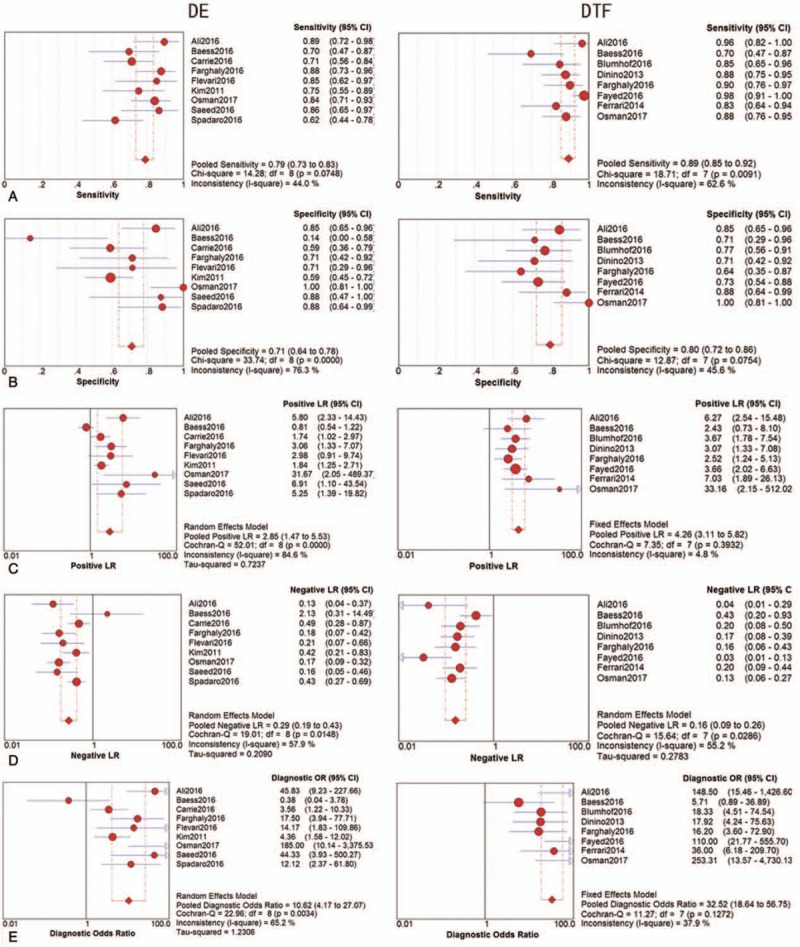
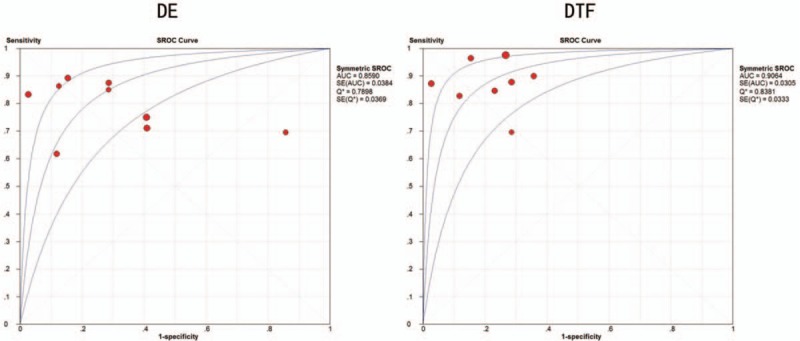
Results: Thirteen studies with 742 subjects were included in this meta-analysis. The pooled sensitivities for diaphragm excursion (DE) and diaphragm thickness fraction (DTF) were 0.786 and 0.893, and the pooled specificities were 0.711 and 0.796, respectively. The area under curve (AUC) for DE and DTF were 0.8590 and 0.8381. The DORs for DE and DTF were 10.623 and 32.521. No publication bias was observed among these studies.
Conclusions: Diaphragmatic ultrasonography is a promising tool for predicting reintubation within 48 hours of extubation. However, due to heterogeneities among the included studies, large-scale studies are warranted to confirm our findings.
Conflict of interest statement
The authors have no conflicts of interest to disclose.
Figures


References
-
- Flevari A, Lignos M, Konstantonis D, et al. Diaphragmatic ultrasonography as an adjunct predictor tool of weaning success in patients with difficult and prolonged weaning. Minerva Anestesiol 2016;82:1149–57. - PubMed
-
- Epstein SK. Extubation. Respir Care 2002;47:483–92. - PubMed
-
- Esteban A, Anzueto A, Frutos F, et al. Characteristics and outcomes in adult patients receiving mechanical ventilation: a 28-day international study. JAMA 2002;287:345–55. - PubMed
-
- Funk G, Anders S, Breyer M, et al. Incidence and outcome of weaning from mechanical ventilation according to new categories. Eur Respir J 2010;35:88–94. - PubMed
Publication types
MeSH terms
LinkOut - more resources
Full Text Sources
Other Literature Sources
Medical
