


Associations of physical strength with facial shape in an African pastoralist society, the Maasai of Northern Tanzania
- PMID: 29852024
- PMCID: PMC5978875
- DOI: 10.1371/journal.pone.0197738
Associations of physical strength with facial shape in an African pastoralist society, the Maasai of Northern Tanzania
Abstract
Objectives: Previous research has documented associations of physical strength and facial morphology predominantly in men of Western societies. Faces of strong men tend to be more robust, are rounder and have a prominent jawline compared with faces of weak men. Here, we investigate whether the morphometric patterns of strength-face relationships reported for members of industrialized societies can also be found in members of an African pastoralist society, the Maasai of Northern Tanzania.
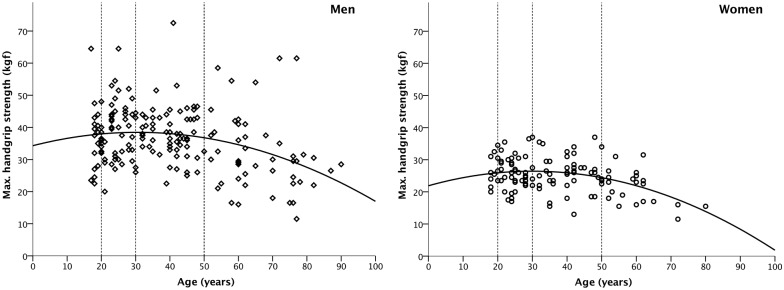
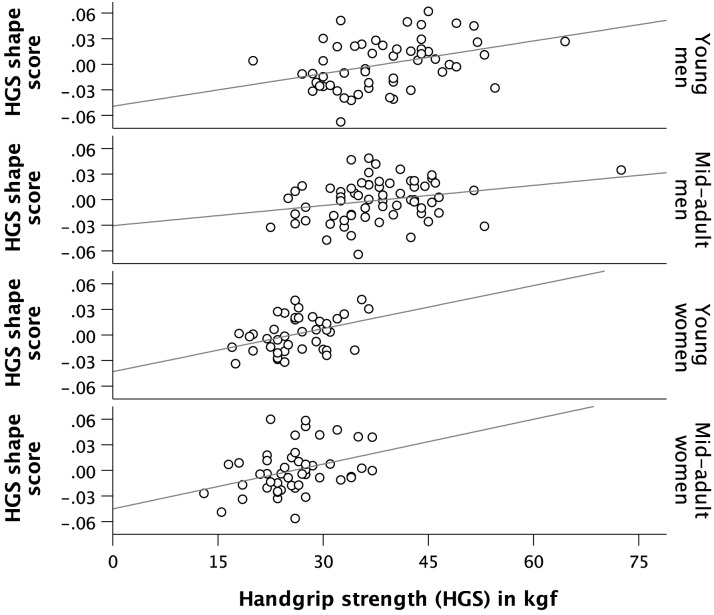
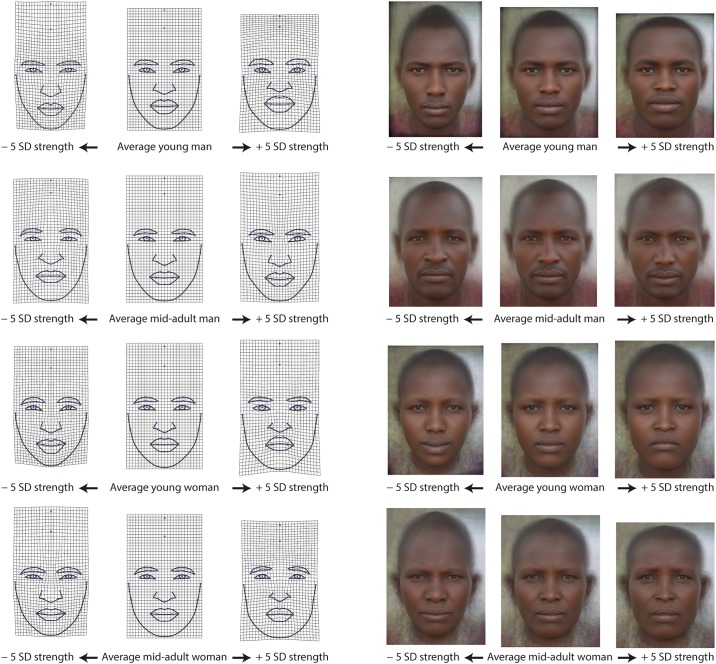
Materials and methods: Handgrip strength (HGS) measures and facial photographs were collected from a sample of 185 men and 120 women of the Maasai in the Ngorongoro Conservation Area. In young-adults (20-29 years; n = 95) and mid-adults (30-50 years; n = 114), we digitized 71 somatometric landmarks and semilandmarks to capture variation in facial morphology and performed shape regressions of landmark coordinates upon HGS. Results were visualized in the form of thin-plate plate spline deformation grids and geometric morphometric morphs.
Results: Individuals with higher HGS tended to have wider faces with a lower and broader forehead, a wider distance between the medial canthi of the eyes, a wider nose, fuller lips, and a larger, squarer lower facial outline compared with weaker individuals of the same age-sex group. In mid-adult men, these associations were weaker than in the other age-sex groups.
Discussion: We conclude that the patterns of HGS relationships with face shape in the Maasai are similar to those reported from related investigations in samples of industrialized societies. We discuss differences between the present and related studies with regard to knowledge about the causes for age- and sex-related facial shape variation and physical strength associations.
Conflict of interest statement
The authors have declared that no competing interests exist.
Figures
References
-
- Terrence H, Robert WS, Andrew SJ. Sex difference in strength. Am J Sports Med. 1979;7(4):265–7. doi: 10.1177/036354657900700415 - DOI - PubMed
-
- Komi PV, Karlsson J. Skeletal muscle fibre types, enzyme activities and physical performance in young males and females. Acta Physiol Scand. 1978;103(2):210–8. doi: 10.1111/j.1748-1716.1978.tb06208.x - DOI - PubMed
-
- Lassek WD, Gaulin SJC. Costs and benefits of fat-free muscle mass in men: relationship to mating success, dietary requirements, and native immunity. Evol Hum Behav. 2009;30:322–8. doi: 10.1016/j.evolhumbehav.2009.04.002 - DOI
-
- Miller A, MacDougall J, Tarnopolsky M, Sale D. Gender differences in strength and muscle fiber characteristics. Eur J Appl Physiol. 1993;66:254–62. - PubMed
-
- Frederiksen H, Gaist D, Christian Petersen H, Hjelmborg J, McGue M, Vaupel JW, et al. Hand grip strength: A phenotype suitable for identifying genetic variants affecting mid- and late-life physical functioning. Genet Epidemiol. 2002;23(2):110–22. doi: 10.1002/gepi.1127 - DOI - PubMed
Publication types
MeSH terms
Associated data
Grants and funding
LinkOut - more resources
Full Text Sources
Other Literature Sources
