Review
. 2019 Feb:122:83-93.
doi: 10.1016/j.nbd.2018.05.012. Epub 2018 May 28.

TFEB dysregulation as a driver of autophagy dysfunction in neurodegenerative disease: Molecular mechanisms, cellular processes, and emerging therapeutic opportunities

Affiliations
Review

TFEB dysregulation as a driver of autophagy dysfunction in neurodegenerative disease: Molecular mechanisms, cellular processes, and emerging therapeutic opportunities

Constanza J Cortes et al. Neurobiol Dis. 2019 Feb.

Abstract

Two decades ago, the recognition of protein misfolding and aggregate accumulation as defining features of neurodegenerative disease set the stage for a thorough examination of how protein quality control is maintained in neurons and in other non-neuronal cells in the central nervous system (CNS). Autophagy, a pathway of cellular self-digestion, has emerged as especially important for CNS proteostasis, and autophagy dysregulation has been documented as a defining feature of neurodegeneration in Alzheimer's disease (AD), Parkinson's disease (PD), and Huntington's disease (HD). Transcription factor EB (TFEB) is one of the main transcriptional regulators of autophagy, as it promotes the expression of genes required for autophagosome formation, lysosome biogenesis, and lysosome function, and it is highly expressed in CNS. Over the last 7 years, TFEB has received considerable attention and TFEB dysfunction has been implicated in the pathogenesis of numerous neurodegenerative disorders. In this review, we delineate the current understanding of how TFEB dysregulation is involved in neurodegeneration, highlighting work done on AD, PD, HD, X-linked spinal & bulbar muscular atrophy, and amyotrophic lateral sclerosis. Because TFEB is a central node in defining autophagy activation status, efforts at understanding the basis for TFEB dysfunction are yielding insights into how TFEB might be targeted for therapeutic application, which may represent an exciting opportunity for the development of a treatment modality with broad application to neurodegeneration.

Keywords: Alzheimer's disease; Amyotrophic lateral sclerosis; Autophagy; Huntington's disease; Lysosome; Neurodegeneration; Parkinson's disease; Polyglutamine; Spinal & bulbar muscular atrophy; Synucleinopathy; Transcription factor EB.


Figures

Figure 1.
Figure 1.. Autophagy Dysfunction in Neurodegenerative Disease
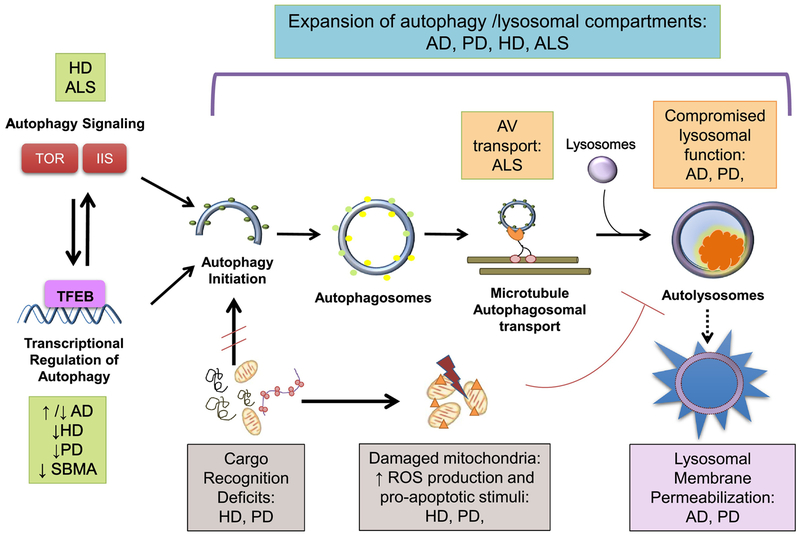
Increased numbers of autophagic vesicles (AVs) are a common finding for many neurodegenerative disorders, including Alzheimer’s disease (AD), Parkinson’s disease (PD), Huntington’s disease (HD), X-linked spinal & bulbar muscular atrophy (SBMA), and amyotrophic lateral sclerosis (ALS). However, different molecular mechanisms account for the observed autophagy pathway dysfunction in these neurodegenerative disorders. 1) Autophagy signaling pathways are impaired in HD, ALS, and in the aging brain, with the mechanistic target of rapamycin (TOR) and insulin/IGF1 signaling (IIS) being significantly impacted. 2) Autophagy transcriptional network activity decreases in HD, PD, and in the aging brain. Contradictory to these findings, some evidence suggests up-regulation of autophagy genes in AD. Alterations in the master autophagy regulator transcription factor E-B (TFEB) signaling have been reported for PD, HD, and SBMA. 3) Deficits in cargo recognition, particularly of defective mitochondria, occur in HD and PD. The accumulation of damaged mitochondria generates an increased burden of reactive-oxygen species (ROS), which compromises lysosomal function and culminates in lysosomal permeabilization and leakage of lysosomal contents into the cytoplasm. Accumulation of ‘empty’ autophagosomes in HD also compromises neuronal homeostasis. 4) Despite normal autophagy induction and autophagosome formation, impaired maturation and microtubule-transport of autophagic vacuoles (AVs) towards lysosomes is a feature of ALS. 5) Lysosomal dysfunction contributes to autophagy dysregulation in AD and HD, especially as proteostasis clearance mechanisms decline with age. Accumulation of undigested cargo in the lysosomal lumen (e.g. organelles, liposfuscin) further impairs the lysosome’s degradative ability, enhancing lysosomal membrane destabilization and leakage.
Figure 2.
Figure 2.. TFEB dysregulation in Neurodegenerative Disease
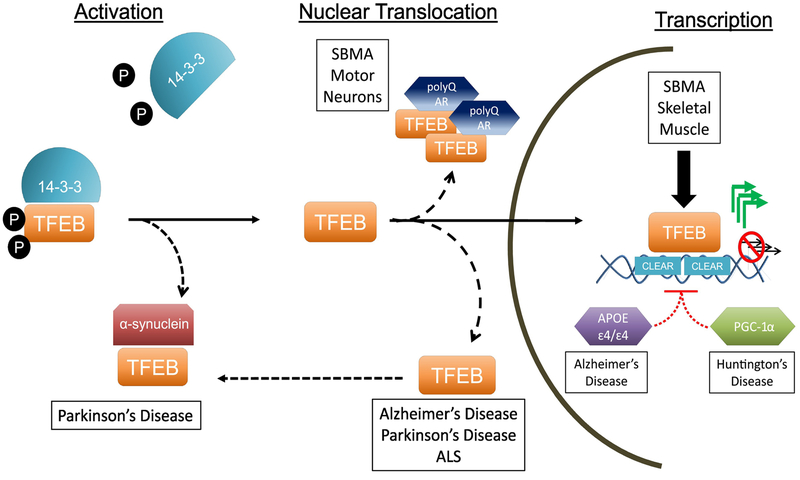
TFEB function is tightly regulated at three distinct steps: its own activation, nuclear translocation, and transcription activity at its target genes. In its inactive form, phosphorylated TFEB interacts with 14–3–3 proteins, remaining sequestered in the cytosol. Upon activation (under conditions of lysosomal stress or mTOR inhibition), TFEB is dephosphorylated and dissociates from the 14–3–3 complex, unmasking its nuclear localization signal. TFEB can now translocate into the nucleus, driving transcription of the CLEAR network of target genes. Several of these steps have been reported to be dysfunctional in neurodegenerative disease, including TFEB sequestration (in PD), nuclear exclusion (in SBMA, AD, PD, and ALS) and transcription incompetence (in SBMA, AD, and HD). These observations indicate that TFEB dysregulation is a defining feature of neurodegenerative proteinopathies.
Figure 3.
Figure 3.. Non cell-autonomous dysregulation of TFEB in neurodegeneration
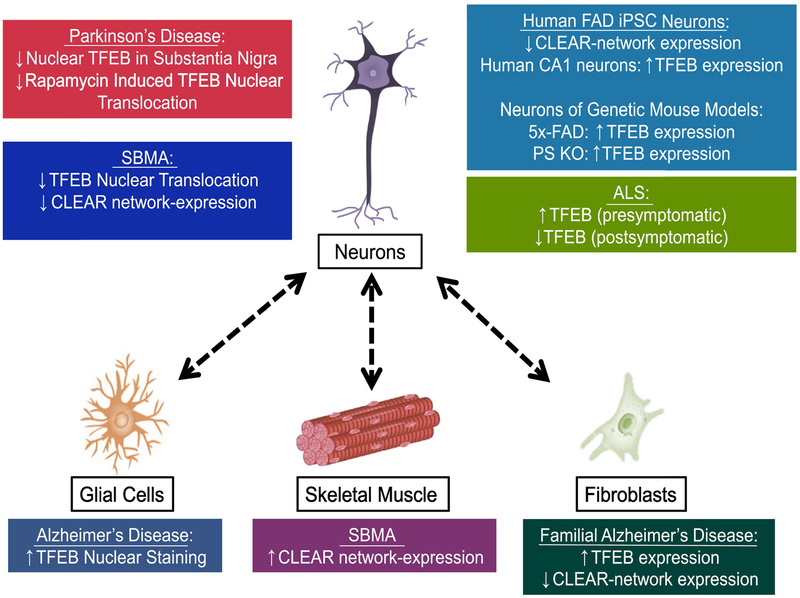
Non cell-autonomous neurotoxicity, wherein non-neuronal cells contribute to neuron dysfunction in neurodegeneration, has emerged as a major feature of disease pathogenesis in most disorders. Many studies have documented cell-type specific dysregulation of TFEB in neurodegenerative disease, indicating that cellular context plays an important role in TFEB biology. This is especially relevant for Alzheimer’s disease and SBMA, where different disease-relevant tissues display diametrically opposite patterns of TFEB dysregulation. Understanding the cell-type specific regulation of TFEB function, and the signaling pathways that communicate TFEB status between different tissues, may yield important targets for neurodegenerative disease therapy development. FAD: Familial Alzheimer’s Disease; iPSC: induced pluripotent stem cell

References

    1. Amick J, Roczniak-Ferguson A, Ferguson SM, 2016. C9orf72 binds SMCR8, localizes to lysosomes, and regulates mTORC1 signaling. Mol Biol Cell. 27, 3040–3051. - PMC - PubMed
    1. Bao J, Zheng L, Zhang Q, Li X, Zhang X, Li Z, Bai X, Zhang Z, Huo W, Zhao X, et al. , 2016. Deacetylation of TFEB promotes fibrillar Abeta degradation by upregulating lysosomal biogenesis in microglia. Protein Cell. 7, 417–33. - PMC - PubMed
    1. Berger Z, Ravikumar B, Menzies FM, Oroz LG, Underwood BR, Pangalos MN, Schmitt I, Wullner U, Evert BO, O’Kane CJ, Rubinsztein DC, 2006. Rapamycin alleviates toxicity of different aggregate-prone proteins. Hum Mol Genet. 15, 433–42. - PubMed
    1. Blalock EM, Geddes JW, Chen KC, Porter NM, Markesbery WR, Landfield PW, 2004. Incipient Alzheimer’s disease: microarray correlation analyses reveal major transcriptional and tumor suppressor responses. Proc Natl Acad Sci U S A. 101, 2173–8. - PMC - PubMed
    1. Blessing AM, Rajapakshe K, Reddy Bollu L, Shi Y, White MA, Pham AH, Lin C, Jonsson P, Cortes CJ, Cheung E, et al. , 2017. Transcriptional regulation of core autophagy and lysosomal genes by the androgen receptor promotes prostate cancer progression. Autophagy. 13, 506–521. - PMC - PubMed

Publication types

MeSH terms

Substances