. 2018 Jul;20(7):710-720.
doi: 10.1016/j.neo.2018.05.001. Epub 2018 May 28.

Improved Brain Penetration and Antitumor Efficacy of Temozolomide by Inhibition of ABCB1 and ABCG2

Affiliations

Improved Brain Penetration and Antitumor Efficacy of Temozolomide by Inhibition of ABCB1 and ABCG2

Mark C de Gooijer et al. Neoplasia. 2018 Jul.

Abstract

The anticancer drug temozolomide is the only drug with proven activity against high-grade gliomas and has therefore become a part of the standard treatment of these tumors. P-glycoprotein (P-gp; ABCB1) and breast cancer resistance protein (BCRP; ABCG2) are transport proteins, which are present at the blood-brain barrier and limit the brain uptake of substrate drugs. We have studied the effect of P-gp and BCRP on the pharmacokinetics and pharmacodynamics of temozolomide, making use of a comprehensive set of in vitro transport experiments and in vivo pharmacokinetic and antitumor efficacy experiments using wild-type, Abcg2-/-, Abcb1a/b-/-, and Abcb1a/b;Abcg2-/- mice. We here show that the combined deletion of Abcb1a/b and Abcg2 increases the brain penetration of temozolomide by 1.5-fold compared to wild-type controls (P < .001) without changing the systemic drug exposure. Moreover, the same increase was achieved when temozolomide was given to wild-type mice in combination with the dual P-gp/BCRP inhibitor elacridar (GF120918). The antitumor efficacy of temozolomide against three different intracranial tumor models was significantly enhanced when Abcb1a/b and Abcg2 were genetically deficient or pharmacologically inhibited in recipient mice. These findings call for further clinical testing of temozolomide in combination with elacridar for the treatment of gliomas, as this offers the perspective of further improving the antitumor efficacy of this already active agent.


Figures

Figure 1
Figure 1
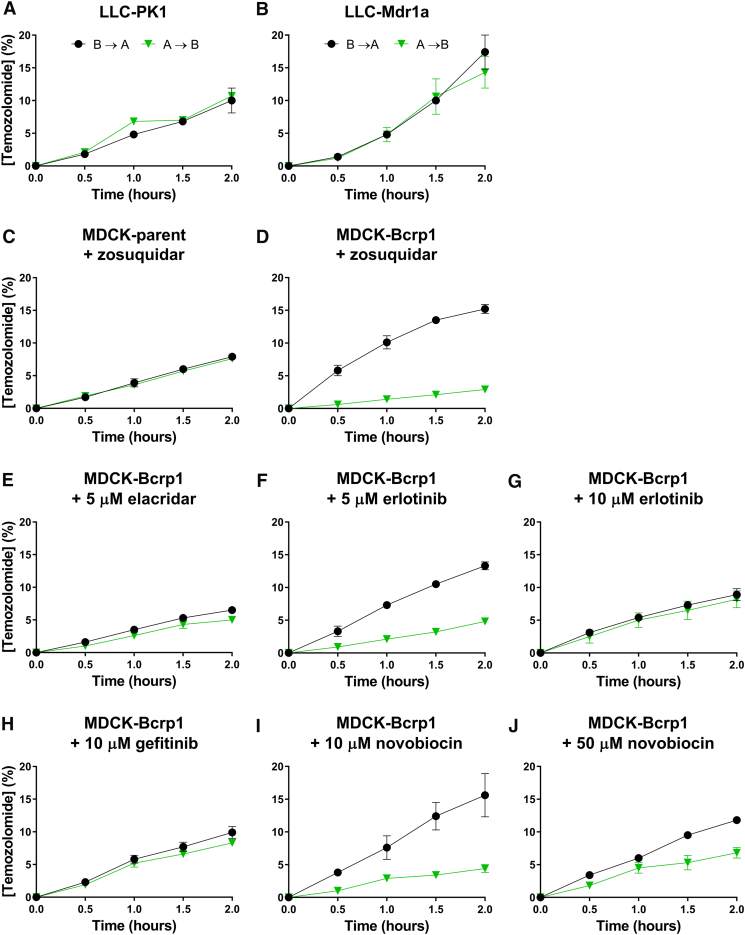
In vitro temozolomide transport experiments. Temozolomide was added to the basolateral or apical compartment of the Transwell to measure basolateral-to-apical (B → A) or apical-to-basolateral (A → B) transport, respectively, using LLC-PK1 (parent) versus the Mdr1a subline or using MDCKII (parent) versus the Bcrp1 transduced sublines. The transport of temozolomide is depicted as percentage of temozolomide initially present at the donor compartment (mean ± SD). Because degradation will also take place in the acceptor compartment during the experiment, this value will be an underestimation of the fraction that is actually translocated. Temozolomide transport by Mdr1a was not readily detected by this assay, whereas transport by Bcrp1 was evident. The dual P-gp-BCRP inhibitor elacridar and the presumed Bcrp1 inhibitors gefitinib, erlotinib, and novobiocin were added at the depicted concentrations.
Figure 2
Figure 2
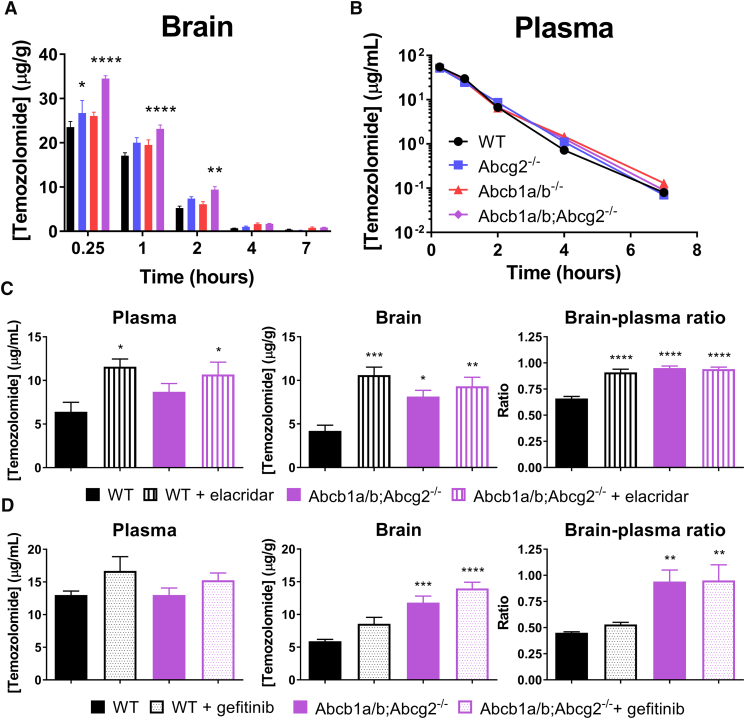
The impact of Abcb1a/b and Abcg2 on the brain and plasma concentration of temozolomide after intravenous administration. (A) Brain and (B) plasma concentrations of temozolomide in WT, Abcg2−/−, Abcb1a/b−/− and Abcb1a/b;Abcg2−/− FVB mice that received 50 mg/kg of temozolomide by intravenous injection. Both Abcg2−/− and Abcb1a/b−/− mice accumulated 20% more temozolomide in the brain compared to WT mice, whereas Abcb1a/b;Abcg2−/− mice even accumulated 50% (P < .001) more drug in the brain. The absence of the drug transporters Abcb1a/b and Abcg2 did not affect the plasma levels (see also Table 1). Data are depicted as mean ± SE; n ≥ 7. (C) Elacridar (100 mg/kg) and (D) gefitinib (100 mg/kg) were orally administered to WT and Abcb1a/b;Abcg2−/− mice 2 hours (elacridar) or 1 hour (gefitinib) prior to intravenous temozolomide, and blood and brain samples were collected 2 hours after temozolomide administration. Elacridar significantly enhanced the brain penetration (brain-to-plasma ratio) in WT mice (P = .001) to levels that were similar to those observed in Abcb1a/b;Abcg2−/− mice, whereas the brain-to-plasma ratio was not significantly different between Abcb1a/b;Abcg2−/− mice with or without elacridar. Administration of gefitinib did not result in a significantly enhanced brain penetration of temozolomide in WT mice. Data are depicted as mean ± SE; n = 5; * P < .05, ** P < .01, *** P < .001, **** P < .0001.
Figure 3
Figure 3
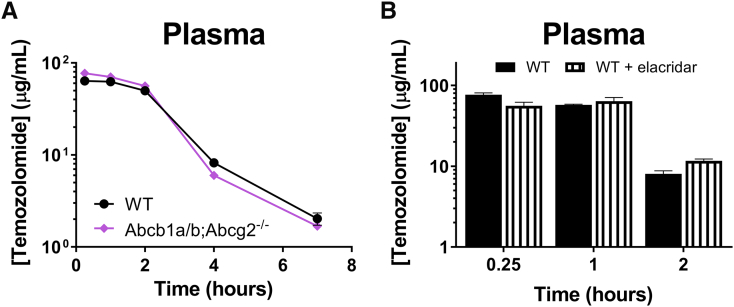
Plasma concentration-time curves of orally administered temozolomide. (A) Temozolomide (100 mg/kg) was given orally to WT and Abcb1a/b;Abcg2−/− mice, after which serial blood samples were drawn from the tail vein at various time points. The plasma curves of temozolomide were similar in both mouse strains. Depicted are the curves of the mean ± SE concentrations; n ≥ 18. (B) Plasma levels of temozolomide in intracranial Mel57 tumor-bearing mice following oral temozolomide administration (100 mg/kg) with or without orally co-administered elacridar (100 mg/kg). Blood samples were collected from the tail vein of the mice used in the study depicted in Figure 5B. Elacridar did not significantly affect the plasma pharmacokinetics of orally given temozolomide. Data are depicted as mean ± SE; n = 8.
Figure 4
Figure 4
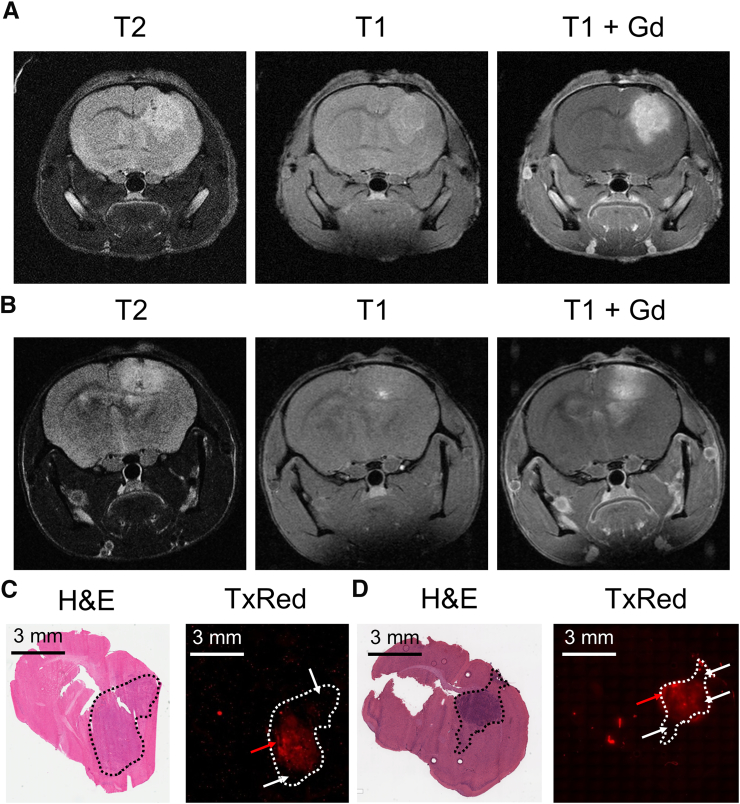
Characterization of the blood-brain barrier integrity of the orthotopic murine glioma models. T2- and T1-weighted MRI of orthotopic (A) GSC457 and (B) p53−/−;p16Ink4a/p19Arf−/−;K-rasv12;Luc tumors. Some contrast enhancement was observed in both tumor models on T1-weighted images after gadolinium (Gd) administration. (C) GSC457 and (D) p53−/−;p16Ink4a/p19Arf−/−;K-rasv12;Luc glioma-bearing WT mice received TexasRed shortly prior to being sacrificed. Comparison of the hematoxylin and eosin (H&E) staining with fluorescence microscopy of coronal brain sections revealed heterogeneous TexasRed (TxRed) extravasation in the tumor regions (dashed circumscribed area) of both models, with some regions showing moderate extravasation (red arrows) and others showing little to no extravasation (white arrows).
Figure 5
Figure 5
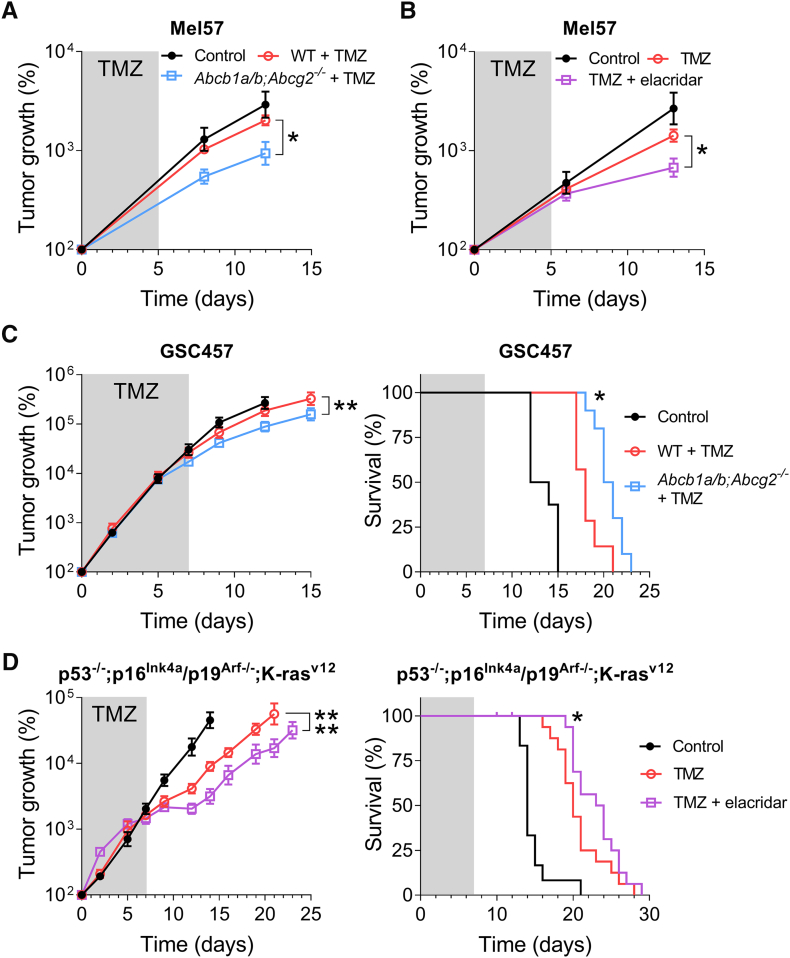
The impact of Abcb1a/b and Abcg2 on the efficacy of temozolomide against intracranial tumors. (A) The efficacy of temozolomide (TMZ) against intracranial Mel57-luc tumors in WT and Abcb1a/b;Abcg2−/− mice. A significantly better response to treatment with oral temozolomide (100 mg/kg/day × 5) was observed in Abcb1a/b;Abcg2−/− mice compared to WT mice. Data are depicted as mean ± SE; n ≥ 6. (B) Intracranial Mel57-luc tumors treated with the combination of temozolomide (100 mg/kg/day × 5) and elacridar (100 mg/kg/day × 5) grew considerably slower in WT mice than tumors treated with temozolomide alone. Data are depicted as mean ± SE; n ≥ 3. (C) WT and Abcb1a/b;Abcg2−/− mice were orthotopically grafted with GSC457 cells and monitored using in vivo bioluminescence imaging. Oral treatment with temozolomide (TMZ; 100 mg/kg/day × 7) reduced tumor growth and significantly improved survival of Abcb1a/b;Abcg2−/− mice compared to WT mice. Data are depicted as mean ± SE; n ≥ 7. (D) Spontaneous p53−/−;p16Ink4a/p19Arf−/−;K-rasv12;Luc gliomas were induced in WT mice using a lenti-Cre vector. As is apparent from previously reported data , elacridar and temozolomide co-administration significantly reduced tumor growth and prolonged survival compared to TMZ monotherapy. Data are depicted as mean ± SE; n ≥ 11; * P < .05, ** P < .01, **** P < .0001.

References

    1. Sarkaria JN, Hu LS, Parney IF, Pafundi DH, Brinkmann DH, Laack NN, Giannini C, Burns TC, Kizilbash SH, Laramy JK. Is the blood-brain barrier really disrupted in all glioblastomas? A critical assessment of existing clinical data. Neuro Oncol. 2018;20(2):184–191. - PMC - PubMed
    1. van Tellingen O, Yetkin-Arik B, de Gooijer MC, Wesseling P, Wurdinger T, de Vries HE. Overcoming the blood-brain tumor barrier for effective glioblastoma treatment. Drug Resist Updat. 2015;19:1–12. - PubMed
    1. Pencheva N, de Gooijer MC, Vis DJ, Wessels LFA, Würdinger T, van Tellingen O, Bernards R. Identification of a druggable pathway controlling glioblastoma invasiveness. Cell Rep. 2017;20(1):48–60. - PubMed
    1. Abbott NJ, Patabendige AA, Dolman DE, Yusof SR, Begley DJ. Structure and function of the blood-brain barrier. Neurobiol Dis. 2010;37(1):13–25. - PubMed
    1. Durmus S, Hendrikx JJMA, Schinkel AH. Apical ABC transporters and cancer chemotherapeutic drug disposition. Adv Cancer Res. 2015;125:1–41. - PubMed

MeSH terms

Substances