. 2018 Sep:176:13-23.
doi: 10.1016/j.biomaterials.2018.05.032. Epub 2018 May 22.

Neighboring cells override 3D hydrogel matrix cues to drive human MSC quiescence

Affiliations

Neighboring cells override 3D hydrogel matrix cues to drive human MSC quiescence

Silvia A Ferreira et al. Biomaterials. 2018 Sep.

Abstract

Physical properties of modifiable hydrogels can be tuned to direct stem cell differentiation in a role akin to that played by the extracellular matrix in native stem cell niches. However, stem cells do not respond to matrix cues in isolation, but rather integrate soluble and non-soluble signals to balance quiescence, self-renewal and differentiation. Here, we encapsulated single cell suspensions of human mesenchymal stem cells (hMSC) in hyaluronic acid-based hydrogels at high and low densities to unravel the contributions of matrix- and non-matrix-mediated cues in directing stem cell response. We show that in high-density (HD) cultures, hMSC do not rely on hydrogel cues to guide their fate. Instead, they take on characteristics of quiescent cells and secrete a glycoprotein-rich pericellular matrix (PCM) in response to signaling from neighboring cells. Preventing quiescence precluded the formation of a glycoprotein-rich PCM and forced HD cultures to differentiate in response to hydrogel composition. Our observations may have important implications for tissue engineering as neighboring cells may act counter to matrix cues provided by scaffolds. Moreover, as stem cells are most regenerative if activated from a quiescent state, our results suggest that ex vivo native-like niches that incorporate signaling from neighboring cells may enable the production of clinically relevant, highly regenerative cells.

Keywords: Extracellular matrix; Hydrogel; Mesenchymal stem cell; Quiescence.


Figures

Fig. 1
Fig. 1
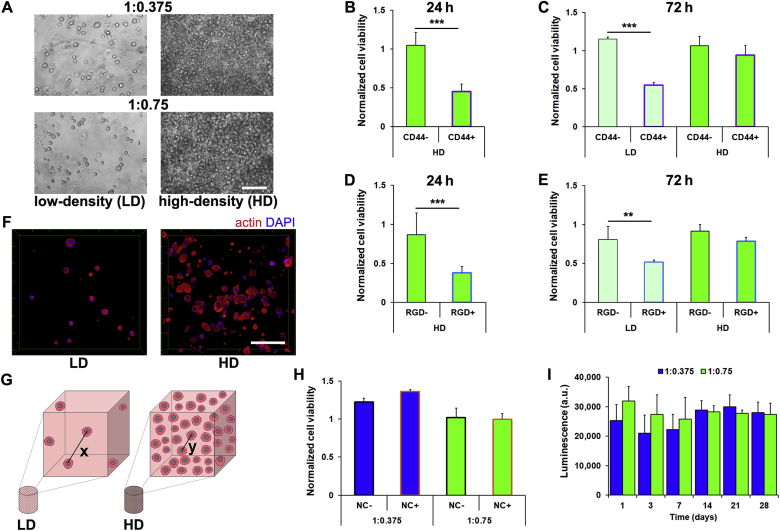
HD cultures do not rely on matrix cues or N-cadherin interactions to prevent anoikis. (A) Representative micrographs of hMSC (5 × 105 cells/mL (LD), 5 × 106 cells/mL (HD)) in 1:0.375 and 1:0.75 S-HA-PEGDA hydrogels after 24 h. (B) Viability of HD cultures of hMSC encapsulated within 1:0.75 hydrogels for 24 h and treated with anti-CD44 (CD44+) antibodies or isotype controls (CD44) and normalized to vehicle controls, and (C) in both HD and LD cultures for 72 h (n = 3, ***P < 0.001). (D) Viability of HD cultures of hMSC in 1:0.75 hydrogels for 24 h and treated with RGD sequence-containing peptides (RGD+) or scrambled peptides (RGD-) and normalized to vehicle controls, and (E) in both HD and LD for 72 h (n = 3, **P < 0.01, ***P < 0.001). (F) Representative micrographs of hMSC in LD and HD cultures for 72 h in 1:0.75 hydrogels stained with Phalloidin-TRITC. (G) Schematic highlighting theoretical distances between any two ‘nearest neighbor’ cells, where x = 69.8 μm and y = 32.4 μm. (H) Viability of LD and HD cultures of hMSC encapsulated in 1:0.75 hydrogels for 72 h and treated with anti-N-cadherin antibody (NC+) or isotype controls (NC-) and normalized to vehicle controls (n = 3). (I) Viability of HD cultures of hMSC in 1:0.375 and 1:0.75 S-HA-PEGDA hydrogels after up to 28 days (n = 3). In (A) and (F) scale bar = 100 μm. Plots show mean + SD. In (B)–(E) and (H) a two-tailed Mann-Whitney test, and in (I) a Kruskal-Wallis test followed by Dunn's Multiple Comparison were used to detect statistical significance.
Fig. 2
Fig. 2
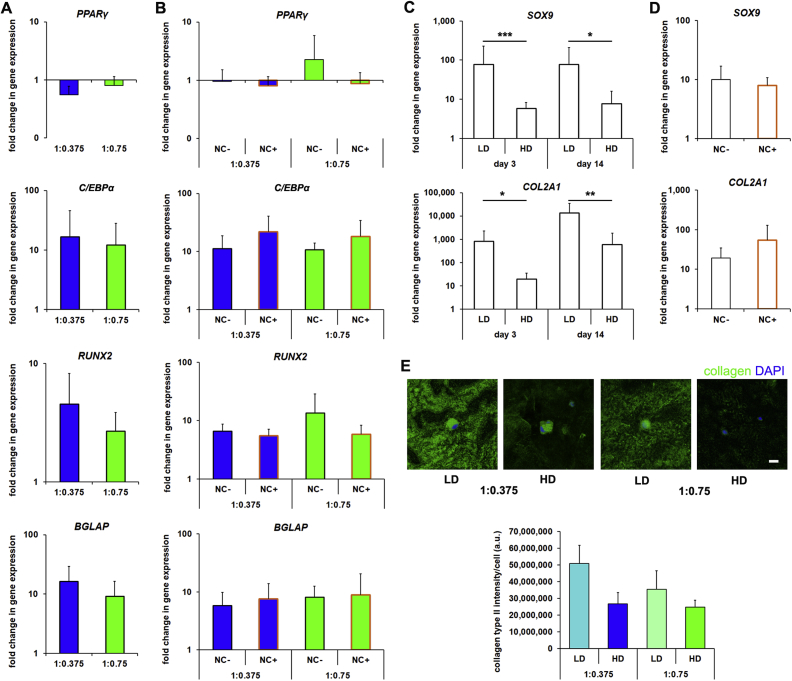
HD cultures do not differentiate in response to hydrogel cues. (A) Gene expression analyses (normalized to undifferentiated controls) for markers of adipogenesis (PPARγ, C/EPBα) and osteogenesis (RUNX2, BGLAP) in HD cultures in 1:0.375 and 1:0.75 S-HA-PEGDA hydrogels after 72 h in culture (n ≥ 6), or (B) treated with anti-N-cadherin antibody (NC+, outlined orange) or isotype controls (NC-) (n ≥ 6). (C) Gene expression analyses for markers of chondrogenesis (SOX9, COL2A1) in LD and HD cultures after 3 or 14 days (n ≥ 12, *P < 0.05, **P < 0.01, ***P < 0.001), or (D) in HD cultures treated for 72 h with anti-N-cadherin antibody (NC+, outlined orange) or isotype controls (NC-) (n ≥ 16). (E) Representative micrographs of LD and HD cultures after 28 days and stained for collagen type II. Plot shows a pixel intensity-based semi-quantification of collagen type II produced per cell (n ≥ 20). Scale bar = 20 μm. In (A)–(D) bars show mean + SD, and in (E) bars show median + SEM. In (A)–(D) a two-tailed Mann-Whitney test was used to detect statistical significance.
Fig. 3
Fig. 3
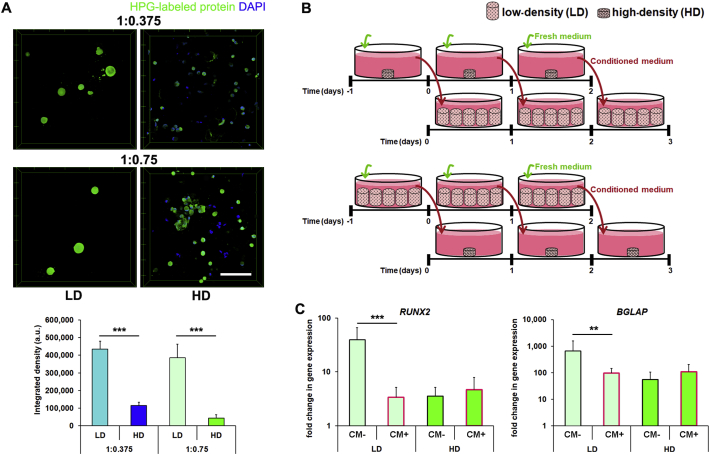
HD cultures produce less protein and release factors that downregulate hMSC differentiation. (A) Representative micrographs of HPG-labeled proteins produced by LD and HD cultures of hMSC in 1:0.375 and 1:0.75 hydrogels after 72 h. Scale bar = 100 μm. Total protein produced by hMSC was determined by quantifying the integrated density of fluorescence labeling on a per cell basis (n ≥ 20, ***P < 0.001). (B) Schematic of experimental design to examine the role of paracrine signaling. Either conditioned medium (CM) from HD cultures was placed on LD cultures, or CM from LD cultures was placed on HD cultures such that the total number of cells (2.5 × 106 cells/well) and volume of culture media was kept constant. CM was transferred every 24 h for a total of 72 h. (C) Gene expression analyses (normalized to undifferentiated controls) for markers of osteogenesis (RUNX2, BGLAP) in LD and HD cultures 72 h after encapsulation in 1:0.75 hydrogels. hMSC-laden hydrogels were cultured with basal medium (CM-, control) or treated with CM (CM+, outlined pink) (n ≥ 6, **P < 0.01, ***P < 0.001). In (A) bars show median + SEM and in (C) bars show mean + SD. In (A) and (C) a two-tailed Mann-Whitney test was used to detect statistical significance.
Fig. 4
Fig. 4
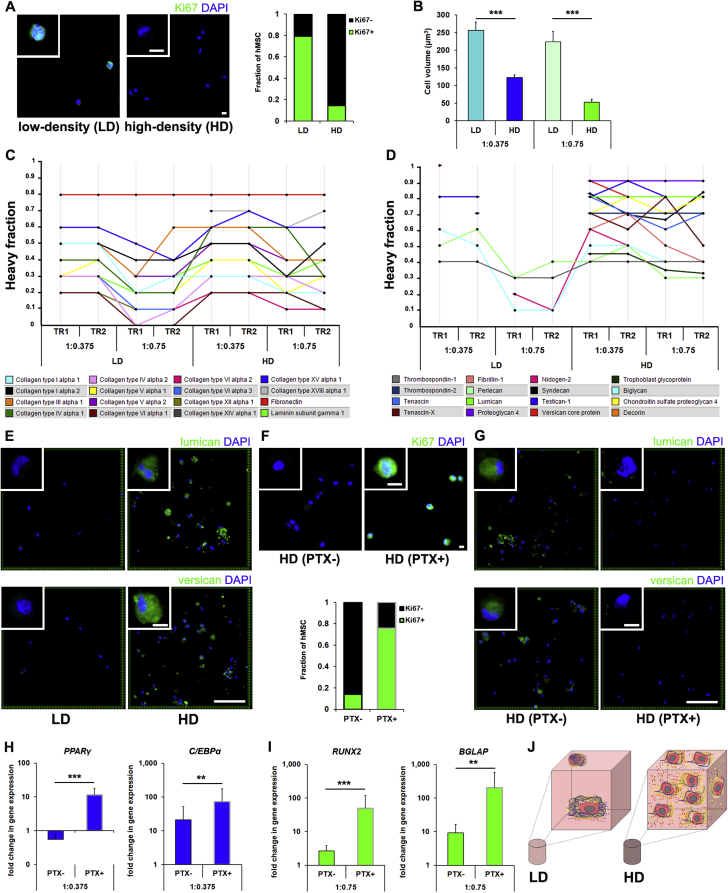
HD cultures secrete a glycoprotein-rich PCM and take on characteristics of quiescent cells. (A) Representative micrographs of Ki67 staining of hMSC in 1:0.75 hydrogels after 72 h. Significantly more hMSC were positive for Ki67 in LD (n = 250) than HD (n ≥ 500) cultures (P < 0.001). (B) Quantification of hMSC volume in LD and HD cultures (n ≥ 20, ***P < 0.001). (C) Profile plots showing the heavy fraction of a selection of structural proteins, or (D) glycoproteins synthesized by LD and HD cultures of hMSC encapsulated in 1:0.375 and 1:0.75 S-HA-PEGDA hydrogels (two technical replicates, TR) after 72 h in culture. (E) Representative micrographs showing staining for lumican and versican secreted by hMSC in LD and HD cultures in 1:0.375 hydrogels after 72 h. (F) Representative micrographs showing Ki67 staining of hMSC in HD cultures within 1:0.75 hydrogels after treatment with paclitaxel (PTX+) or vehicle control (PTX-) for 72 h. Significantly more hMSC were positive for Ki67 in the presence of paclitaxel than vehicle controls (n ≥ 500, P < 0.001). (G) Representative micrographs showing staining for lumican and versican secreted by hMSC in 1:0.75 hydrogels treated with paclitaxel or the vehicle control after 72 h. (H) Gene expression analyses (normalized to undifferentiated controls) in HD cultures of hMSC for markers of adipogenesis (PPARγ, C/EPBα) in 1:0.375, and (I) osteogenesis (RUNX2, BGLAP) in 1:0.75 hydrogels 72 h after encapsulation. Cultures were treated with paclitaxel (outlined grey) or with the vehicle control (n ≥ 8, **P < 0.01, ***P < 0.001). (J) Schematic highlighting potential means by which HD cultures could regulate hMSC response compared to LD cultures. In LD cultures, hMSC rely on cues from the hydrogel, secrete PCM and interact with it to differentiate. HD culture may drive quiescence via an indirect effect mediated by the formation of interacting PCM and their sequestration of signaling molecules. In (A) and (F) scale bar = 10 μm. In (E) and (G) scale bar = 100 μm, insets = 10 μm. In (A) and (F) a Fisher's exact test was used to detect statistical significance. In (B), and (H)–(I) plots show mean + SD and a two-tailed Mann-Whitney test was used to detect statistical significance.

References

    1. Foyt D.A., Norman M.D.A., Yu T.T.L., Gentleman E. Exploiting advanced hydrogel Technologies to address key challenges in regenerative medicine. Adv. Healthcare Mater. 2018;7 - PMC - PubMed
    1. Kloxin A.M., Kasko A.M., Salinas C.N., Anseth K.S. Photodegradable hydrogels for dynamic tuning of physical and chemical properties. Science. 2009;324:59–63. - PMC - PubMed
    1. Lutolf M.P., Lauer-Fields J.L., Schmoekel H.G., Metters A.T., Weber F.E., Fields G.B. Synthetic matrix metalloproteinase-sensitive hydrogels for the conduction of tissue regeneration: engineering cell-invasion characteristics. Proc. Natl. Acad. Sci. U. S. A. 2003;100:5413–5418. - PMC - PubMed
    1. Walters N.J., Gentleman E. Evolving insights in cell-matrix interactions: elucidating how non-soluble properties of the extracellular niche direct stem cell fate. Acta Biomater. 2015;11:3–16. - PMC - PubMed
    1. Bian L.M., Guvendiren M., Mauck R.L., Burdick J.A. Hydrogels that mimic developmentally relevant matrix and N-cadherin interactions enhance MSC chondrogenesis. Proc. Natl. Acad. Sci. U. S. A. 2013;110:10117–10122. - PMC - PubMed

Publication types