


The Physical and Biochemical Properties of the Extracellular Matrix Regulate Cell Fate
- PMID: 29853174
- PMCID: PMC6586474
- DOI: 10.1016/bs.ctdb.2018.02.002
The Physical and Biochemical Properties of the Extracellular Matrix Regulate Cell Fate
Abstract
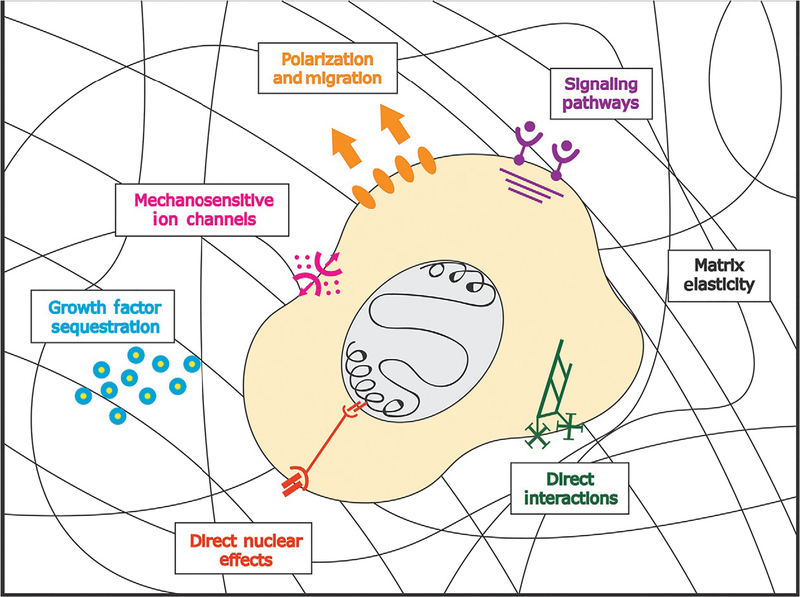
The extracellular matrix is a complex network of hydrated macromolecular proteins and sugars that, in concert with bound soluble factors, comprise the acellular stromal microenvironment of tissues. Rather than merely providing structural information to cells, the extracellular matrix plays an instructive role in development and is critical for the maintenance of tissue homeostasis. In this chapter, we review the composition of the extracellular matrix and summarize data illustrating its importance in embryogenesis, tissue-specific development, and stem cell differentiation. We discuss how the biophysical and biochemical properties of the extracellular matrix ligate specific transmembrane receptors to activate intracellular signaling that alter cell shape and cytoskeletal dynamics to modulate cell growth and viability, and direct cell migration and cell fate. We present examples describing how the extracellular matrix functions as a highly complex physical and chemical entity that regulates tissue organization and cell behavior through a dynamic and reciprocal dialogue with the cellular constituents of the tissue. We suggest that the extracellular matrix not only transmits cellular and tissue-level force to shape development and tune cellular activities that are key for coordinated tissue behavior, but that it is itself remodeled such that it temporally evolves to maintain the integrated function of the tissue. Accordingly, we argue that perturbations in extracellular matrix composition and structure compromise key developmental events and tissue homeostasis, and promote disease.
Keywords: Development; Extracellular matrix; Mechanobiology; Stem cell niche.
Copyright © 2018 Elsevier Inc. All rights reserved.
Figures
References
-
- Adams JC, & Watt FM (1993). Regulation of development and differentiation by the extracellular matrix. Development (Cambridge, England), 117(4), 1183–1198. - PubMed
-
- Akhurst RJ, Lehnert SA, Faissner A, & Duffie E (1990). TGF beta in murine morphogenetic processes: The early embryo and cardiogenesis. Development (Cambridge, England), 108(4), 645–656. Retrieved from http://www.ncbi.nlm.nih.gov/pubmed/1696875. - PubMed
Publication types
MeSH terms
Grants and funding
LinkOut - more resources
Full Text Sources
Other Literature Sources
