


Mutagenicity and genotoxicity of ClearTaste
- PMID: 29854589
- PMCID: PMC5977158
- DOI: 10.1016/j.toxrep.2017.12.015
Mutagenicity and genotoxicity of ClearTaste
Erratum in
-
Erratum regarding missing Declaration of Competing Interest statements in previously published articles.Toxicol Rep. 2020 Dec 25;8:62-63. doi: 10.1016/j.toxrep.2020.12.008. eCollection 2021. Toxicol Rep. 2020. PMID: 33391998 Free PMC article.
Abstract
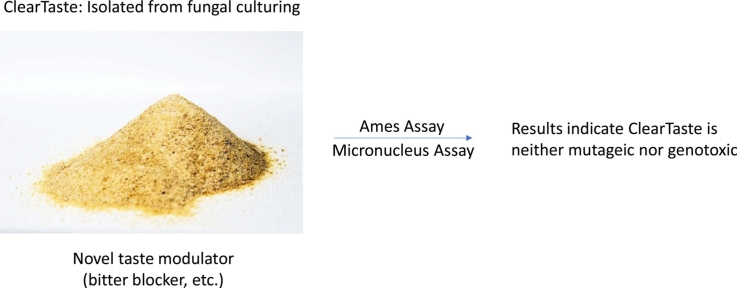
The present study investigates whether ClearTaste is mutagenic/genotoxic by employing it as a test article in bacterial reverse mutation (Ames test) and in vitro human peripheral blood lymphocyte micronucleus assays conducted by a Good Laboratory Practice certified third party as parameterized by the United States Food and Drug Administration. ClearTaste is a taste modulator derived from the filtrate of submerged Cordyceps sinensis and is typically processed into a powder. It functions as a bitter, sour, astringency, metallic and lingering aftertaste mitigator/blocker. The Ames test includes revertant colony counts almost exclusively less than 100/plate and significantly fewer ClearTaste counts as opposed to known mutagen counts. The micronucleus assay reported cytotoxicity exclusively < 25% for doses up to 2,000 μg/L with Cytokinesis Block Proliferation Indices less than water and statistically significant differences between micronucelated cells post dosing compared to cyclophosphamide and vinblastine controls. The conclusion of these data is that ClearTaste is neither muta- nor carcinogenic.
Keywords: Ames; ClearTaste; Genotoxicity; Micronucleus; Mutagenicity.
References
-
- Slack J.P., Brockhoff A., Batram C., Menzel S., Sonnabend C., Born S., Galindo M.M., Kohl S., Thalmann S., Ostopovici-Halip L., Simons C.T., Ungureanu I., Duineveld K., Bologa C.G., Behrens M., Furrer S., Oprea T.I., Meyerhof W. Modulation of bitter taste perception by a small molecule hTAS2R antagonist. Curr. Biol. 2010;20:1104–1109. http://www.sciencedirect.com/science/article/pii/S0960982210005221 Available from: Accessed 2 Feb 2013. - PMC - PubMed
-
- Behrens M., Meyerhof W. Bitter taste receptor research comes of age: from characterization to modulation of TAS2Rs. Sem. Cell Dev. Biol. 2013;24:215–221. http://www.sciencedirect.com/science/article/pii/S1084952112001474 Available from: Accessed 1 Jan 2016. - PubMed
-
- Greene T.A., Alarcon S., Thomas A., Berdougo E., Doranz B.J., Breslin P.A.S., Rucker J. Probenecid inhibits the human bitter taste receptor TAS2R16 and suppresses bitter perception of salicin. PLoS One. 2011;6:1–9. http://journals.plos.org/plosone/article/asset?id=10.1371%2Fjournal.pone... Available from: Accessed 12 Dec 2015. - PMC - PubMed
-
- Katsuragi Y., Yasumasu T., Kurihara K. Lipoprotein that selectively inhibits taste nerve responses to bitter substances. Brain Res. 1996;713:240–245. http://www.sciencedirect.com/science/article/pii/0006899395015418 Available from: Accessed 3 Mar 2016. - PubMed
-
- Ming D., Ninomiya Y., Margolskee R.F. Blocking taste receptor activation of gustducin inhibits gustatory responses to bitter compounds. Proc. Natl. Acad. Sci. U. S. A. 1999;96:9903–9908. http://www.pnas.org/content/96/17/9903. short Available from: Accessed 6 Aug 2015. - PMC - PubMed
LinkOut - more resources
Full Text Sources
Other Literature Sources
