. 2018 May 15:5:598-607.
doi: 10.1016/j.toxrep.2018.05.001. eCollection 2018.

Capsaicinoids improve consequences of physical activity

Affiliations

Capsaicinoids improve consequences of physical activity

Kazim Sahin et al. Toxicol Rep. .

Abstract

The purpose of this study was to investigate the effects of capsaicinoids (CAPs) on lipid metabolism, inflammation, antioxidant status and the changes in gene products involved in these metabolic functions in exercised rats. A total of 28 male Wistar albino rats were randomly divided into four groups (n = 7) (i) No exercise and no CAPs, (ii) No exercise + CAPs (iii) Regular exercise, (iv) Regular exercise + CAPs. Rats were administered as 0.2 mg capsaicinoids from 10 mg/kg BW/day Capsimax® daily for 8 weeks. A significant decrease in lactate and malondialdehyde (MDA) levels and increase in activities of antioxidant enzymes were observed in the combination of regular exercise and CAPs group (P < 0.0001). Regular exercise + CAPs treated rats had greater nuclear factor-E2-related factor-2 (Nrf2) and heme oxygenase-1 (HO-1) levels in muscle than regular exercise and no exercise rats (P < 0.001). Nevertheless, regular exercise + CAPs treated had lower nuclear factor kappa B (NF-κB) and IL-10 levels in muscle than regular exercise and control rats (P < 0.001). Muscle sterol regulatory element-binding protein 1c (SREBP-1c), liver X receptors (LXR), ATP citrate lyase (ACLY) and fatty acid synthase (FAS) levels in the regular exercise + CAPs group were lower than all groups (P < 0.05). However, muscle PPAR-γ level was higher in the regular exercise and CAPs alone than the no exercise rats. These results suggest CAPs with regular exercise may enhance lipid metabolism by regulation of gene products involved in lipid and antioxidant metabolism including SREBP-1c, PPAR-γ, and Nrf2 pathways in rats.

Keywords: ACLY, ATP-citrate lyase; ACS, acetyl-CoA synthetase; AMPK, phosphorylated AMP-activated protein kinase; ARE, antioxidant response element; CAPs, capsaicinoids; Capsaicinoid; Exercise; FAS, fatty acid synthase; GSH-Px, glutathione peroxidase; HO-1, heme-oxygenase 1; IL-10, interleukin-10; LXR-s, liver X receptor-s; MDA, malondialdehyde; MMP-9, matrix metalloproteinase-9; NF-κB, nuclear factor kappa-light-chain-enhancer of activated B cells; Nrf2; Nrf2, nuclear factor (erythroid-derived 2)-like 2; PGC-la, peroxisomal proliferator activator receptor c coactivator; PPAR-γ; PPAR-γ, peroxisome proliferator-activated receptor gamma; ROS, reactive oxygen species; SOD, superoxide dismutase; SREBP-1c; SREBP-1c, sterol regulatory element-binding protein1c; TC, total serum cholesterol; TG, triglyceride; TNF-α, tumor necrosis factor-α; TRPV1, transient receptor potential vanilloid subtype 1; Tfam, mitochondrial transcription factor A.


Figures
None
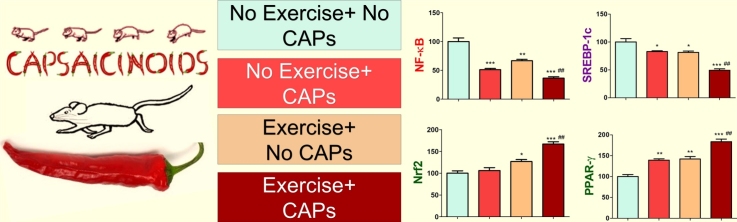
Graphical abstract
Fig. 1
Fig. 1
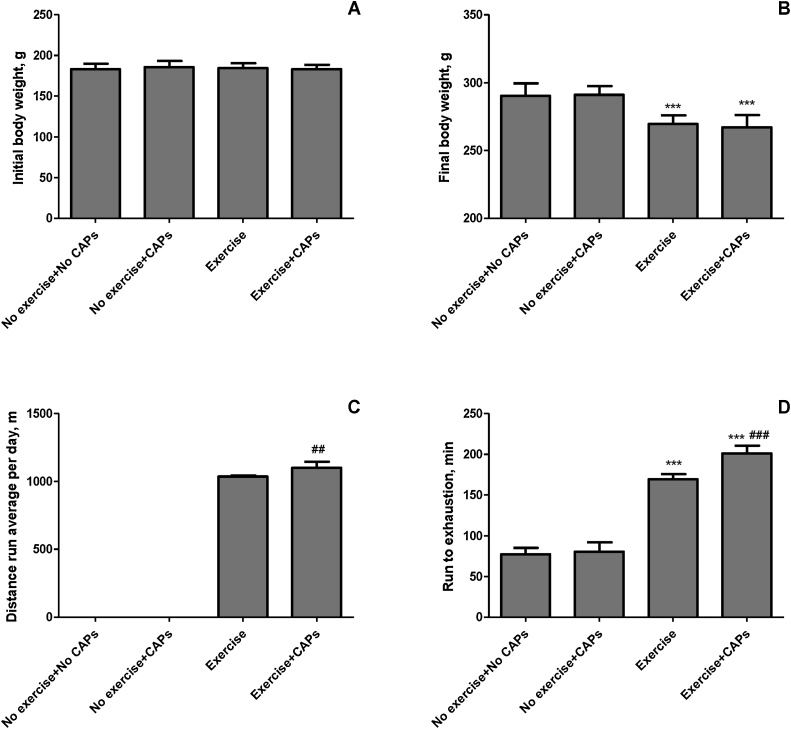
Effects of Capsaicinoids (CAPs) supplementation and regular exercise on body weight (initial BW Panel A and final BW Panel B), distance run average (Panel C) and exhaustion time (Panel D) in rats. Each bar represents the mean (n = 7) and standard error. *** p < 0.001 as compared with control group; ## p < 0.01, ### p < 0.001 as compared with exercise group.
Fig. 2
Fig. 2
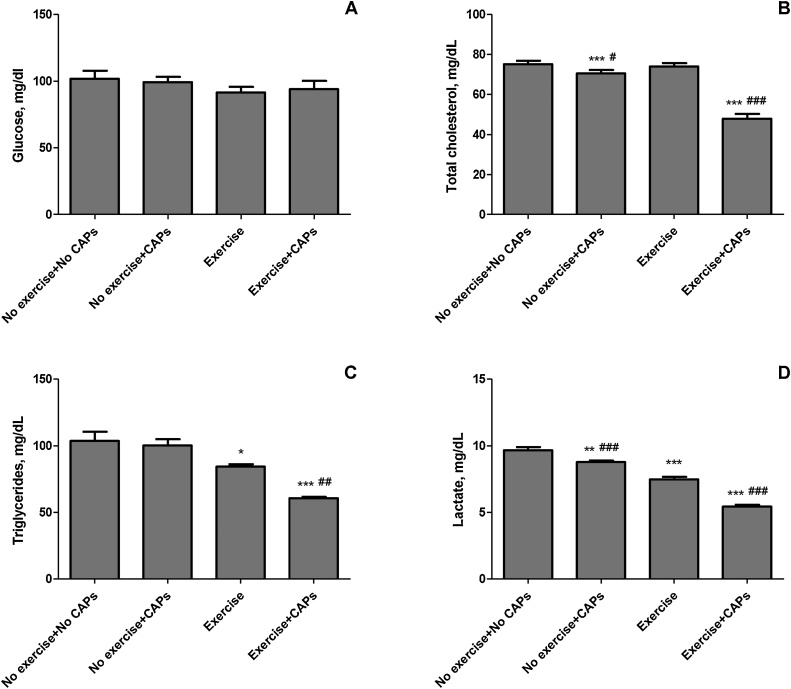
The effects of Capsaicinoids (CAPs) on serum biochemical parameters in regular exercise-trained rats. Panels A–D show the level of blood glucose (Panel A), total serum cholesterol (Panel B), triglycerides (Panel C), and lactate (Panel D) in various groups. Each bar represents the mean (n = 7) and standard error. * p < 0.05, ** p < 0.01, *** p < 0.001 as compared with control group; # p < 0.05, ## p < 0.01, ### p < 0.001 as compared with exercise group.
Fig. 3
Fig. 3
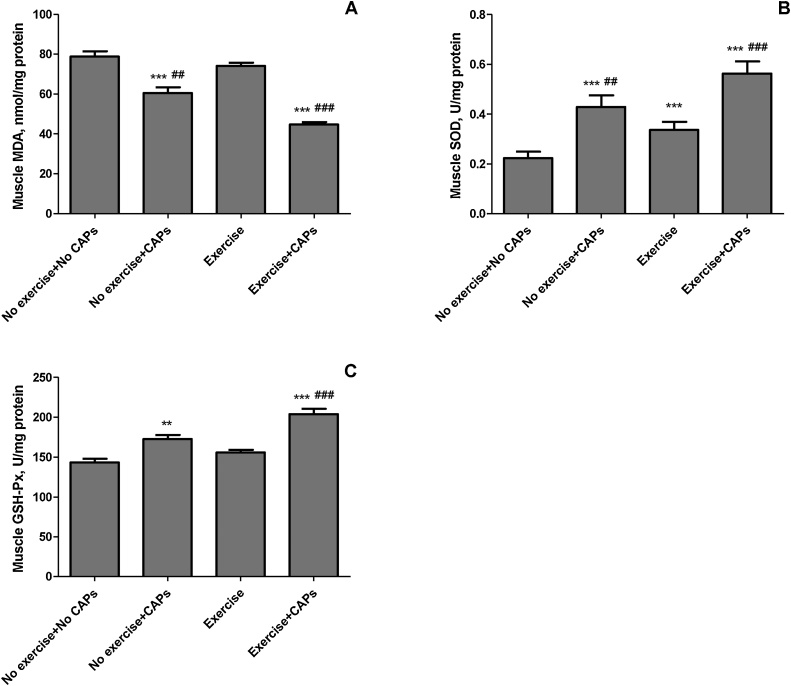
The effects of Capsaicinoids (CAPs) on muscle lipid peroxidation [Panel A: muscle malondialdehyde (MDA)] and antioxidant enzymes [Panel B: muscle three forms of superoxide dismutase (SOD) (mitochondrial, cytoplasmic, and extracellular); Panel C: Glutathione peroxidase (GSH-Px)] in regular exercise-trained rats. Each bar represents the mean (n = 7) and standard error. ** p < 0.01, *** p < 0.001 as compared with control group; ## p < 0.01, ### p < 0.001 as compared with exercise group.
Fig. 4
Fig. 4
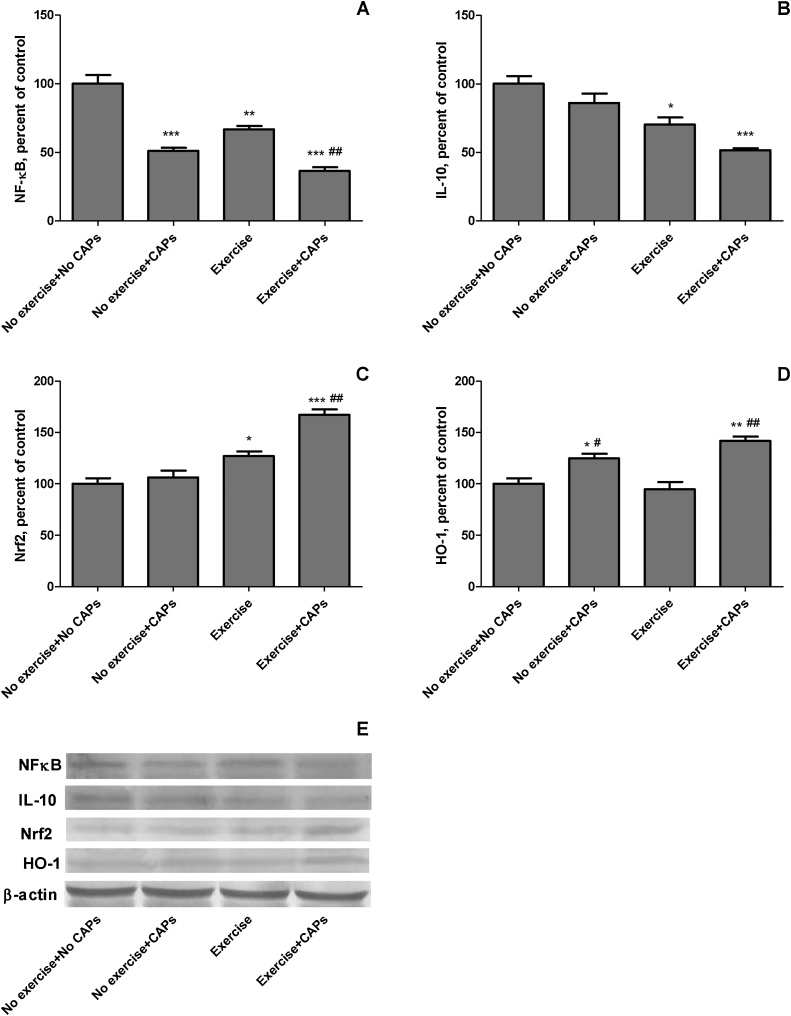
The effects of Capsaicinoids (CAPs) on muscle protein levels of anti-inflammatory and antioxidant markers of NF-κB (Panel A), IL-10 (Panel B), Nrf2 (Panel C), and HO-1 (Panel D) in exercise-trained rats determined by immunoblot analysis. The intensity of the bands shown in Panel E was quantified by densitometric analysis. Data are expressed as a ratio of normal control value (set to 100%). Each bar represents the mean and standard error. Blots were repeated at least 3 times (n = 3) and only a representative blot is shown in Panel E. β-Actin was included to ensure equal protein loading. * p < 0.05, ** p < 0.01, *** p < 0.001 as compared with control group; # p < 0.05, ## p < 0.01, ### p < 0.001 as compared with exercise group.
Fig. 5
Fig. 5
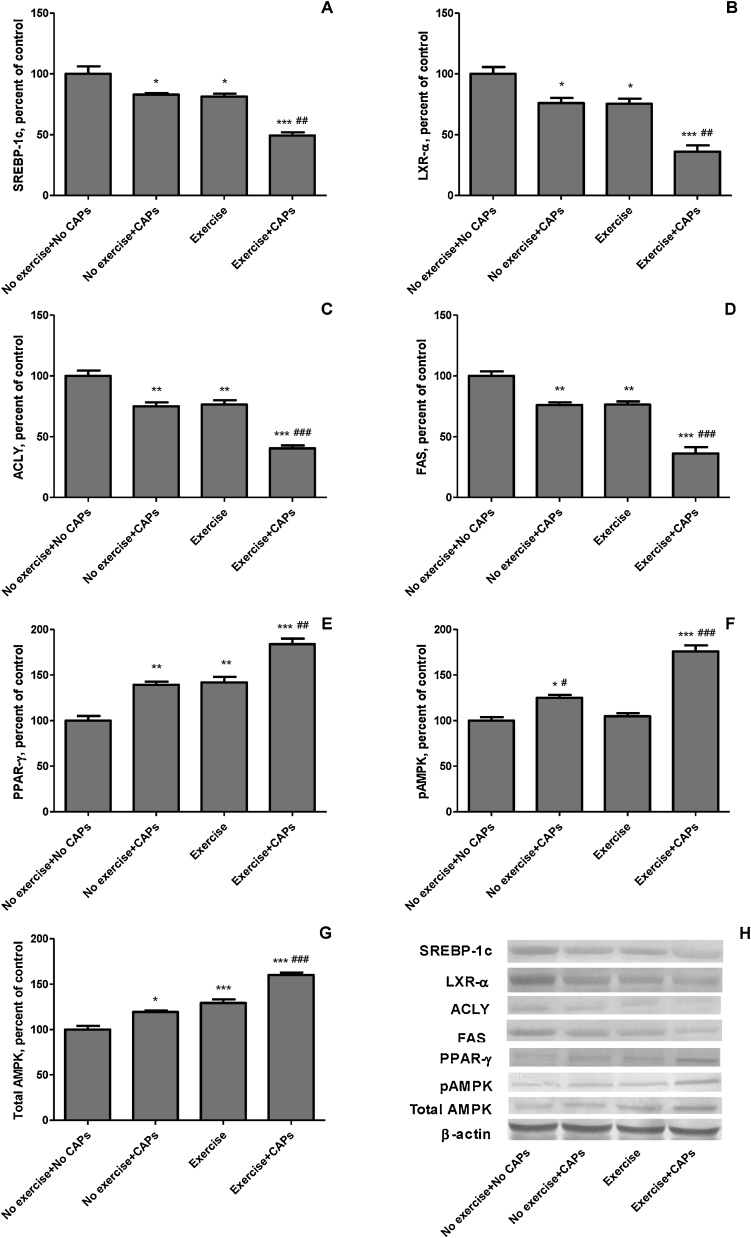
The effects of Capsaicinoids (CAPs) on muscle protein levels of SREBP-1c (Panel A), LXRs (Panel B), ACLY (Panel C), FAS (Panel D), PPAR-γ (Panel E), pAMPK (Panel F), and total AMPK (Panel G) in exercise-trained rats determined by immunoblot analysis. The intensity of the bands shown in Panel H was quantified by densitometric analysis. Data are expressed as a ratio of normal control value (set to 100%). Each bar represents the mean and standard error. Blots were repeated at least 3 times (n = 3) and only a representative blot is shown in Panel H. β-Actin was included to ensure equal protein loading. * p < 0.05, ** p < 0.01, *** p < 0.001 as compared with control group; # p < 0.05, ## p < 0.01, ### p < 0.001 as compared with exercise group.

References

    1. Mathieu P., Poirier P., Pibarot P., Lemieux I., Despres J.P. Visceral obesity: the link among inflammation, hypertension and cardiovascular disease. Hypertension. 2009;53:577–584. - PubMed
    1. Tuzcu M., Sahin N., Orhan C., Agca C., Akdemir F., Tuzcu Z., Komorowski J., Sahin K. Impact of chromium histidinate on high fat diet induced obesity in rats. Nutr. Metabol. (London) 2012;8(28) - PMC - PubMed
    1. Gaggini M., Morelli M., Buzzigoli E., DeFronzo R., Bugianesi E., Gastaldelli A. Non-alcoholic fatty liver disease (NAFLD) and its connection with insulin resistance, dyslipidemia, atherosclerosis and coronary heart disease. Nutrients. 2013;5:1544–1560. - PMC - PubMed
    1. Caponi P.W., Lehnen A.M., Pinto G.H., Borges J., Markoski M., Machado U.F., Schaan B.D. Aerobic exercise training induces metabolic benefits in rats with metabolic syndrome independent of dietary changes. Clinics (Sao Paulo) 2013;68:1010–1017. - PMC - PubMed
    1. Awobajo F.O., Olawale O.A., Bassey S. Changes in blood glucose, lipid profile and antioxidant activities in trained and untrained adult male subjects during programmed exercise on the treadmill. Nig. Q. J. Hosp. Med. 2013;23:117–124. - PubMed