Review
. 2018 Apr 24:2018:1417528.
doi: 10.1155/2018/1417528. eCollection 2018.

Drosophila melanogaster as a Model for Diabetes Type 2 Progression

Affiliations
Review

Drosophila melanogaster as a Model for Diabetes Type 2 Progression

Jéssica P Álvarez-Rendón et al. Biomed Res Int. .

Abstract

Drosophila melanogaster has been used as a very versatile and potent model in the past few years for studies in metabolism and metabolic disorders, including diabetes types 1 and 2. Drosophila insulin signaling, despite having seven insulin-like peptides with partially redundant functions, is very similar to the human insulin pathway and has served to study many different aspects of diabetes and the diabetic state. Yet, very few studies have addressed the chronic nature of diabetes, key for understanding the full-blown disease, which most studies normally explore. One of the advantages of having Drosophila mutant viable combinations at different levels of the insulin pathway, with significantly reduced insulin pathway signaling, is that the abnormal metabolic state can be studied from the onset of the life cycle and followed throughout. In this review, we look at the chronic nature of impaired insulin signaling. We also compare these results to the results gleaned from vertebrate model studies.


Figures
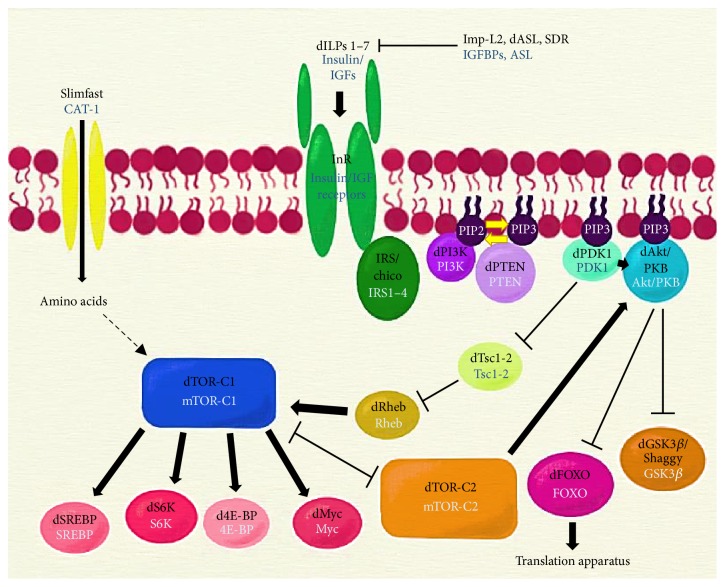
Figure 1
Figure 1
The insulin signaling pathway. The binding of insulin to its receptor initiates a phosphorylation cascade that results in the regulation of metabolism through several effectors. Names for the vertebrate counterparts of the pathway appear below their Drosophila names. CAT-1: cationic amino acid transporter-1; Imp-L2: ecdysone-inducible gene L2; IGFBPs: insulin-like growth factor binding proteins; ASL: acid-labile subunit; SDR: secreted decoy of InR; dILPs 1–7: insulin-like ligands 1–7; IGFs: insulin-like growth factors; InR: insulin receptor; IRS/chico: insulin receptor substrate; PI3K: phosphatidylinositol 3-kinase (two subunits: Pi3K92E is the catalytic subunit, and Pi3K21B is the regulatory subunit); PIP2: phosphatidylinositol 4,5-bisphosphate; PIP3: phosphatidylinositol 3,4,5-trisphosphate; PTEN: phosphatase and tensin homolog; dPDK1: 3-phosphoinositide dependent protein kinase-1; GSK3β: glycogen synthase kinase 3 beta; Tsc1-2: tuberous sclerosis proteins 1 and 2; Rheb: Ras homolog enriched in brain; TOR-C1: target of rapamycin complex 1 (the TOR-C1 complex consists primarily of TOR, regulatory associated protein of TOR (raptor), and lethal with Sec-13 protein 8 (LST8)); TOR-C2: target of rapamycin complex 2 (the TOR-C2 complex consists primarily of TOR, rapamycin-insensitive companion of TOR (Rictor), and stress-activated protein kinase-interacting protein 1 (Sin1)); Myc: Myc protein; SREBP: sterol regulatory element-binding protein; S6K: ribosomal protein S6 kinase beta-1; 4E-BP: eukaryotic translation initiation factor 4E-binding protein 1; FoxO: Forkhead box O transcription factor. Dashed lines indicate an indirect interaction; arrows and bar-headed lines indicate activation and inhibition, respectively.

References

    1. Narayan K. M. V., Zhang P., Kanaya A. M., et al. Diabetes: The Pandemic and Potential Solutions. In: Jamison D. T., Breman J. G., Measham A. R., editors. Disease Control Priorities in Developing Countries. 2nd. Washington, DC, USA: 2006. - PubMed
    1. Chen L., Magliano D. J., Zimmet P. Z. The worldwide epidemiology of type 2 diabetes mellitus—present and future perspectives. Nature Reviews Endocrinology. 2012;8(4):228–236. doi: 10.1038/nrendo.2011.183. - DOI - PubMed
    1. Mathers C. D., Loncar D. Projections of global mortality and burden of disease from 2002 to 2030. PLoS Medicine. 2006;3(11, article e442) doi: 10.1371/journal.pmed.0030442. - DOI - PMC - PubMed
    1. OECD. Health at a Glance 2017: OECD Indicators. Paris, France: OECD Publishing; 2017. Diabetes prevalence.
    1. Dodds S. The How-To for Type 2: An Overview of Diagnosis and Management of Type 2 Diabetes Mellitus. Nursing Clinics of North America. 2017;52(4):513–522. doi: 10.1016/j.cnur.2017.07.002. - DOI - PubMed

MeSH terms

LinkOut - more resources
