


Performance of the PROMIS in Patients After Anterior Cruciate Ligament Reconstruction
- PMID: 29854864
- PMCID: PMC5971387
- DOI: 10.1177/2325967118774509
Performance of the PROMIS in Patients After Anterior Cruciate Ligament Reconstruction
Abstract
Background: The Patient-Reported Outcomes Measurement Information System (PROMIS) is designed to advance patient-reported outcome (PRO) instruments by utilizing question banks for major health domains.
Purpose: To compare the responsiveness and construct validity of the PROMIS physical function computer adaptive test (PF CAT) with current PRO instruments for patients before and up to 2 years after anterior cruciate ligament (ACL) reconstruction.
Study design: Cohort study (diagnosis); Level of evidence, 2.
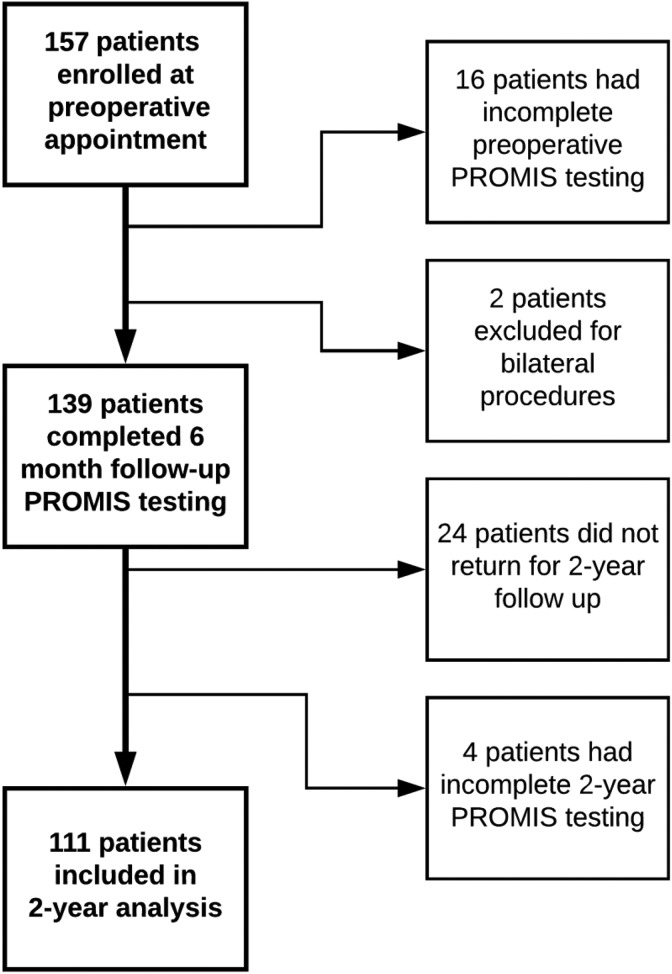
Methods: Initially, 157 patients completed the PROMIS PF CAT, Short Form-36 Health Survey (SF-36 physical function [PF] and general health [GH]), Marx Activity Rating Scale (MARS), Knee injury and Osteoarthritis Outcome Score (KOOS activities of daily living [ADL], sport, and quality of life [QOL]), and EuroQol-5 dimensions questionnaire (EQ-5D) at 6 weeks, 6 months, and 2 years after ACL reconstruction. Correlations between instruments, ceiling and floor effects, effect sizes (Cohen d), and standardized response means to describe responsiveness were evaluated. Subgroup analyses compared participants with and without additional arthroscopic procedures using linear mixed models.
Results: At baseline, 6 weeks, and 6 months, the PROMIS PF CAT showed excellent or excellent-good correlations with the SF-36 PF (r = 0.75-0.80, P < .01), KOOS-ADL (r = 0.63-0.70, P < .01), and KOOS-sport (r = 0.32-0.69, P < .01); excellent-good correlation with the EQ-5D (r = 0.60-0.71, P < .01); and good correlation with the KOOS-QOL (r = 0.52-0.58, P < .01). As expected, there were poor correlations with the MARS (r = 0.00-0.24, P < .01) and SF-36 GH (r = 0.16-0.34, P < .01 ). At 2 years, the PROMIS PF CAT showed good to excellent correlations with all PRO instruments (r = 0.42-0.72, P < .01), including the MARS (r = 0.42, P < .01), indicating frequent return to preinjury function. The PROMIS PF CAT had the fewest ceiling or floor effects of all instruments tested, and patients answered, on average, 4 questions. There was no significant difference in baseline physical function scores between subgroups; at follow-up, all groups showed improvements in scores that were not statistically different.
Conclusion: The PROMIS PF CAT is a valid tool to assess outcomes after ACL reconstruction up to 2 years after surgery, demonstrating the highest responsiveness to change with the fewest ceiling and floor effects and a low time burden among all instruments tested. The PROMIS PF CAT is a beneficial alternative for assessing physical function in adults before and after ACL reconstruction.
Keywords: ACL; PROMIS; arthroscopic surgery; knee; outcomes.
Conflict of interest statement
One or more of the authors has declared the following potential conflict of interest or source of funding: R.W. receives educational support from Smith & Nephew and has received hospitality payments from Smith & Nephew. C.H. receives research support from Tornier and Zimmer Biomet, is a past consultant for Pacira Pharmaceuticals, and has received hospitality payments from Tornier and Arthrex. B.R.W. is a paid consultant for ConMed Linvatec, receives research support from OREF, receives educational support from Wardlow Enterprises, receives financial or material support from Arthrex and Smith & Nephew, is a speaker/presenter for Linvatec, and has received hospitality payments from Linvatec. M.J.B. receives financial or material support from Arthrex, has received hospitality payments from Arthrex and DePuy Orthopaedics, and is a paid speaker/presenter for Arthrex.
Figures
References
-
- Anthony CA, Glass NA, Hancock K, Bollier M, Wolf BR, Hettrich CM. Performance of PROMIS instruments in patients with shoulder instability. Am J Sports Med. 2017;45(2):449–453. - PubMed
-
- Barber-Westin SD, Noyes FR, McCloskey JW. Rigorous statistical reliability, validity, and responsiveness testing of the Cincinnati Knee Rating System in 350 subjects with uninjured, injured, or anterior cruciate ligament-reconstructed knees. Am J Sports Med. 1999;27(4):402–416. - PubMed
-
- Beaton DE, Schemitsch E. Measures of health-related quality of life and physical function. Clin Orthop Relat Res. 2003;(413):90–105. - PubMed
-
- Carr AJ. Evidence-based orthopaedic surgery: what type of research will best improve clinical practice? J Bone Joint Surg Br. 2005;87(12):1593–1594. - PubMed
LinkOut - more resources
Full Text Sources
Other Literature Sources
Medical
Research Materials
Miscellaneous
