


Season of birth and depression in adulthood: Revisiting historical forerunner evidence for in-utero effects
- PMID: 29854915
- PMCID: PMC5976843
- DOI: 10.1016/j.ssmph.2018.03.008
Season of birth and depression in adulthood: Revisiting historical forerunner evidence for in-utero effects
Erratum in
-
Erratum regarding missing Declaration of Competing Interest statements in previously published articles.SSM Popul Health. 2020 Dec 10;12:100711. doi: 10.1016/j.ssmph.2020.100711. eCollection 2020 Dec. SSM Popul Health. 2020. PMID: 33381634 Free PMC article.
Abstract
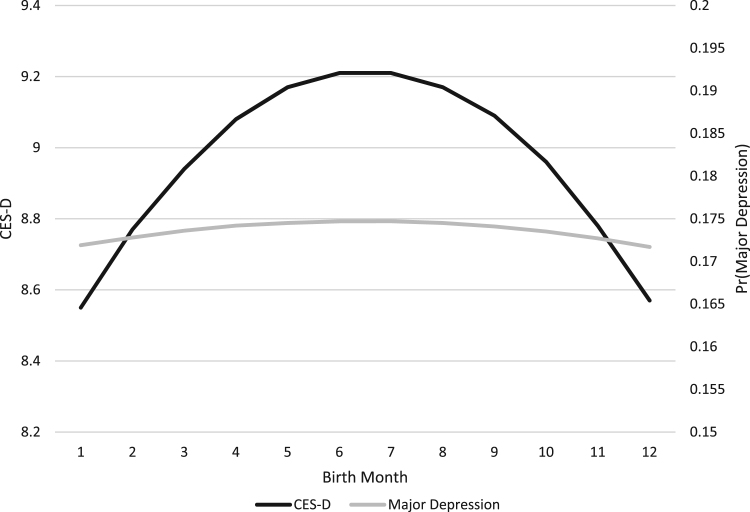
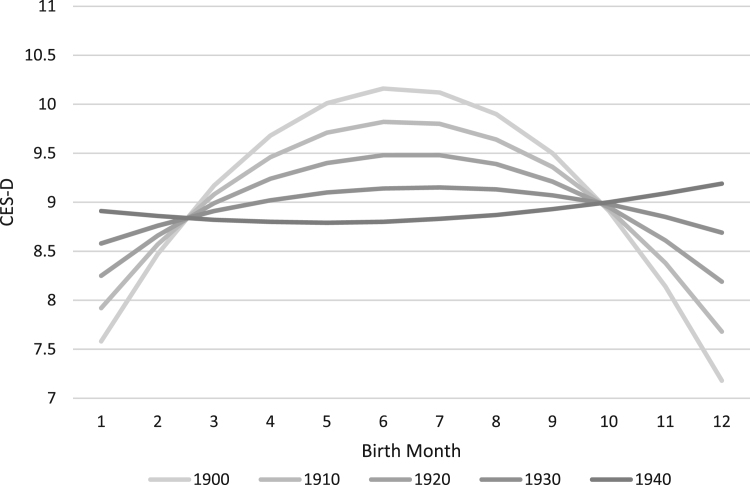
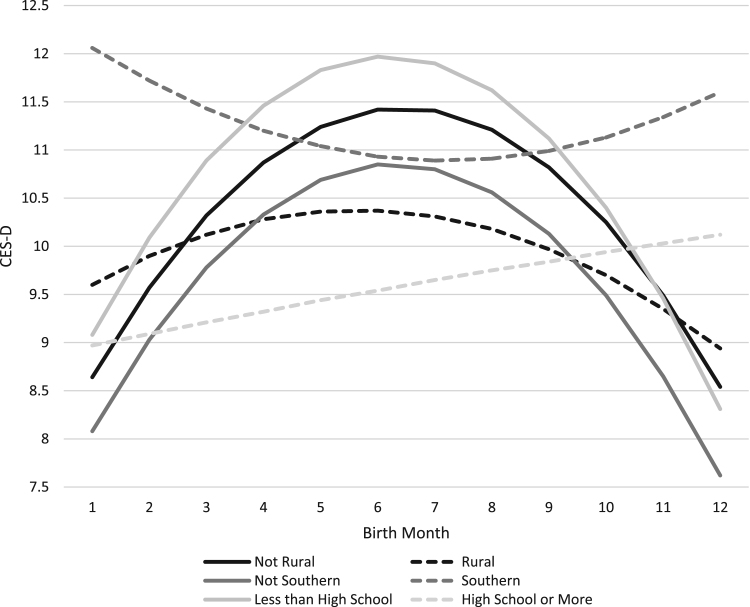
Evidence showing a relationship between season of birth and adult well-being is long-standing, but is now largely overlooked or dismissed. In light of increasingly compelling evidence for the effects of in-utero conditions on adult health, however, it is instructive to revisit the relationship, with an eye toward resolving the reasons for skepticism. This study uses data from the first National Health and Nutritional Examination Survey to examine the effects of month of birth on adult depression. The data correspond to an important time in history and the analysis points to one reason why enthusiasm for birth seasonality in depression has faded: although there was a strong relationship between month of birth and depression in the early 20th century, with spring and summer month births corresponding to significantly more depression, the relationship was largely eliminated by the 1940 birth cohort. Few adults alive today would be subject to this effect, but when it was apparent it was enormously consequential. Population attributable risk scenarios indicate that among those born between 1900 and 1920 the prevalence of major depression would have been reduced by approximately 22% if all births had been confined to November through March. The percent rises to 26% among those born between 1900 and 1910, and was likely even higher in earlier cohorts. Additional analyses point to the importance of nutritional deficits in explaining these effects. In the early 20th century, the relationship between month of birth and depression was weaker in circumstances where the food supply was less seasonally sensitive. For this reason, the turn-of-the-century relationship between month of birth and depression was much weaker among the well-educated, in Southern states, and in urban areas. Although birth seasonality in depression can be regarded as a historical artefact of diet and nutrition, evidence for its prior existence nonetheless speaks to the significance of other in-utero effects, both past and present.
Figures
References
-
- Adams W., Kendell R.E., Hare E.H., Munk-Jørgensen P. Epidemiological evidence that maternal influenza contributes to the aetiology of schizophrenia. An analysis of Scottish, English, and Danish data. The British Journal of Psychiatry. 1993;163:522. - PubMed
-
- Almond Douglas. Is the 1918 influenza pandemic over? Long-term effects of in utero influenza exposure in the post-1940 U.S. population. Journal of Political Economy. 2006;114:672–712.
-
- Bailar John C., Gurian Joan. Congenital malformations and season of birth: A brief review. Eugenics Quarterly. 1965;12:146–153. - PubMed
-
- Barker David J.P. British Medical Journal Books; London: 1992. Fetal and infant origins of adult disease.
-
- Barker David J.P. Churchill Livingstone; London: 1998. Mothers, babies, and health in later life.
LinkOut - more resources
Full Text Sources
Other Literature Sources
Miscellaneous
