. 2015 Jul 26;1(2):111-121.
doi: 10.1016/j.trci.2015.06.006. eCollection 2015 Sep.

Delayed-start analysis: Mild Alzheimer's disease patients in solanezumab trials, 3.5 years

Affiliations

Delayed-start analysis: Mild Alzheimer's disease patients in solanezumab trials, 3.5 years

Hong Liu-Seifert et al. Alzheimers Dement (N Y). .

Abstract

Introduction: Solanezumab is an anti-amyloid monoclonal antibody in clinical testing for treatment of Alzheimer's disease (AD). Its mechanism suggests the possibility of slowing the progression of AD.

Methods: A possible disease-modifying effect of solanezumab was assessed using a new statistical method including noninferiority testing. Performance differences were compared during the placebo-controlled period with performance differences after the placebo patients crossed over to solanezumab in the delayed-start period.

Results: Noninferiority of the 14-item Alzheimer's Disease Assessment Scale-Cognitive subscale (ADAS-Cog14) and Alzheimer's Disease Cooperative Study Activities of Daily Living inventory instrumental items (ADCS-iADL) differences was met through 132 weeks, indicating that treatment differences observed in the placebo-controlled period remained, within a predefined margin, after the placebo group initiated solanezumab. Solanezumab was well tolerated, and no new safety concerns were identified.

Discussion: The results of this secondary analysis show that the mild subgroup of solanezumab-treated patients who initiated treatment early, at the start of the placebo-controlled period, retained an advantage at most time points in the delayed-start period.

Keywords: Alzheimer's disease; Anti-amyloid-β antibody; Clinical trials; Delayed-start; Solanezumab.


Figures
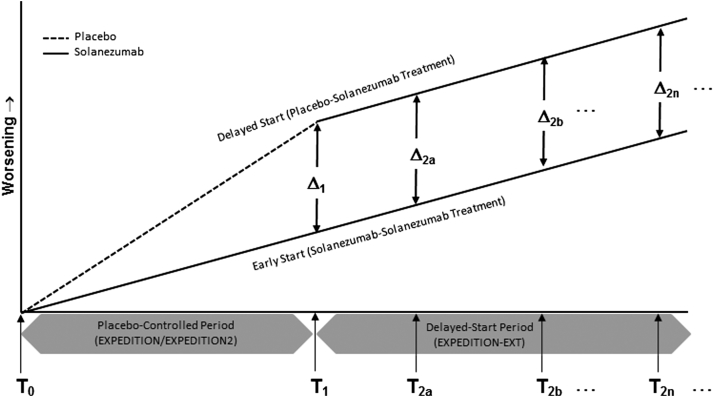
Fig. 1
Fig. 1
Model of delayed-start design and analysis in the solanezumab EXPEDITION program. T0 = beginning time point in the placebo-controlled period; T1 = end time point in the placebo-controlled period/beginning time point in the delayed-start period; T2 = postbaseline time point in the delayed-start analysis (multiple time points are analyzed in the MMRM analysis; the primary time point for the delayed-start analysis in the EXPEDITION program was 108 weeks, that is, 28 weeks after the start of the delayed-start period); Δ1 = the true treatment difference at T1; Δ2 = the true treatment difference at T2. Abbreviation: MMRM, mixed-model repeated measure.
Fig. 2
Fig. 2
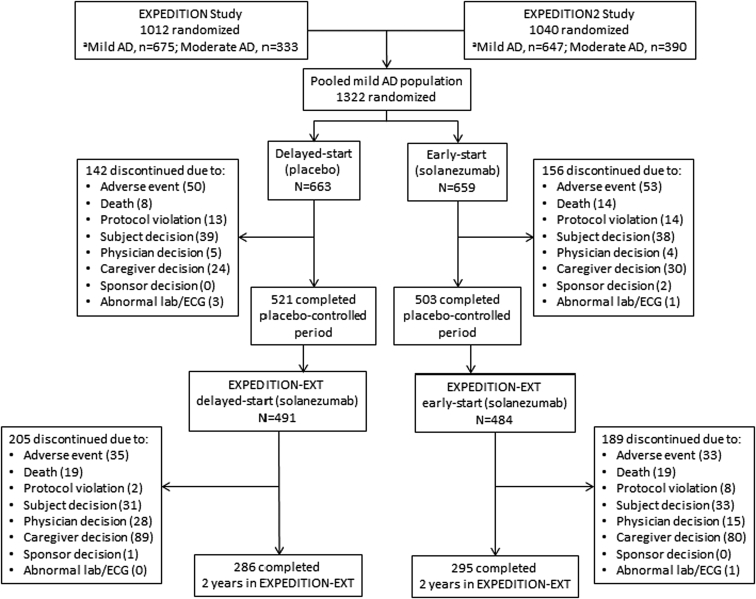
Flow of study participants. Abbreviations: AD, Alzheimer's disease; lab, laboratory measure; ECG, electrocardiogram; MMSE, Mini-Mental Status Examination. aDisease severity was based on MMSE score at baseline (mild, MMSE 20–26; moderate, MMSE 16–19). Baseline MMSE was outside of the study eligibility range (>26) for some randomized subjects, and these individuals were not categorized based on disease severity or included in pooled mild AD data set.
Fig. 3
Fig. 3
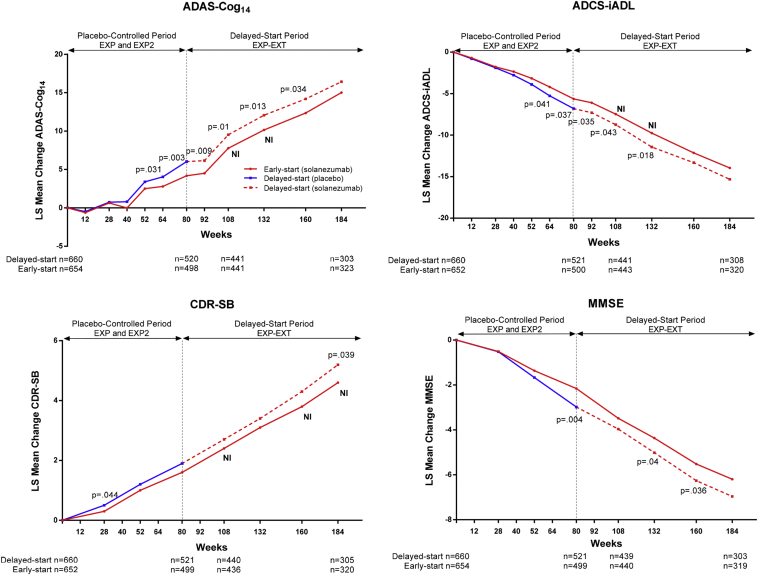
Delayed-start analysis of ADAS-Cog14, ADCS-iADL, MMSE, and CDR-SB among patients with mild AD in the solanezumab EXPEDITION program through 3.5 years. P values for treatment difference shown at all time points at which P < .05. Abbreviations: ADAS-Cog14, 14-item Alzheimer's Disease Assessment Scale-Cognitive subscale; ADCS-iADL, Alzheimer's Disease Cooperative Study Activities of Daily Living inventory, instrumental items; MMSE, Mini-Mental Status Examination; CDR-SB, Clinical Dementia Rating Scale-Sum of Boxes; AD, Alzheimer's disease; NI, noninferiority criterion met (90% one-sided confidence interval for Δ2 – 0.5Δ1 >0); LS, least squares.
Fig. 4
Fig. 4
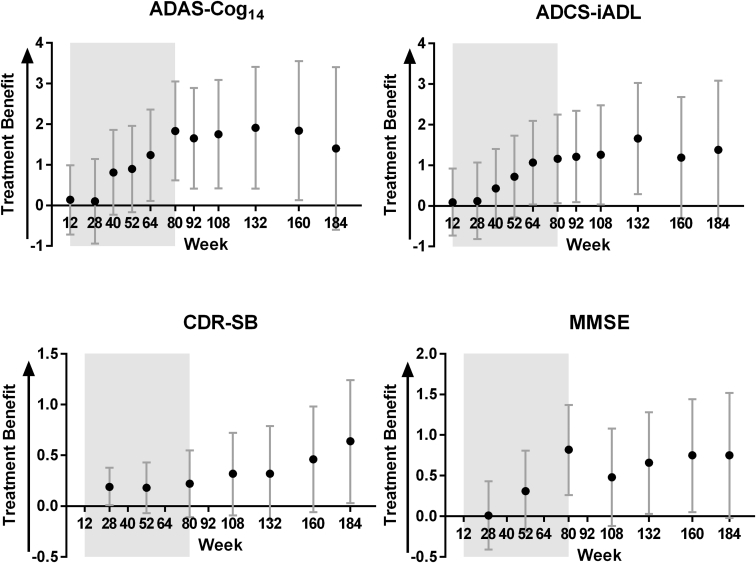
Differences in least squares means between delayed-start and early-start treatment groups and 95% confidence intervals for ADAS-Cog14, ADCS-iADL, CDR-SB, and MMSE among patients with mild AD in the solanezumab EXPEDITION program through 3.5 years. Shading represents the placebo-controlled period. Abbreviations: ADAS-Cog14, 14-item Alzheimer's Disease Assessment Scale-Cognitive subscale; ADCS-iADL, Alzheimer's Disease Cooperative Study Activities of Daily Living inventory, instrumental items; CDR-SB, Clinical Dementia Rating Scale-Sum of Boxes; MMSE, Mini-Mental Status Examination; AD, Alzheimer's disease.
Fig. S1
Fig. S1
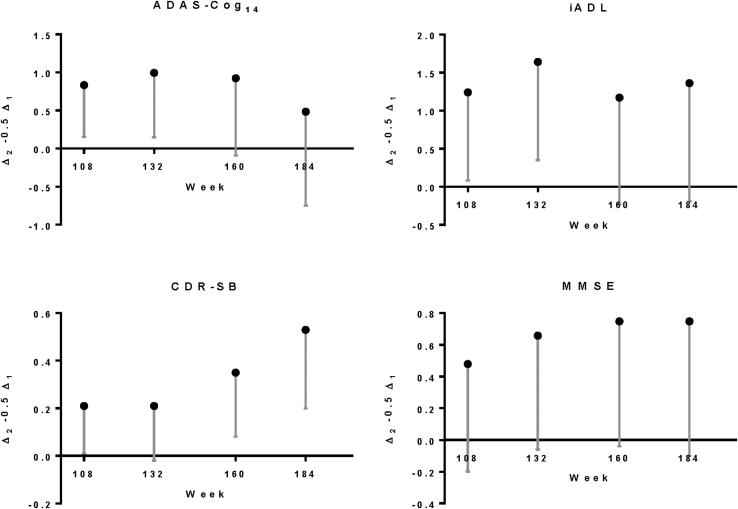
Noninferiority statistics for early-start compared with delayed-start treatment groups for ADAS-Cog14, ADCS-iADL, CDR-SB, and MMSE among patients with mild AD in the solanezumab Expedition program through 3.5 years. Point estimates represent Δ2–0.5Δ1, and error bars represent the lower 90% confidence limit. Abbreviations: ADAS-Cog14, 14-item Alzheimer's disease assessment scale–cognitive subscale; ADCS-iADL, Alzheimer's Disease Cooperative Study activities of daily living inventory, instrumental items; CDR-SB, clinical dementia rating scale–sum of boxes; MMSE, mini-mental status examination; AD, Alzheimer's disease.
Fig. S2
Fig. S2
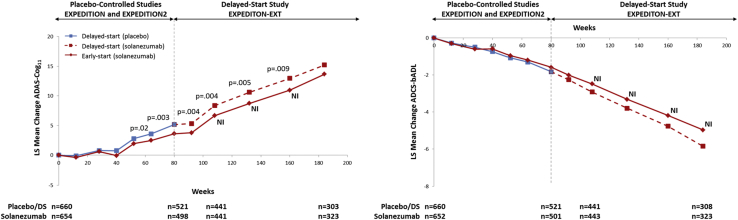
Delayed-start analysis of ADAS-Cog11 and ADCS-bADL among patients with mild AD in the solanezumab Expedition program through 3.5 years. Abbreviations: LS, least squares; ADAS-Cog11, 11-item Alzheimer's disease assessment scale–cognitive subscale; ADCS-bADL, Alzheimer's disease cooperative study activities of daily living inventory, basic items; NI, noninferiority criterion met (90% one-sided confidence interval for Δ2–0.5Δ1 >0); DS, delayed-start.
Fig. S3
Fig. S3
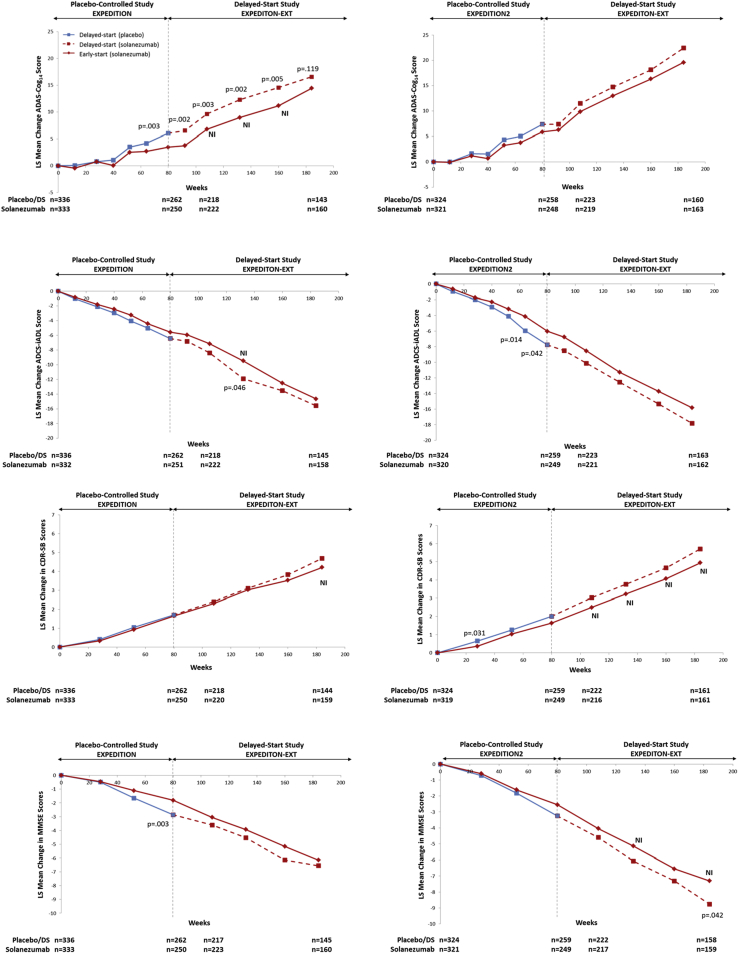
Delayed-start analysis of ADAS-Cog14, ADCS-iADL, MMSE, and CDR-SB among patients with mild AD in the solanezumab Expedition program by placebo-controlled study (Expedition and Expedition 2) through 3.5 years. Abbreviations: ADAS-Cog14, 14-item Alzheimer's disease assessment scale–cognitive subscale; ADCS-iADL, Alzheimer's disease cooperative study activities of daily living inventory, instrumental items; MMSE, mini-mental status examination; CDR-SB, clinical dementia rating scale–sum of boxes; AD, Alzheimer's disease; LS, least squares; DS, delayed-start; NI, noninferiority criterion met (90% one-sided confidence interval for Δ2–0.5Δ1 >0).
Fig. S4
Fig. S4
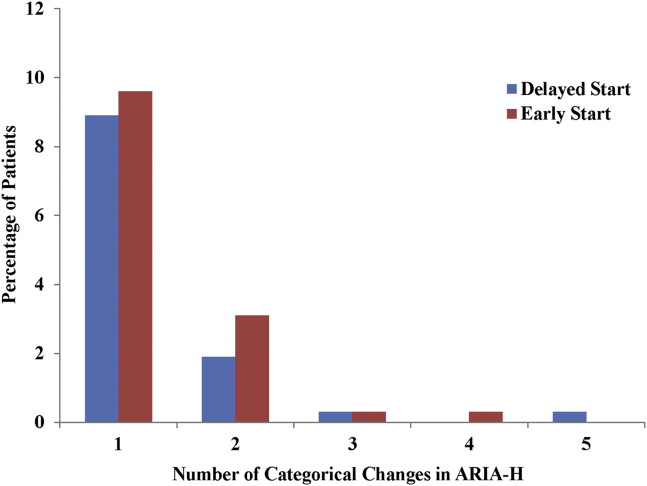
Categorical changes in ARIA-H. Categories: 0, 1, 2–5, 6–10, >10, and >10 with additional increase. Abbreviation: ARIA-H, amyloid-related imaging abnormality-hemorrhage/hemosiderin deposition.

References

    1. Galimberti D., Scarpini E. Disease-modifying treatments for Alzheimer's disease. Ther Adv Neurol Disord. 2001;4:203–216. - PMC - PubMed
    1. Leber P. Slowing the progression of Alzheimer disease: Methodologicalissues. Alzheimer Dis Assoc Disord. 1997;11:S10–S21. - PubMed
    1. Olanow C.W., Rascol O., Hauser R., Feigin P.D., Jankovic J., Lang A. A double-blind, delayed-start trial of rasagiline in Parkinson's disease. N Engl J Med. 2009;361:1268–1278. - PubMed
    1. Doody R.S., Geldmacher D.S., Gordon B., Perdomo C.A., Pratt R.D., Donepezil Study Group Open-label, multicenter, phase 3 extension study of the safety and efficacy of donepezil in patients with Alzheimer disease. Arch Neurol. 2001;58:427–433. - PubMed
    1. Winblad B., Wimo A., Engedal K., Soininen H., Verhey F., Waldemar G. 3-year study of donepezil therapy in Alzheimer's disease: Effects of early and continuous therapy. Dement Geriatr Cogn Disord. 2006;21:353–363. - PubMed