


Impact of CKD on Household Income
- PMID: 29854968
- PMCID: PMC5976816
- DOI: 10.1016/j.ekir.2017.12.008
Impact of CKD on Household Income
Abstract
Introduction: The impact of chronic kidney disease (CKD) on income is unclear. We sought to determine whether CKD severity, serious adverse events, and CKD progression affected household income.
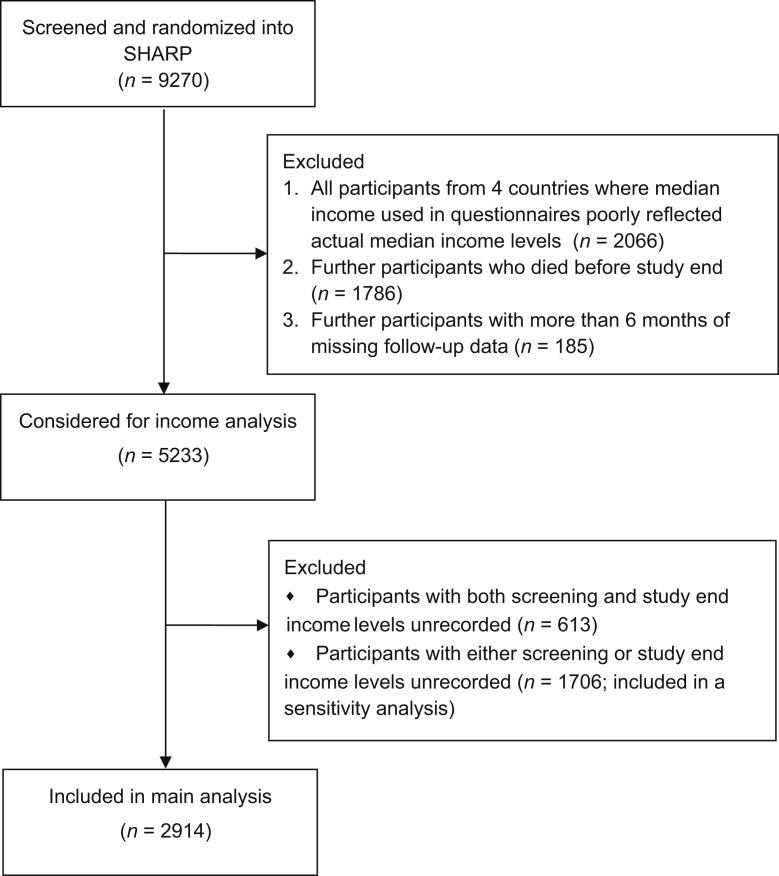
Methods: Analyses were undertaken in a prospective cohort of adults with moderate-to-severe CKD in the Study of Heart and Renal Protection (SHARP), with household income information available at baseline screening and study end. Logistic regressions, adjusted for sociodemographic characteristics, smoking, and prior diseases at baseline, estimated associations during the 5-year follow-up, among (i) baseline CKD severity, (ii) incident nonfatal serious adverse events (vascular or cancer), and (iii) CKD treatment modality (predialysis, dialysis, or transplanted) at study end and the outcome "fall into relative poverty." This was defined as household income <50% of country median income.
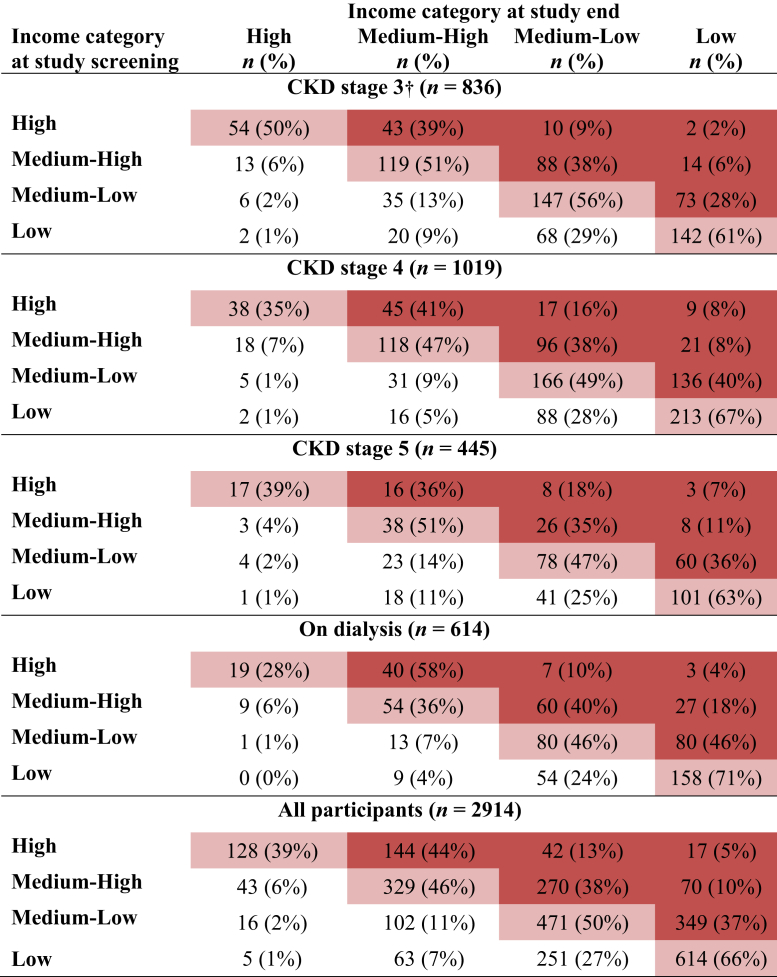
Results: A total of 2914 SHARP participants from 14 countries were included in the main analysis. Of these, 933 (32%) were in relative poverty at screening; of the remaining 1981, 436 (22%) fell into relative poverty by study end. Compared with participants with stage 3 CKD at baseline, the odds of falling into poverty were 51% higher for those with stage 4 (odds ratio [OR]: 1.51; 95% confidence interval [CI]: 1.09-2.10), 66% higher for those with stage 5 (OR: 1.66; 95% CI: 1.11-2.47), and 78% higher for those on dialysis at baseline (OR: 1.78, 95% CI: 1.22-2.60). Participants with kidney transplant at study end had approximately half the risk of those on dialysis or those with CKD stages 3 to 5.
Conclusion: More advanced CKD is associated with increased odds of falling into poverty. Kidney transplantation may have a role in reducing this risk.
Keywords: chronic renal insufficiency; dialysis; income; poverty; transplantation.
Figures
References
-
- Drey N.R.P., Mullee M., Rogerson M. A population-based study of the incidence and outcomes of diagnosed chronic kidney disease. Am J Kidney Dis. 2003;42:677–684. - PubMed
-
- Grace B., Clayton P., Cass A., McDonald S. Socio-economic status and incidence of renal replacement therapy: a registry study of Australian patients. Nephrol Dial Transplant. 2012;27:4173–4180. - PubMed
-
- Webster A.C., Nagler E.V., Morton R.L., Masson P. Chronic kidney disease. Lancet. 2017;389:1238–1252. - PubMed
Grants and funding
LinkOut - more resources
Full Text Sources
Other Literature Sources
