Measurement of the Optic Nerve Sheath Diameter with Magnetic Resonance Imaging and Its Association with Eyeball Diameter in Healthy Adults
- PMID: 29856162
- PMCID: PMC6032005
- DOI: 10.3988/jcn.2018.14.3.345
Measurement of the Optic Nerve Sheath Diameter with Magnetic Resonance Imaging and Its Association with Eyeball Diameter in Healthy Adults
Abstract
Background and purpose: The optic nerve sheath diameter (ONSD) is an indirect marker of the intracranial pressure, but the normal range of ONSD as measured using magnetic resonance imaging (MRI) and its associations with clinical parameters and the eyeball transverse diameter (ETD) remain unclear.
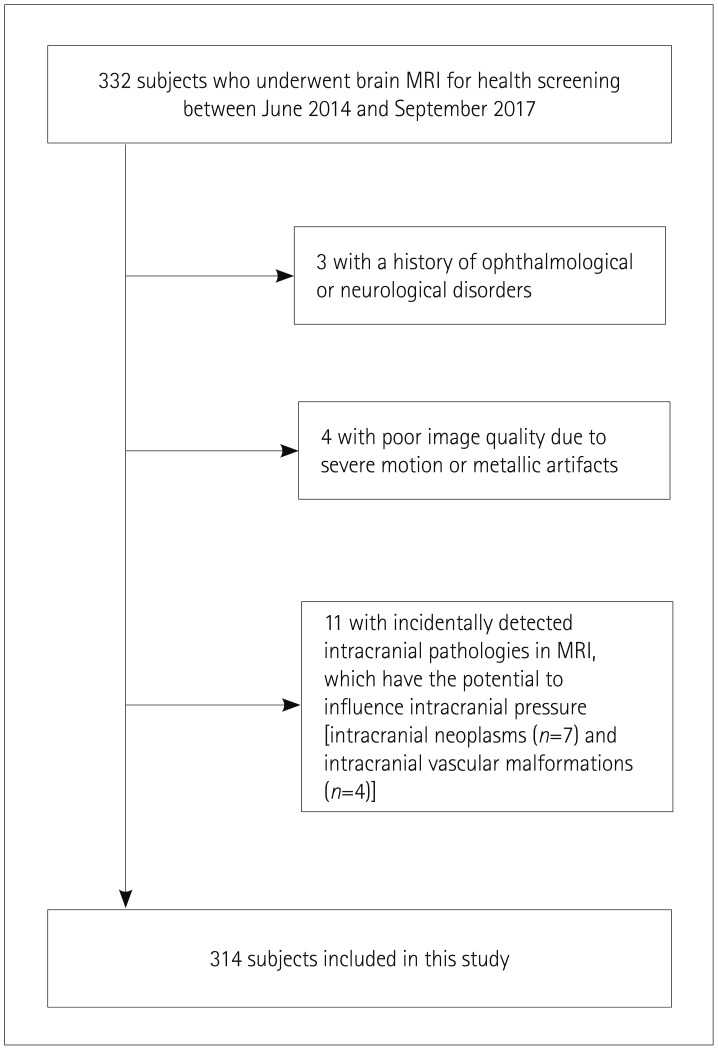
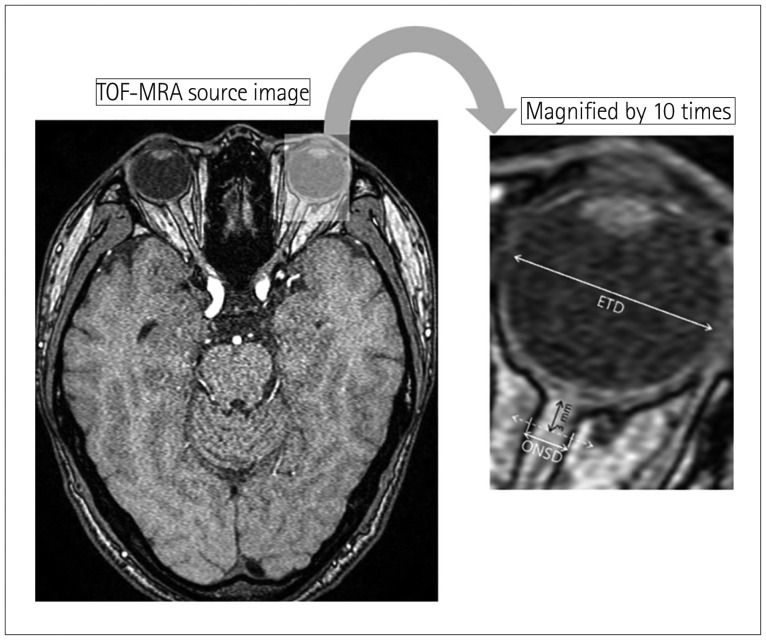
Methods: We included 314 healthy adults who underwent brain MRI examinations for health screening between June 2014 and September 2017. The ONSD and ETD of each eye were calculated using time-of-flight magnetic resonance angiography. Linear regression analyses were performed to assess the relationships between ONSD and variables including age, sex, height, weight, body mass index (BMI), mean arterial blood pressure (MABP), intraocular pressure (IOP), and ETD. We further investigated a normative value for the ONSD/ETD ratio and its associated factors.
Results: The mean ONSD and ETD were 4.71 mm [95% confidence interval (CI), 4.66-4.75 mm] and 21.24 mm (95% CI, 21.13-21.35 mm), respectively. Multiple linear regression analysis showed that ONSD was only associated with ETD (p<0.001), with it being independent of age, sex, height, weight, BMI, MABP, and IOP. The ONSD/ETD ratio had a mean value of 0.22 (95% CI, 0.22-0.22), and was not correlated with age, sex, height, weight, BMI, MABP, or IOP.
Conclusions: This study determined the normative value of MRI-based ONSD in healthy Korean adults. There was a strong correlation between the ETD and ONSD, which can be presented as the ONSD/ETD ratio. This parameter needs to be investigated further in disease populations.
Keywords: Korean; eyeball transverse diameter; healthy; magnetic resonance imaging; optic nerve sheath diameter.
Copyright © 2018 Korean Neurological Association.
Conflict of interest statement
The authors have no financial conflicts of interest.
Figures
References
-
- Balestreri M, Czosnyka M, Hutchinson P, Steiner LA, Hiler M, Smielewski P, et al. Impact of intracranial pressure and cerebral perfusion pressure on severe disability and mortality after head injury. Neurocrit Care. 2006;4:8–13. - PubMed
LinkOut - more resources
Full Text Sources
Other Literature Sources