


Beyond the "at risk mental state" concept: transitioning to transdiagnostic psychiatry
- PMID: 29856558
- PMCID: PMC5980504
- DOI: 10.1002/wps.20514
Beyond the "at risk mental state" concept: transitioning to transdiagnostic psychiatry
Abstract
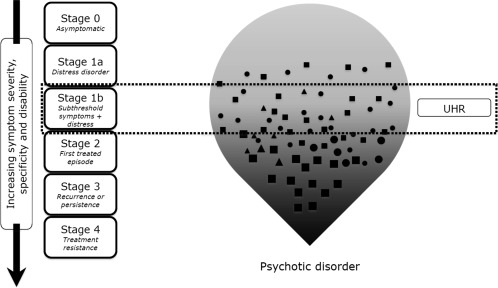
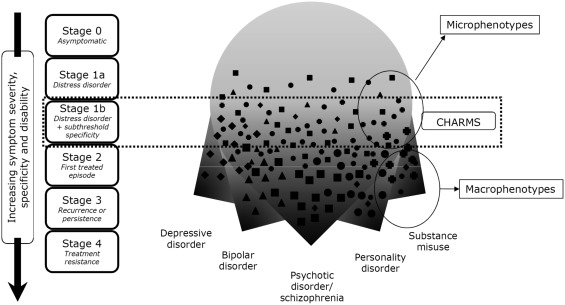
The "at risk mental state" for psychosis approach has been a catalytic, highly productive research paradigm over the last 25 years. In this paper we review that paradigm and summarize its key lessons, which include the valence of this phenotype for future psychosis outcomes, but also for comorbid, persistent or incident non-psychotic disorders; and the evidence that onset of psychotic disorder can at least be delayed in ultra high risk (UHR) patients, and that some full-threshold psychotic disorder may emerge from risk states not captured by UHR criteria. The paradigm has also illuminated risk factors and mechanisms involved in psychosis onset. However, findings from this and related paradigms indicate the need to develop new identification and diagnostic strategies. These findings include the high prevalence and impact of mental disorders in young people, the limitations of current diagnostic systems and risk identification approaches, the diffuse and unstable symptom patterns in early stages, and their pluripotent, transdiagnostic trajectories. The approach we have recently adopted has been guided by the clinical staging model and adapts the original "at risk mental state" approach to encompass a broader range of inputs and output target syndromes. This approach is supported by a number of novel modelling and prediction strategies that acknowledge and reflect the dynamic nature of psychopathology, such as dynamical systems theory, network theory, and joint modelling. Importantly, a broader transdiagnostic approach and enhancing specific prediction (profiling or increasing precision) can be achieved concurrently. A holistic strategy can be developed that applies these new prediction approaches, as well as machine learning and iterative probabilistic multimodal models, to a blend of subjective psychological data, physical disturbances (e.g., EEG measures) and biomarkers (e.g., neuroinflammation, neural network abnormalities) acquired through fine-grained sequential or longitudinal assessments. This strategy could ultimately enhance our understanding and ability to predict the onset, early course and evolution of mental ill health, further opening pathways for preventive interventions.
Keywords: At risk mental state; CHARMS; clinical staging; dynamical systems theory; joint modelling; network theory; prediction strategies; psychosis; transdiagnostic psychiatry; transition; ultra high risk.
© 2018 World Psychiatric Association.
Figures
References
-
- McGorry PD, Edwards J, Mihalopoulos C et al. EPPIC: an evolving system of early detection and optimal management. Schizophr Bull 1996;22:305‐26. - PubMed
-
- McGorry PD, Copolov DL, Singh BS. Current concepts in functional psychosis. The case for a loosening of associations. Schizophr Res 1990;3:221‐34. - PubMed
-
- Henry LP, Harris MG, Amminger GP et al. Early Psychosis Prevention and Intervention Centre long‐term follow‐up study of first‐episode psychosis: methodology and baseline characteristics. Early Interv Psychiatry 2007;1:49‐60. - PubMed
-
- Fusar‐Poli P, Bonoldi I, Yung AR et al. Predicting psychosis: meta‐analysis of transition outcomes in individuals at high clinical risk. Arch Gen Psychiatry 2012;69:220‐9. - PubMed
LinkOut - more resources
Full Text Sources
Other Literature Sources
Medical
