


Associative nitrogen fixation (ANF) in switchgrass (Panicum virgatum) across a nitrogen input gradient
- PMID: 29856843
- PMCID: PMC5983442
- DOI: 10.1371/journal.pone.0197320
Associative nitrogen fixation (ANF) in switchgrass (Panicum virgatum) across a nitrogen input gradient
Abstract
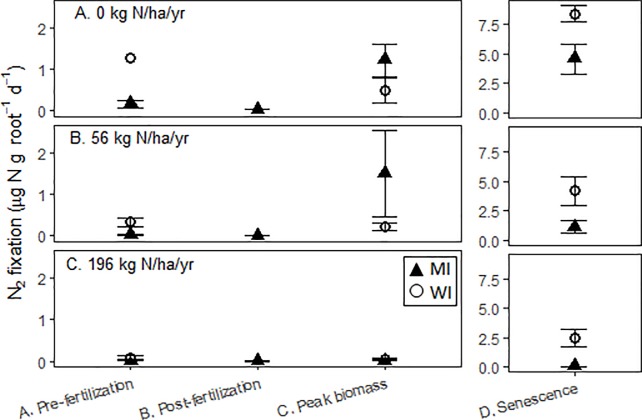
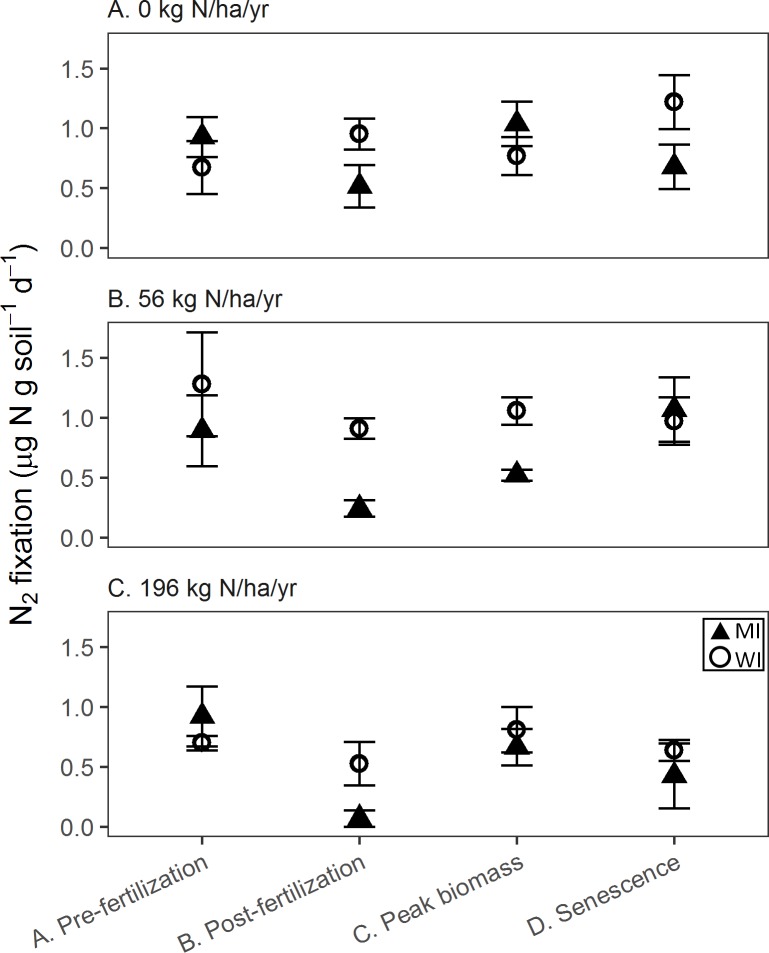
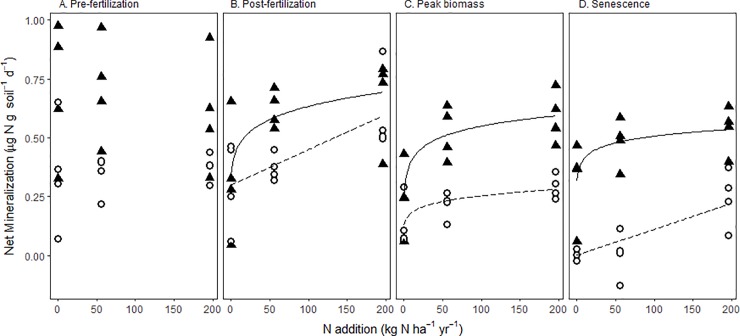
Associative N fixation (ANF), the process by which dinitrogen gas is converted to ammonia by bacteria in casual association with plants, has not been well-studied in temperate ecosystems. We examined the ANF potential of switchgrass (Panicum virgatum L.), a North American prairie grass whose productivity is often unresponsive to N fertilizer addition, via separate short-term 15N2 incubations of rhizosphere soils and excised roots four times during the growing season. Measurements occurred along N fertilization gradients at two sites with contrasting soil fertility (Wisconsin, USA Mollisols and Michigan, USA Alfisols). In general, we found that ANF potentials declined with long-term N addition, corresponding with increased soil N availability. Although we hypothesized that ANF potential would track plant N demand through the growing season, the highest root fixation rates occurred after plants senesced, suggesting that root diazotrophs exploit carbon (C) released during senescence, as C is translocated from aboveground tissues to roots for wintertime storage. Measured ANF potentials, coupled with mass balance calculations, suggest that ANF appears to be an important source of N to unfertilized switchgrass, and, by extension, to temperate grasslands in general.
Conflict of interest statement
The authors have declared that no competing interests exist.
Figures
References
-
- Bormann BT, Bormann FH, Bowden WB, Pierce RS, Hamburg SP, Wang D, et al. Rapid N2 fixation in pines, alder, and locust—evidence from the sandbox ecosystem study. Ecology. 1993;74(2):583–98.
-
- Chapman HD, Liebig GF, Rayner DS. A lysimeter investigation of nitrogen gains and losses under various systems of covercropping and fertilization, and a discussion of error sources. Hilgardia. 1949;19(3):57–128.
-
- Oelze J. Respiratory protection of nitrogenase in Azotobacter species: is a widely held hypothesis unequivocally supported by experimental evidence? FEMS Microbiology Reviews. 2000;24:321–33. - PubMed
-
- Postgate JR. Nitrogen fixation. 3rd ed. Cambridge, UK: University Press; 1998. 112 p.
Publication types
MeSH terms
Substances
Associated data
LinkOut - more resources
Full Text Sources
Other Literature Sources
