


Global Estimate of Lung Cancer Mortality Attributable to Residential Radon
- PMID: 29856911
- PMCID: PMC6072010
- DOI: 10.1289/EHP2503
Global Estimate of Lung Cancer Mortality Attributable to Residential Radon
Abstract
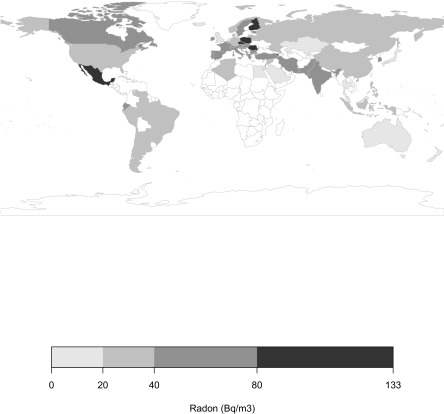
Background: Radon is the second most important cause of lung cancer, ranked by the World Health Organization as the fifth leading cause of mortality in 2010. An updated database of national radon exposures for 66 countries allows the global burden of lung cancer mortality attributable to radon to be estimated.
Objective: Our goal was to estimate the global population attributable burden of lung cancer mortality in 2012 from residential radon.
Methods: Estimates of the population attributable risk (PAR) of lung cancer mortality from radon were determined using the attributable fraction approach, using three models for excess relative risk of lung cancer from radon.
Results: The estimates of the median PAR of lung cancer mortality from residential radon in 2012 for the 66 countries having representative national radon surveys were consistent, as 16.5%, 14.4%, and 13.6% for the exposure-age-concentration (EAC) model (BEIR VI), the Hunter model, and the Kreuzer model, respectively. The mean PAR using the EAC model ranged from 4.2% (95% CI: 0.9, 11.7) for Japan, to 29.3% (95% CI: 22.9, 35.7) for Armenia, with a median for the 66 countries of 16.5%. Radon-attributable lung cancer deaths for all 66 countries totaled 226,057 in 2012 and represent a median of 3.0% of total cancer deaths.
Conclusions: Consistent findings between the three models used to estimate excess relative risks of lung cancer from radon, and between the attributable fraction methodology and the life table analysis, confirm that residential radon is responsible for a substantial proportion of lung cancer mortality worldwide. https://doi.org/10.1289/EHP2503.
Figures
Comment in
-
Radon Risk: A Global Estimate of Radon's Contribution to Lung Cancer.Environ Health Perspect. 2019 Feb;127(2):24001. doi: 10.1289/EHP4169. Environ Health Perspect. 2019. PMID: 30741556 Free PMC article.
References
-
- Darby S, Hill D, Deo H, Auvinen A, Barros-Dios JM, Baysson H, et al. 2006. Residential radon and lung cancer—detailed results of a collaborative analysis of individual data on 7148 persons with lung cancer and 14,208 persons without lung cancer from 13 epidemiologic studies in Europe. Scand J Work Environ Health 32(suppl 1):1–84. - PubMed
MeSH terms
Substances
LinkOut - more resources
Full Text Sources
Other Literature Sources
Medical