


Thalamocortical Circuits and Functional Architecture
- PMID: 29856937
- PMCID: PMC7525828
- DOI: 10.1146/annurev-vision-091517-034122
Thalamocortical Circuits and Functional Architecture
Abstract
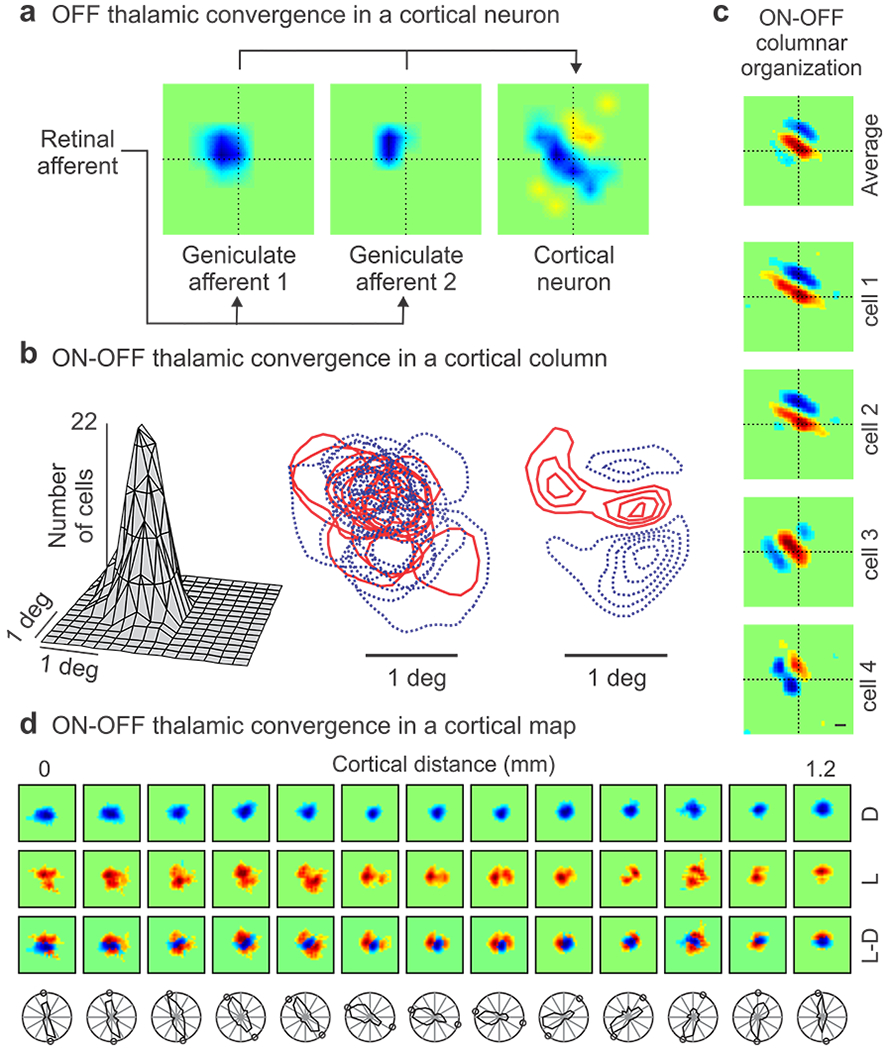
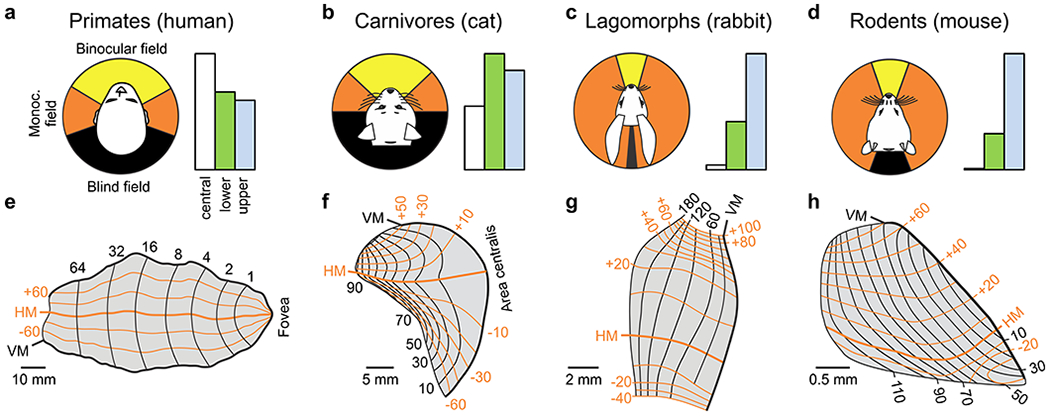
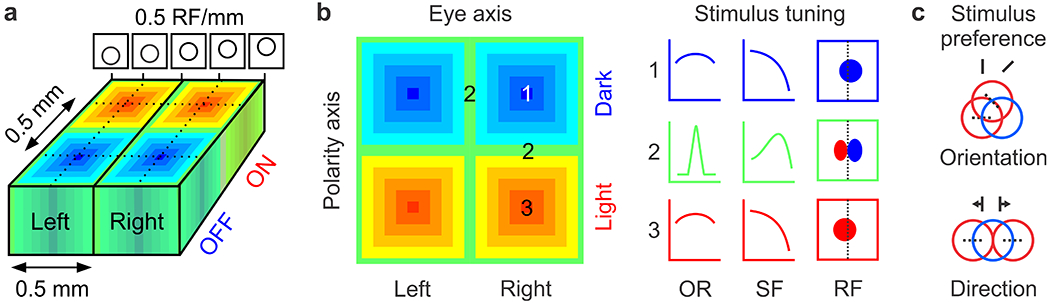
The thalamocortical pathway is the main route of communication between the eye and the cerebral cortex. During embryonic development, thalamocortical afferents travel to L4 and are sorted by receptive field position, eye of origin, and contrast polarity (i.e., preference for light or dark stimuli). In primates and carnivores, this sorting involves numerous afferents, most of which sample a limited region of the binocular field. Devoting abundant thalamocortical resources to process a limited visual field has a clear advantage: It allows many stimulus combinations to be sampled at each spatial location. Moreover, the sampling efficiency can be further enhanced by organizing the afferents in a cortical grid for eye input and contrast polarity. We argue that thalamocortical interactions within this eye-polarity grid can be used to represent multiple stimulus combinations found in nature and to build an accurate cortical map for multidimensional stimulus space.
Keywords: cortical map; receptive field; thalamocortical; thalamus; visual cortex; visual development.
Figures
References
-
- Adams DL, Horton JC. 2003a. Capricious expression of cortical columns in the primate brain. Nature neuroscience 6: 113–4 - PubMed
-
- Allendoerfer KL, Shatz CJ. 1994. The subplate, a transient neocortical structure: its role in the development of connections between thalamus and cortex. Annual review of neuroscience 17: 185–218 - PubMed
Publication types
MeSH terms
Grants and funding
LinkOut - more resources
Full Text Sources
Other Literature Sources
