Review
. 2019 Jul:91:119-131.
doi: 10.1016/j.semcdb.2018.05.024. Epub 2018 Jun 5.

Evolution, kidney development, and chronic kidney disease

Affiliations
Review

Evolution, kidney development, and chronic kidney disease

Robert L Chevalier. Semin Cell Dev Biol. 2019 Jul.

Abstract

There is a global epidemic of chronic kidney disease (CKD) characterized by a progressive loss of nephrons, ascribed in large part to a rising incidence of hypertension, metabolic syndrome, and type 2 diabetes mellitus. There is a ten-fold variation in nephron number at birth in the general population, and a 50% overall decrease in nephron number in the last decades of life. The vicious cycle of nephron loss stimulating hypertrophy by remaining nephrons and resulting in glomerulosclerosis has been regarded as maladaptive, and only partially responsive to angiotensin inhibition. Advances over the past century in kidney physiology, genetics, and development have elucidated many aspects of nephron formation, structure and function. Parallel advances have been achieved in evolutionary biology, with the emergence of evolutionary medicine, a discipline that promises to provide new insight into the treatment of chronic disease. This review provides a framework for understanding the origins of contemporary developmental nephrology, and recent progress in evolutionary biology. The establishment of evolutionary developmental biology (evo-devo), ecological developmental biology (eco-devo), and developmental origins of health and disease (DOHaD) followed the discovery of the hox gene family, the recognition of the contribution of cumulative environmental stressors to the changing phenotype over the life cycle, and mechanisms of epigenetic regulation. The maturation of evolutionary medicine has contributed to new investigative approaches to cardiovascular disease, cancer, and infectious disease, and promises the same for CKD. By incorporating these principles, developmental nephrology is ideally positioned to answer important questions regarding the fate of nephrons from embryo through senescence.

Keywords: Chronic kidney disease; Development; Epigenetics; Evolution; Genetics; Physiology.


Conflict of interest statement

The author has no competing interests to declare.

Figures
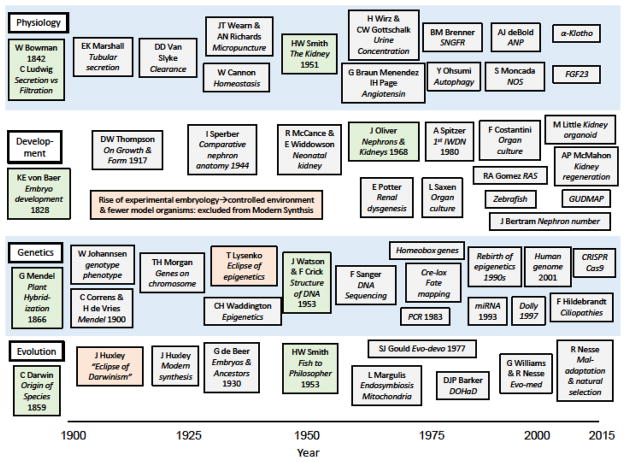
Figure 1
Figure 1
Parallel timelines of significant advances and publications in physiology, developmental biology, and genetics contributing to the current status of developmental nephrology. Whereas progress in these disciplines has been interdependent, inclusion of evolutionary biology has been minimal, with the exception of studies by Homer Smith and Jean Oliver in the mid-20th century. A century after Charles Darwin’s publication of the Origin of Species in 1859, major advances in molecular genetics have led to a renaissance for evolutionary biology. The new disciplines of evolutionary developmental biology (evo-devo), developmental origins of health and disease (DOHaD) and evolutionary medicine (evo-med) are particularly relevant to future investigation of kidney development and the progression of chronic kidney disease. Green boxes, key publications; red boxes, factors delaying progress. Abbreviations: ANP, atrial natriuretic factor; CRISPR, Clustered Regularly Interspaced Short Palindromic Repeats; Cas9, CRISPR associated protein 9; DNA, deoxyribonucleic acid; DOHaD, developmental origins of health and disease; Dolly, first cloned mammal (sheep); Evo-devo, evolutionary developmental biology; Evo-med, evolutionary medicine; FGF23, fibroblast growth factor 23; GUDMAP, GenitoUrinary Development Molecular Anatomy Project; IWDN, International Workshop of Developmental Nephrology; miRNA, micro RNA; NOS, nitric oxide synthase; PCR, polymerase chain reaction; RAS, renin-angiotensin system; SNGFR, single nephron glomerular filtration rate.
Figure 2
Figure 2
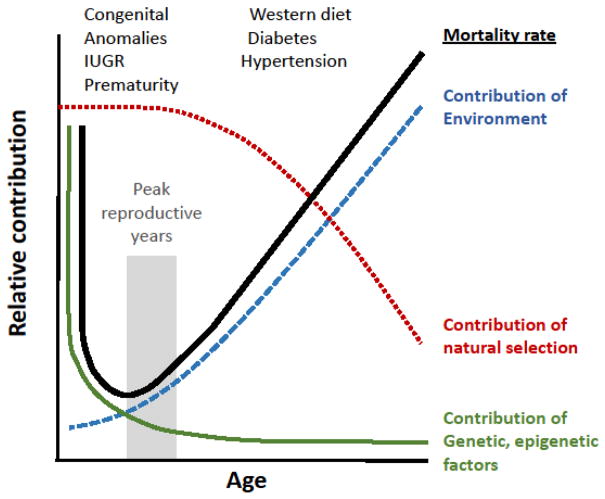
Factors contributing to mortality rate across the human lifespan. The V-shaped solid line represents overall mortality rate, which is high in early embryonic life, decreases to a nadir in early adolescence, then increases linearly in adulthood. The mortality curve is the summation of two intersecting curves: genetic and epigenetic factors predominate in early development (early embryonic mortality is primarily the result of lethal mutations), whereas cumulative environmental factors account for the increasing mortality in post reproductive life. Natural selection operates from conception through reproductive years, and decreases thereafter. Congenital anomalies of the kidneys and urinary tract, compounded by intrauterine growth restriction and prematurity, are the leading cause of CKD in childhood; diabetes and hypertension, promoted by the Western diet, account for most CKD in adulthood. However, prenatal and perinatal factors are now recognized as additional contributors to the progression of adult CKD. Adapted from Barton Childs, Acceptance of the Howland Award, Pediatr. Res. 26:392, 1989 [70].
Figure 3
Figure 3
Factors determining the developmental origins of health and disease (DOHaD). Environmental cues can affect the epigenome of gametes of both parents, the zygote, and the developing embryo, fetus, and infant. Of primary relevance to developmental nephrology, epigenetic factors can modulate nephron number at birth. Through cumulative effects on gene expression and metabolism, susceptibility to CKD is increased. K.M. Godfrey et al. The developmental environment, epigenetic biomakers and long-term health, J. Devel. Origins Health Dis. 6:403, 2015 [79].

References

    1. Global Facts About Kidney Disease. National Kidney Foundation; Oct 22, 2017. https://www.kidney.org/kidneydisease/global-facts-about-kidney-disease, 2015.
    1. Jamison RL. Resolving an 80-yr-old controversy: the beginning of the modern era of renal physiology. Adv Physiol Educ. 2014;38:286–295. - PubMed
    1. Smith HW. The Kidney. Oxford University Press; New York: 1951.
    1. Wirz H, Hargitay B, Kuhn W. Lokalisation des konzentrierungsprozesses in der niere durch direkte kryoskopie. Helv Physiol Pharmcol Acta. 1951;9:196–207. - PubMed
    1. Gottschalk CW, Mylle M. Micropuncture study of the mammalian urinary concentrating mechanism: evidence for the countercurrent hypothesis. Am J Physiol. 1959;196:936. - PubMed

Publication types

MeSH terms