


Development and Validation of a Scoring System to Predict Outcomes of Vedolizumab Treatment in Patients With Crohn's Disease
- PMID: 29857091
- PMCID: PMC6419724
- DOI: 10.1053/j.gastro.2018.05.039
Development and Validation of a Scoring System to Predict Outcomes of Vedolizumab Treatment in Patients With Crohn's Disease
Abstract
Background & aims: As more treatment options for inflammatory bowel diseases become available, it is important to identify patients most likely to respond to different therapies. We created and validated a scoring system to identify patients with Crohn's disease (CD) who respond to vedolizumab.
Methods: We collected data from the GEMINI 2 phase 3 trial of patients with active CD treated with vedolizumab for 26 weeks (n = 814) and performed logistic regression analysis to identify factors associated with clinical, steroid-free, and durable remission (derivation set). We used these data to develop a clinical decision support tool, which we validated using data from 366 participants in a separate clinical practice observational cohort of patients with active CD treated with vedolizumab for 26 weeks (the VICTORY cohort). We evaluated the ability of this tool to identify patients in clinical remission or corticosteroid-free remission, or those with mucosal healing (MH), clinical remission with MH, or corticosteroid-free remission with MH after vedolizumab therapy using receiver operating characteristic area under the curve (AUC) analyses. The primary outcome was to develop and validate a list of factors associated with achieving remission by vedolizumab in patients with active CD.
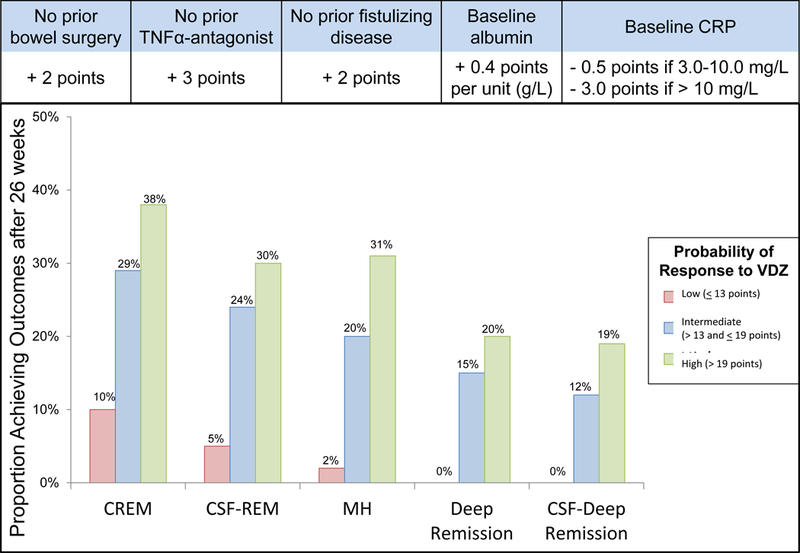
Results: In the derivation analysis, we identified absence of previous treatment with a tumor necrosis factor antagonist (+3 points), absence of prior bowel surgery (+2 points), absence of prior fistulizing disease (+2 points), baseline level of albumin (+0.4 points per g/L), and baseline concentration of C-reactive protein (reduction of 0.5 points for values between 3.0 and 10.0 mg/L and 3.0 points for values >10.0 mg/L) as factors associated with remission. In the validation set, our model identified patients in clinical remission with an AUC of 0.67, patients in corticosteroid-free remission with an AUC of 0.66, patients with MH with an AUC of 0.72, patients in clinical remission with MH with an AUC of 0.73, and patients in corticosteroid-free clinical remission with MH with an AUC of 0.75. A cutoff value of 13 points identified patients in clinical remission after vedolizumab therapy with 92% sensitivity, patients in corticosteroid-free remission with 94% sensitivity, patients with MH with 98% sensitivity, patients with clinical remission and MH with 100% sensitivity, and patients with corticosteroid-free clinical remission with MH with 100% sensitivity.
Conclusions: We developed and validated a scoring system to identify patients with CD most likely to respond to 26 weeks of vedolizumab therapy. Further studies are needed to optimize its accuracy in select populations and determine its cost-effectiveness.
Keywords: Biomarker; CD; IBD; Prediction Model.
Copyright © 2018 AGA Institute. Published by Elsevier Inc. All rights reserved.
Conflict of interest statement
Potential Conflicts of Interest:
All other authors have no disclosures or potential conflicts of interest.
Figures
References
-
- Sandborn WJ, Feagan BG, Rutgeerts P, Hanauer S, Colombel JF, Sands BE, Lukas M, Fedorak RN, Lee S, Bressler B, Fox I, Rosario M, Sankoh S, Xu J, Stephens K, Milch C, Parikh A, Group GS. Vedolizumab as induction and maintenance therapy for Crohn’s disease. N Engl J Med 2013;369:711–21. - PubMed
-
- Ha C, Ullman TA, Siegel CA, Kornbluth A. Patients enrolled in randomized controlled trials do not represent the inflammatory bowel disease patient population. Clin Gastroenterol Hepatol 2012;10:1002–1007. - PubMed
-
- Dulai PS, Singh S, Jiang X, Peerani F, Narula N, Chaudrey K, Whitehead D, Hudesman D, Lukin D, Swaminath A, Shmidt E, Wang S, Boland BS, Chang JT, Kane S, Siegel CA, Loftus EV, Sandborn WJ, Sands BE, Colombel JF. The Real-World Effectiveness and Safety of Vedolizumab for Moderate-Severe Crohn’s Disease: Results From the US VICTORY Consortium. Am J Gastroenterol 2016;111:1147–55. - PubMed
-
- Stallmach A, Langbein C, Atreya R, Bruns T, Dignass A, Ende K, Hampe J, Hartmann F, Neurath MF, Maul J, Preiss JC, Schmelz R, Siegmund B, Schulze H, Teich N, von Arnim U, Baumgart DC, Schmidt C. Vedolizumab provides clinical benefit over 1 year in patients with active inflammatory bowel disease - a prospective multicenter observational study. Aliment Pharmacol Ther 2016;44:1199–1212. - PubMed
-
- Sands BE, Feagan BG, Rutgeerts P, Colombel JF, Sandborn WJ, Sy R, D’Haens G, Ben-Horin S, Xu J, Rosario M, Fox I, Parikh A, Milch C, Hanauer S. Effects of vedolizumab induction therapy for patients with Crohn’s disease in whom tumor necrosis factor antagonist treatment failed. Gastroenterology 2014;147:618–627.e3. - PubMed
Publication types
MeSH terms
Substances
Grants and funding
LinkOut - more resources
Full Text Sources
Other Literature Sources
Medical
Research Materials
