Review
. 2018 May 31;10(6):173.
doi: 10.3390/cancers10060173.

The Role of JMY in p53 Regulation

Affiliations
Review

The Role of JMY in p53 Regulation

Omanma Adighibe et al. Cancers (Basel). .

Abstract

Following the event of DNA damage, the level of tumour suppressor protein p53 increases inducing either cell cycle arrest or apoptosis. Junctional Mediating and Regulating Y protein (JMY) is a transcription co-factor involved in p53 regulation. In event of DNA damage, JMY levels also upregulate in the nucleus where JMY forms a co-activator complex with p300/CREB-binding protein (p300/CBP), Apoptosis-stimulating protein of p53 (ASPP) and Stress responsive activator of p53 (Strap). This co-activator complex then binds to and increases the ability of p53 to induce transcription of proteins triggering apoptosis but not cell cycle arrest. This then suggests that the increase of JMY levels due to DNA damage putatively "directs" p53 activity toward triggering apoptosis. JMY expression is also linked to increased cell motility as it: (1) downregulates the expression of adhesion molecules of the Cadherin family and (2) induces actin nucleation, making cells less adhesive and more mobile, favouring metastasis. All these characteristics taken together imply that JMY possesses both tumour suppressive and tumour metastasis promoting capabilities.

Keywords: JMY; apoptosis; motility; p53; regulation.


Conflict of interest statement

The authors declare no conflict of interest.

Figures
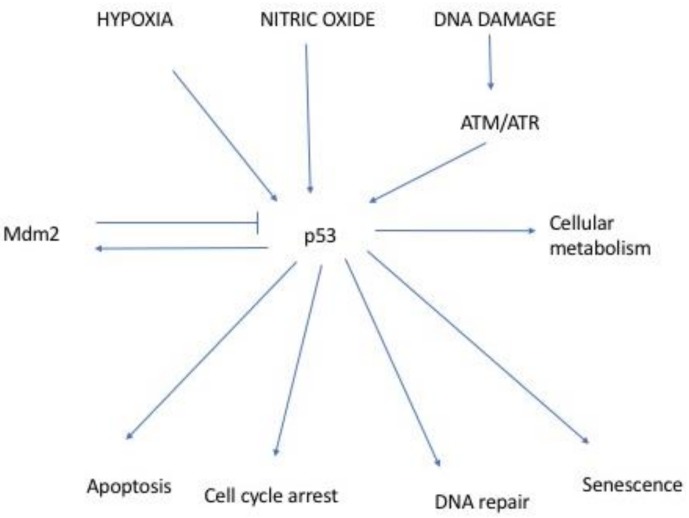
Figure 1
Figure 1
Basic functions of p53. p53 levels are tightly controlled and in unperturbed cells MDM2 is its main regulator via induction of p53 degradation. There is a negative feedback loop between the two proteins. p53 itself induces MDM2 transcription, hence as p53 levels increase, more MDM2 is produced, which in turn down regulates p53 levels. In the presence of DNA damage and other stresses, p53 degradation stops and its levels increase. Elevated levels of stabilized p53 induce transcription of proteins involved in different types of responses, particularly cell cycle arrest and apoptosis. Modified schematic diagram [8].
Figure 2
Figure 2
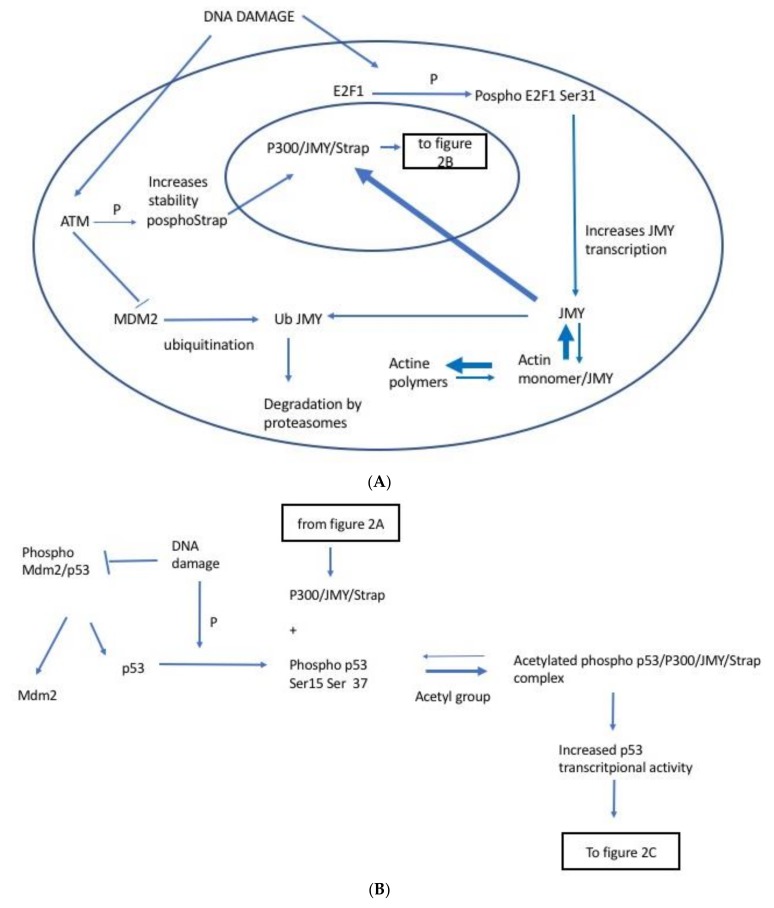
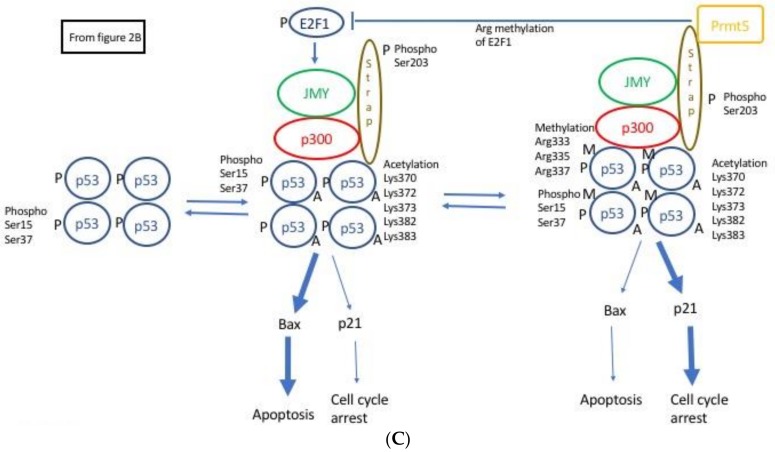
JMY (Junctional Mediating and Regulating Y protein)/P53 interaction pathway. (A) JMY’s regulation. In unperturbed cells, JMY levels are maintained at a constant state by a balance between transcription and degradation. The latter is controlled by Mdm2 which ubiquitinates JMY leading to its degradation by proteasomes. Following DNA damage, the newly phosphorylated E2F1 induces increased transcription of JMY, while ataxia-telangiectasia mutated (ATM) dampens MDM2 activity. Furthermore, actin monomers form polymers and therefore are no longer available to bind to JMY and sequester it in the cytoplasm. Since it is no longer bound to actin monomers, JMY can then bind to Importin and translocate to the nucleus. This causes the levels of JMY in the nucleus to increase and form a complex with P300. Stability of this complex is further increased by linkage with phosphorylated Stress responsive activator of p53 (Strap). Based on: [18,19,20,21,22]. (B) JMY’s effect on p53. Following DNA damage, p53 is phosphorylated and escapes degradation resulting in upregulation of p53 levels. Phosphorylated p53 binds to the JMY/p300/Strap complex and its transcriptional activity increases. Based on: [9]. (C) Formation of molecular complexes and their effects on apoptosis and cell cycle. Following DNA damage, p53 is phosphorylated and released from MDM2. It binds to the p300/JMY/Strap complex which causes acetylation of five Lysine residues located on the C terminus region of p53. This leads to an increased ability of p53 to transcribe Bax, but not p21, resulting in a preferential activation of the apoptotic pathway over cell cycle arrest. However, when PRMT5 is recruited to Strap that is bound to the JMY/p300 complex, this triggers the methylation of p53 shifting the process away from Bax transcription and apoptosis to increased transcription of p21 and induction of cell cycle arrest. PRMT5 further reinforces this switch by E2F1 inhibition via methylation which reduces JMY’s transcription. Based on and modified from: [9,23,24,25,26,27].
Figure 2
Figure 2
JMY (Junctional Mediating and Regulating Y protein)/P53 interaction pathway. (A) JMY’s regulation. In unperturbed cells, JMY levels are maintained at a constant state by a balance between transcription and degradation. The latter is controlled by Mdm2 which ubiquitinates JMY leading to its degradation by proteasomes. Following DNA damage, the newly phosphorylated E2F1 induces increased transcription of JMY, while ataxia-telangiectasia mutated (ATM) dampens MDM2 activity. Furthermore, actin monomers form polymers and therefore are no longer available to bind to JMY and sequester it in the cytoplasm. Since it is no longer bound to actin monomers, JMY can then bind to Importin and translocate to the nucleus. This causes the levels of JMY in the nucleus to increase and form a complex with P300. Stability of this complex is further increased by linkage with phosphorylated Stress responsive activator of p53 (Strap). Based on: [18,19,20,21,22]. (B) JMY’s effect on p53. Following DNA damage, p53 is phosphorylated and escapes degradation resulting in upregulation of p53 levels. Phosphorylated p53 binds to the JMY/p300/Strap complex and its transcriptional activity increases. Based on: [9]. (C) Formation of molecular complexes and their effects on apoptosis and cell cycle. Following DNA damage, p53 is phosphorylated and released from MDM2. It binds to the p300/JMY/Strap complex which causes acetylation of five Lysine residues located on the C terminus region of p53. This leads to an increased ability of p53 to transcribe Bax, but not p21, resulting in a preferential activation of the apoptotic pathway over cell cycle arrest. However, when PRMT5 is recruited to Strap that is bound to the JMY/p300 complex, this triggers the methylation of p53 shifting the process away from Bax transcription and apoptosis to increased transcription of p21 and induction of cell cycle arrest. PRMT5 further reinforces this switch by E2F1 inhibition via methylation which reduces JMY’s transcription. Based on and modified from: [9,23,24,25,26,27].
Figure 3
Figure 3
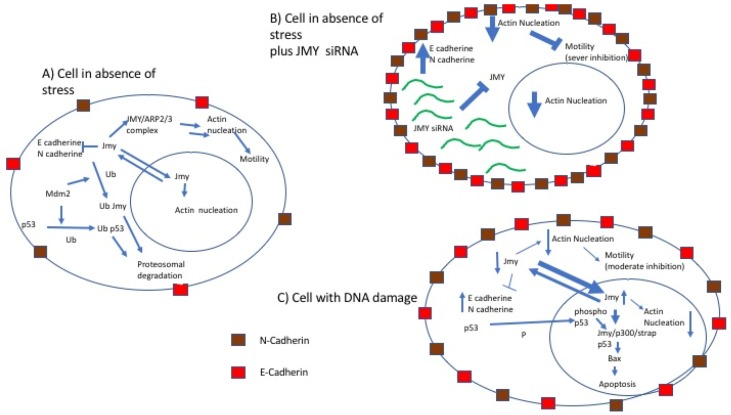
Model of JMY-mediated co-ordination between cell motility and DNA damage response in cell lines. A model of how JMY links p53 response to DNA damage and cell motility in cell lines. (A) In a motile cell, in absence of stress, the amount of JMY in the nucleus and in the cytoplasm are maintained in equilibrium. The available JMY protein in the cytoplasm inhibits E and N cadherin adhesion molecules in a dose dependent fashion and induces actin nucleation for cell motility both in an Arp2/3 dependent and independent fashion. (B) If such a cell is treated with siRNA targeting JMY, the inhibition of JMY transcription leads to a strong upregulation of the E and N cadherins and a reduction of actin nucleation, attenuating cell motility. (C) When DNA damage occurs, a more drastic drop in motility is observed. The explanation for this drastic drop in motility is the translocation of JMY from the cytoplasm to the nucleus diminishing the cytoplasmic JMY level. This however is in part compensated for by the overall increase of JMY levels following the DNA damage. This implies that JMY is capable of producing both forms of biochemical actin filaments. Having both forms of biochemical actin polymerization would also imply that JMY’s contribution to cell motility is via its nucleation filament and that JMY can promote rapid assembly of a new actin network by harnessing its ability to first nucleate new mother filaments and then activate Arp2/3 to branch off these filaments. This duality of JMY localization and functions in the cytoplasm and nucleus might be a characteristically and evolutionarily gained advantage [13,28].

References

    1. Finlay C.A., Hinds P.W., Levine A.J. The p53 proto-oncogene can act as a suppressor of transformation. Cell. 1989;57:1083–1093. doi: 10.1016/0092-8674(89)90045-7. - DOI - PubMed
    1. Bossi G., Lapi E., Strano S., Rinaldo C., Blandino G., Sacchi A. Mutant p53 gain of function: Reduction of tumor malignancy of human cancer cell lines through abrogation of mutant p53 expression. Oncogene. 2006;25:304–309. doi: 10.1038/sj.onc.1209026. - DOI - PubMed
    1. Vogelstein B., Lane D., Levine A.J. Surfing the p53 network. Nature. 2000;408:307–310. doi: 10.1038/35042675. - DOI - PubMed
    1. Zhao R., Gish K., Murphy M., Yin Y., Notterman D., Hoffman W.H., Tom E., Mack D.H., Levine A.J. The transcriptional program following p53 activation. Cold Spring Harbor Symp. Quant. Biol. 2000;65:475–482. doi: 10.1101/sqb.2000.65.475. - DOI - PubMed
    1. Coutts A.S., Boulahbel H., Graham A., La Thangue N.B. MDM2 targets the p53 transcription cofactor jmy for degradation. EMBO Rep. 2007;8:84–90. doi: 10.1038/sj.embor.7400855. - DOI - PMC - PubMed

LinkOut - more resources