


Quantifying the financial burden of households' out-of-pocket payments on medicines in India: a repeated cross-sectional analysis of National Sample Survey data, 1994-2014
- PMID: 29858403
- PMCID: PMC5988077
- DOI: 10.1136/bmjopen-2017-018020
Quantifying the financial burden of households' out-of-pocket payments on medicines in India: a repeated cross-sectional analysis of National Sample Survey data, 1994-2014
Abstract
Objective: The objective of this research is to generate new evidence on financial implications of medicines out-of-pocket (OOP) payments for households. Another objective is to investigate which disease conditions contributed to a significant proportion of households' financial burden.
Setting: All Indian states including union territories, 1993-2014.
Design: Repeated cross-sectional household surveys.
Data: Secondary data of nationwide Consumer Expenditure Surveys for the years 1993-1994, 2004-2005 and 2011-2012 and one wave of Social Consumption: Health for the year 2014 from National Sample Survey Organisation.
Outcome measures: OOP expenditure on healthcare in general and medicines in specific.
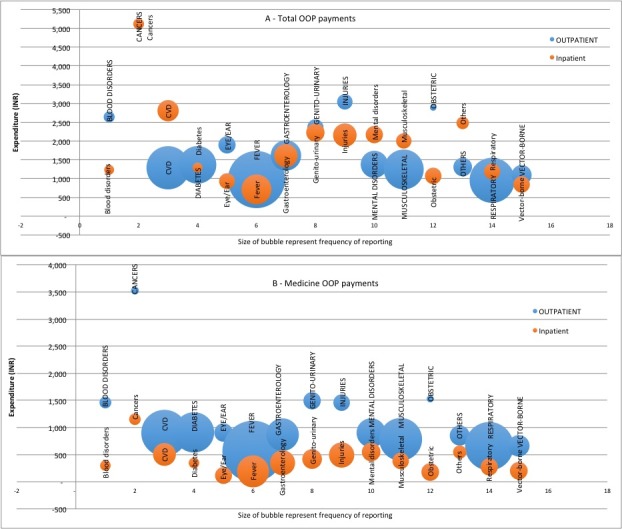
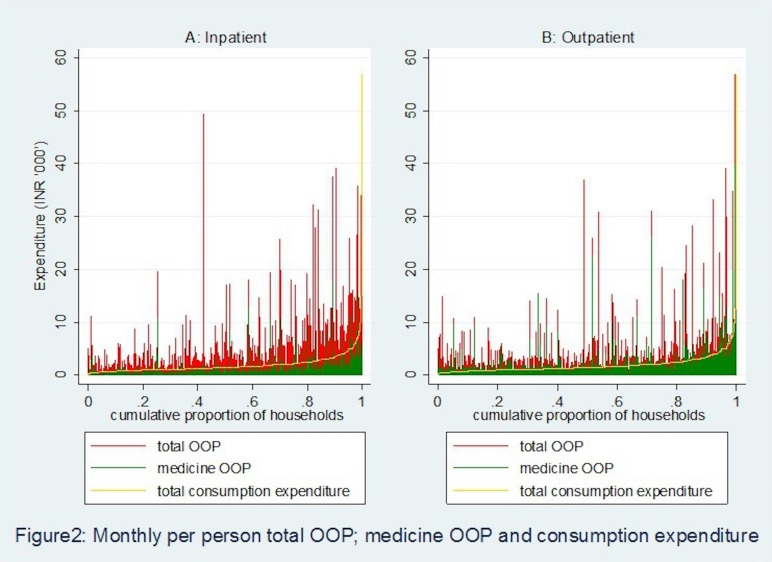
Results: Total OOP payments and medicines OOP payments were estimated to be 6.77% (95% CI 6.70% to 6.84%) and 4.49% (95% CI 4.45% to 4.54%) of total consumption expenditure, respectively, in the year 2011-2012 which marked significant increase since 1993-1994. These proportions were 11.46% (95% CI 11.36% to 11.56%) and 7.60% (95% CI 7.54% to 7.67%) of non-food expenditure, respectively, in the same year. Total OOP payments and medicines OOP payments were catastrophic for 17.9% (95% CI 17.7% to 18.2%) and 11.2% (95% CI 11.0% to 11.4%) households, respectively, in 2011-2012 at the 10% of total consumption expenditure threshold, implying 29 million households incurred catastrophic OOP payments in the year 2011-2012. Further, medicines OOP payments pushed 3.09% (95% CI 2.99% to 3.20%), implying 38 million persons into poverty in the year 2011-2012. Among the leading cause of diseases that caused significant OOP payments are cancers, injuries, cardiovascular diseases, genitourinary conditions and mental disorders.
Conclusions: Purchase of medicines constitutes the single largest component of the total OOP payments by households. Hence, strengthening government intervention in providing medicines free in public healthcare facilities has the potential to considerably reduce medicine-related spending and total OOP payments of households and reduction in OOP-induced poverty.
Keywords: health economics; health policy; public health.
© Article author(s) (or their employer(s) unless otherwise stated in the text of the article) 2018. All rights reserved. No commercial use is permitted unless otherwise expressly granted.
Conflict of interest statement
Competing interests: None declared.
Figures
References
-
- NHSRC. National Health Accounts Estimates for India 2013-14: Ministry of Health and Family Welfare (MoHFW) - Government of India. 2014.
-
- Selvaraj S, Karan A. Deepening health insecurity in India: evidence from national sample surveys since 1980s. Econ Polit Wkly 2009;44:55–60.
-
- WHO. The World Medicines Situation 2011. Geneva: World Health Organozation, 2011.
-
- WHO. The World Medicine Situation 2004. Geneva: World Health Organization, 2004.
Publication types
MeSH terms
Grants and funding
LinkOut - more resources
Full Text Sources
Other Literature Sources
