


Effectiveness of capacity building interventions relevant to public health practice: a systematic review
- PMID: 29859075
- PMCID: PMC5984748
- DOI: 10.1186/s12889-018-5591-6
Effectiveness of capacity building interventions relevant to public health practice: a systematic review
Abstract
Background: This systematic review assessed the effectiveness of capacity building interventions relevant to public health practice. The aim is to inform and improve capacity building interventions.
Methods: Four strategies were used: 1) electronic database searching; 2) reference lists of included papers; 3) key informant consultation; and 4) grey literature searching. Inclusion (e.g., published in English) and exclusion criteria (e.g., non-English language papers published earlier than 2005) are outlined with included papers focusing on capacity building, learning plans, or professional development plans within public health and related settings, such as non-governmental organizations, government, or community-based organizations relating to public health or healthcare. Outcomes of interest included changes in knowledge, skill or confidence (self-efficacy), changes in practice (application or intent), and perceived support or supportive environments, with outcomes reported at the individual, organizational or systems level(s). Quality assessment of all included papers was completed.
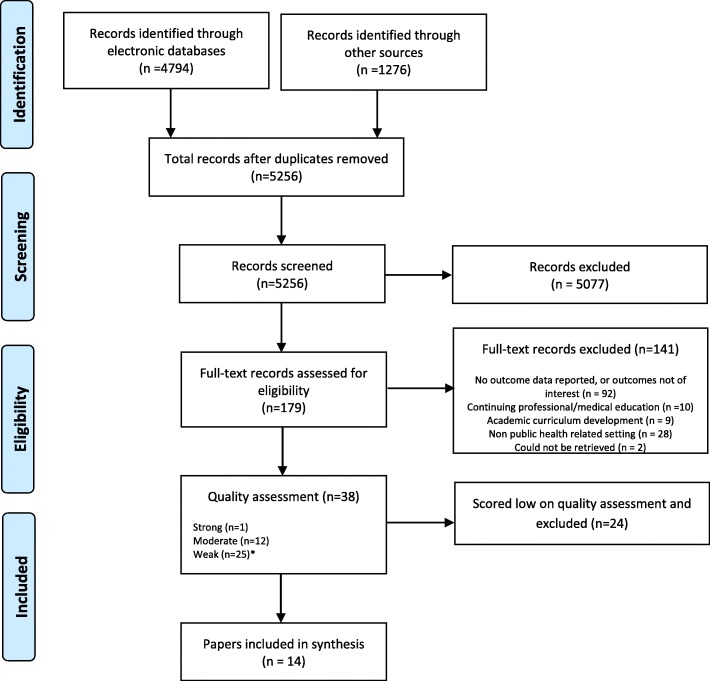
Results: Fourteen papers were included in this review. These papers reported on six intervention types: 1) internet-based instruction, 2) training and workshops, 3) technical assistance, 4) education using self-directed learning, 5) communities of practice, and 6) multi-strategy interventions. The available literature showed improvements in one or more capacity-building outcomes of interest, mainly in terms of individual-level outcomes. The available literature was moderate in quality and showed a range of methodological issues.
Conclusions: There is evidence to inform capacity building programming and how interventions can be selected to optimize impact. Organizations should carefully consider methods for analysis of capacity building interventions offered; specifically, through which mechanisms, to whom, and for which purpose. Capacity-building interventions can enhance knowledge, skill, self-efficacy (including confidence), changes in practice or policies, behaviour change, application, and system-level capacity. However in applying available evidence, organizations should consider the outcomes of highest priority, selecting intervention(s) effective for the outcome(s) of interest. Examples are given for selecting intervention(s) to match priorities and context, knowing effectiveness evidence is only one consideration in decision making. Future evaluations should: extend beyond the individual level, assess outcomes at organizational and systems levels, include objective measures of effect, assess baseline conditions, and evaluate features most critical to the success of interventions.
Keywords: Global Health; Health education/st [standards]; Health promotion/st [standards]; MeSH (7) capacity building; Professional competence/st [standards]; Public health; Total quality management/og [Organization & Administration].
Conflict of interest statement
Ethics approval and consent to participate
Not applicable as no human subjects, human material, or human data were used.
Competing interests
The authors declare that they have no competing financial interests. In terms of non-financial interests, all authors are employed by Public Health Ontario, working within a department that provides capacity building services to public health organizations in the Province of Ontario.
Publisher’s Note
Springer Nature remains neutral with regard to jurisdictional claims in published maps and institutional affiliations.
Figures
References
-
- Jenkins C, Lomazzi M, Yeatman H, Borisch B. Global public health: a review and discussion of the concepts, principles and roles of global public health in Today's society. Glob Policy. 2016;7(3):332–339. doi: 10.1111/1758-5899.12302. - DOI
Publication types
MeSH terms
LinkOut - more resources
Full Text Sources
Other Literature Sources
Miscellaneous
