. 2018 Aug:138:72-79.
doi: 10.1016/j.neuropharm.2018.05.025. Epub 2018 May 21.

New insights on the effects of varenicline on nicotine reward, withdrawal and hyperalgesia in mice

Affiliations

New insights on the effects of varenicline on nicotine reward, withdrawal and hyperalgesia in mice

Deniz Bagdas et al. Neuropharmacology. 2018 Aug.

Abstract

Varenicline, a partial agonist for α4β2* nicotinic acetylcholine receptors (nAChRs) and a full agonist for α3β4 and α7 nAChRs, is approved for smoking cessation treatment. Although, partial agonism at α4β2* nAChRs is believed to be the mechanism underlying the effects of varenicline on nicotine reward, the contribution of other nicotinic subtypes to varenicline's effects on nicotine reward is currently unknown. Therefore, we examined the role of α5 and α7 nAChR subunits in the effects of varenicline on nicotine reward using the conditioned place preference (CPP) test in mice. Moreover, the effects of varenicline on nicotine withdrawal-induced hyperalgesia and aversion are unknown. We also examined the reversal of nicotine withdrawal in mouse models of dependence by varenicline. Varenicline dose-dependently blocked the development and expression of nicotine reward in the CPP test. The blockade of nicotine reward by varenicline (0.1 mg/kg) was preserved in α7 knockout mice but reduced in α5 knockout mice. Administration of varenicline at high dose of 2.5 mg/kg resulted in a place aversion that was dependent on α5 nAChRs but not β2 nAChRs. Furthermore, varenicline (0.1 and 0.5 mg/kg) reversed nicotine withdrawal signs such as hyperalgesia and somatic signs and withdrawal-induced aversion in a dose-related manner. Our results indicate that the α5 nAChR subunit plays a role in the effects of varenicline on nicotine reward in mice. Moreover, the mediation of α5 nAChRs, but not β2 nAChRs are probably needed for aversive properties of varenicline at high dose. Varenicline was also shown to reduce several nicotine withdrawal signs.

Keywords: Alpha 5 nicotinic receptor; Conditioned place preference; Nicotine; Varenicline; Withdrawal.


Conflict of interest statement

Conflicts of interest

None of the other authors declared a conflict of interest.

Figures
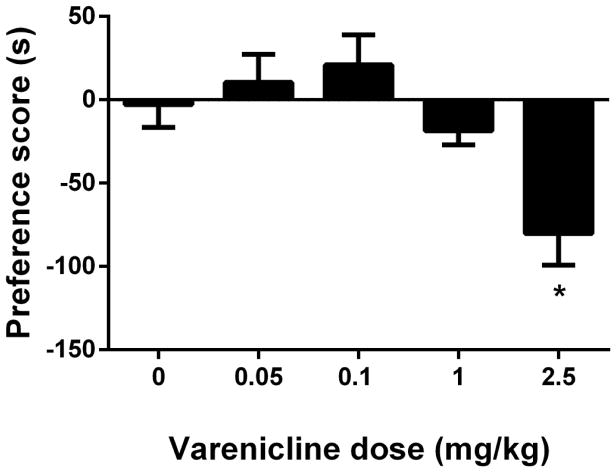
Figure 1
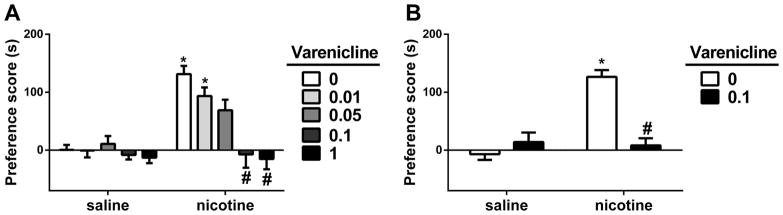
Figure 1. Effects of varenicline on nicotine reward in the conditioned place paradigm
A) Male ICR mice were conditioned with either subcutaneous (s.c.) saline or nicotine (0.5mg/kg) for 3 days. Saline (s.c.) or varenicline (0.01, 0.05, 0.1, and 1 mg/kg; s.c.) pretreatment were given 10-min prior to nicotine-conditioning. Nicotine itself induced a robust place preference and varenicline pretreatment dose-dependently blocked the effect of nicotine. B) Male ICR mice were conditioned with either s.c. saline or nicotine (0.5mg/kg) for 3 days. Saline (s.c.) or varenicline (0.1 mg/kg; s.c.) were given as a challenge 24 hour after last nicotine-conditioning and 10-min prior to test. Nicotine itself induced a robust place preference and varenicline challenge blocked the effect of nicotine. * Denotes p<0.05 from vehicle control; # Denotes p<0.05 from nicotine control. Each point represents the mean ± SEM of n=8 mice per group.
Figure 2
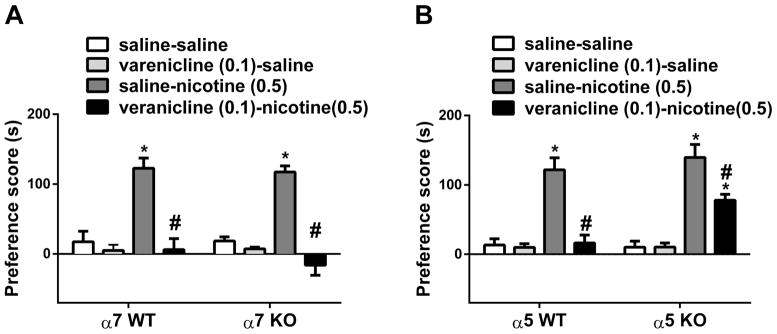
Figure 2. Involvement of α7 and α5 nicotinic subunits in the effects of varenicline on nicotine
Wild type (WT) and knockout (KO) mice for A) α7 and B) α5 nAChRs subunits were conditioned with either subcutaneous (s.c.) saline or nicotine (0.5mg/kg) for 3 days. Saline (s.c.) or varenicline (0.1 mg/kg; s.c.) pretreatment were given 10-min prior to nicotine-conditioning. Nicotine itself induced a robust place preference in α7 and α5 WT mice. Varenicline pretreatment blocked the effect of nicotine in α7 KO mice but not in α5 KO mice. * Denotes p<0.05 from vehicle control; # Denotes p<0.05 from nicotine control. Each point represents the mean ± SEM of n=8 mice per group.
Figure 3
Figure 3. Effects of varenicline in the conditioned place paradigm
Male ICR mice were conditioned with either subcutaneous (s.c.) saline or varenicline (0.05, 0.1, 1 and 2.5 mg/kg; s.c.) for 3 days with a 10-min pretreatment prior to conditioning. A robust aversion was observed in varenicline-conditioned mice. * Denotes p < 0.05 from saline. Each point represents the mean ± SEM of n=8 mice per group.
Figure 4
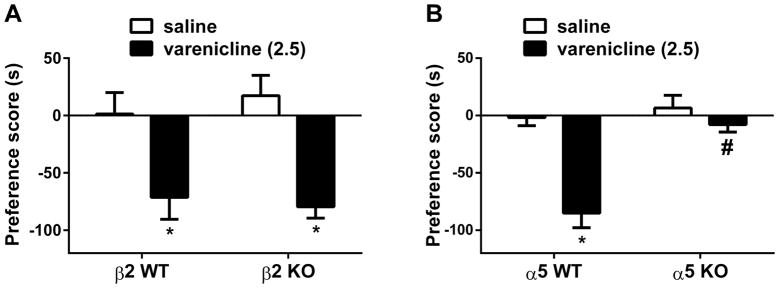
Figure 4. Involvement of β2 and α5 nicotinic subunits in varenicline-induced conditioned place aversion
Wild type (WT) and knockout (KO) mice for A) β2 and B) α5 nAChRs subunits were conditioned with either subcutaneous (s.c.) saline or varenicline (2.5 mg/kg) for 3 days. Varenicline induced a significant place aversion in β2 and α5 WT mice. However, the CPA developed in in β2 KO mice but not in α5 KO mice. *Denotes p<0.05 from vehicle control; # Denotes p<0.05 from varenicline WT. Each point represents the mean ± SEM of n=8 mice per group.
Figure 5
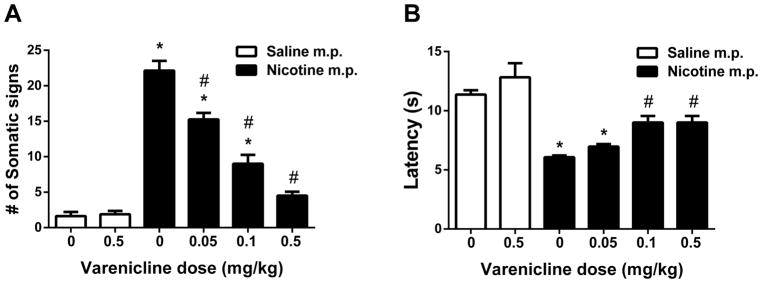
Figure 5. Effects of varenicline on physical and affective signs of precipitated nicotine withdrawal
Male ICR mice were chronically infused with saline or nicotine (24 mg/kg/day) for 14 days. On day 15, mice received subcutaneous (s.c.) injection of saline or varenicline (0.05, 0.1, and 0.5 mg/kg). Mice then were administered mecamylamine (2 mg/kg; s.c.) 10 min prior to behavioral assessment of A) somatic signs, and B) hyperalgesia (hot plate latency). Nicotine induced withdrawal symptoms: increased somatic signs, but decreased hot plate latency. Varenicline pretreatment attenuated somatic signs, and increased hot plate latency in nicotine withdrawn mice in a dose-related fashion. * Denotes p< 0.05 vs. Saline minipump group, # Denotes p< 0.05 vs. Nicotine minipump group. Each point represents the mean ± S.E.M. of n=8 mice per group. MP: minipump
Figure 6
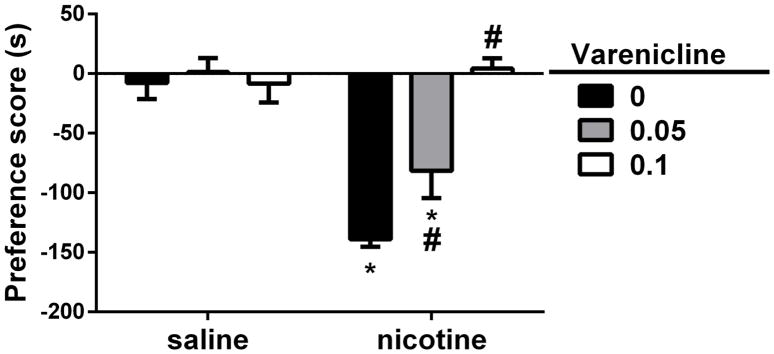
Figure 6. Varenicline reversed mecamylamine-precipitated nicotine withdrawal conditioned placed aversion
Male ICR mice were chronically infused with saline or nicotine (36 mg/kg/day) for 28 days. On CPA conditioning days, all mice received saline injections in the morning session and mecamylamine (3.5 mg/kg; s.c.) in the afternoon session. 15 min before mecamylamine administration, mice were pretreated with varenicline (0.05 and 0.1 mg/kg, s.c.) or vehicle (s.c.). Varenicline reversed mecamylamine-precipitated nicotine withdrawal CPA. Mecamylamine (3.5 mg/kg, s.c.) precipitated a significant CPA in chronic nicotine-treated mice. However, varenicline pretreatment reversed mecamylamine-precipitated nicotine aversion in a dose-related manner. Each point represents the mean ± S.E.M. of n = 8 mice per group. * denotes p < 0.05 vs. saline group/vehicle; # denotes p < 0.05 from nicotine/vehicle

References

    1. Antolin-Fontes B, Ables JL, Görlich A, Ibañez-Tallon I. The habenulo-interpeduncular pathway in nicotine aversion and withdrawal. Neuropharmacology. 2015;96:213–22. doi: 10.1016/j.neuropharm.2014.11.019. - DOI - PMC - PubMed
    1. Bagdas D, AlSharari SD, Freitas K, Tracy M, Damaj MI. The role of alpha5 nicotinic acetylcholine receptors in mouse models of chronic inflammatory and neuropathic pain. Biochem Pharmacol. 2015;97:590–600. doi: 10.1016/j.bcp.2015.04.013. - DOI - PMC - PubMed
    1. Biala G, Staniak N, Budzynska B. Effects of varenicline and mecamylamine on the acquisition, expression, and reinstatement of nicotine-conditioned place preference by drug priming in rats. Naunyn Schmiedebergs Arch Pharmacol. 2010;381:361–370. doi: 10.1007/s00210-010-0498-5. - DOI - PubMed
    1. Bierut LJ, Madden PAF, Breslau N, Johnson EO, Hatsukami D, Pomerleau OF, Swan GE, Rutter J, Bertelsen S, Fox L, Fugman D, Goate AM, Hinrichs AL, Konvicka K, Martin NG, Montgomery GW, Saccone NL, Saccone SF, Wang JC, Chase GA, Rice JP, Ballinger DG. Novel genes identified in a high-density genome wide association study for nicotine dependence. Hum Mol Genet. 2006;16:24–35. doi: 10.1093/hmg/ddl441. - DOI - PMC - PubMed
    1. Cohen A, Treweek J, Edwards S, Leão RM, Schulteis G, Koob GF, George O. Extended access to nicotine leads to a CRF 1 receptor dependent increase in anxiety-like behavior and hyperalgesia in rats. Addict Biol. 2015;20:56–68. doi: 10.1111/adb.12077. - DOI - PMC - PubMed

Publication types

MeSH terms