. 2018 Jun 1;59(7):2818-2827.
doi: 10.1167/iovs.18-24160.

Peripapillary Retinoschisis in Glaucoma: Association With Progression and OCT Signs of Müller Cell Involvement

Affiliations

Peripapillary Retinoschisis in Glaucoma: Association With Progression and OCT Signs of Müller Cell Involvement

Brad Fortune et al. Invest Ophthalmol Vis Sci. .

Abstract

Purpose: To examine demographic and clinical factors associated with glaucomatous peripapillary retinoschisis (PPRS) and assess its association with glaucoma progression.

Methods: Using a case control study design and longitudinal data from a cohort of 166 subjects with a diagnosis of glaucoma or glaucoma suspect, we compared functional, structural, clinical, and demographic characteristics between PPRS cases and controls.

Results: The frequency of PPRS was 6.0% (12 eyes from 10/166 subjects) with two eyes having PPRS in different sectors for a total of 15 retinoschisis events. There were no significant differences (P > 0.05) in age, sex, visual acuity, central corneal thickness, intraocular pressure, or presence of vitreous adhesion between PPRS and controls. However, eyes with PPRS tended to have a higher cup-to-disc ratio (P = 0.06), thinner RNFL (P = 0.02), and worse visual field mean deviation (MD, P = 0.06) than controls. The rate of RNFL thinning was faster in PPRS (average: -2.8%/year; range: -7.4% to 0.0%/year) than controls (-1.3%/year; range: -4.4% to 0.6%/year; P = 0.021). The rate of visual field MD change was faster in PPRS (-0.49 dB/year; range: -2.0 to 0.9 dB/year) than controls (-0.06 dB/year; range: -0.8 to 0.3 dB/year; P = 0.030). OCT scans showed hyperreflective structures spanning the PPRS whose morphology and spacing (50 ± 7 μm) are consistent with Müller glia, causing signal attenuation casting "shadows" onto distal retina.

Conclusions: This is the first report showing that glaucomatous PPRS is associated with a faster overall rate of RNFL thinning and visual field deterioration and to specifically identify OCT signs of Müller cell involvement.


Figures

Figure 1
Figure 1
Example of a relatively large peripapillary retinoschisis (PPRS). Peripapillary retinoschisis is typically difficult to discern on optic disc color photographs (A, white arrow) but is more clearly visible on SLO infrared reflectance images (B); in this example case, the area of retinoschisis involves the entire superior pole of the optic disc, having a radial extent of just over 120°, from the 10 o'clock to the 2 o'clock positions, as can be appreciated in the circumpapillary OCT B-scan (C, white arrow); the red arrowheads demarcate extent of schisis within the inner retina (RNFL and GGL in both [1B] and [1C]), however, there is also evidence of outer retinal involvement in this eye along the posterior boundary of the OPL (C, green arrow). The position of the B-scan shown in (C) is indicated by the bright green circle in (B). The OCT feature segmentations used for RNFL thickness measurements are shown for the same time point in (D). Approximately 3 years later (E), the depth of the schisis within the inner retina had decreased while the lateral extent of the outer retinal break had become wider. OCT scans consisting of a horizontal raster pattern ([F] and [G], 49 B-scans spaced approximately 30 μm apart covering a total of 5° height with 768 A-lines per B-scan spanning 15° width) show that the extent of the schisis overall and involvement of each layer vary with distance from the optic disc margin (compare [F] to [G], ∼750 and 1250 μm from the superior disc margin, respectively); green arrows point to schisis involving the outer retina; green arrowhead points to one of many “bridging structures” crossing the inner retinal schisis.
Figure 2
Figure 2
Example of multiple PPRS events in a single eye involving different sectors and retinal layers. Left column shows SLO infrared reflectance images and right column shows corresponding OCT circumpapillary B-scans for a series of longitudinal follow-up visits; the position of the OCT B-scan at each time point is indicated by the bright green circle in the SLO image. At study entry, there was evidence of outer retinal schisis (spanning the OPL-ONL boundary) within the inferior quadrant (A, B, white arrows), with little apparent involvement of the inner retina). At the next visit 6 months later, the outer retinal schisis appeared to have narrowed but the inner retina at the same inferior location had clearly become involved (D, red arrow) and an entirely separate PPRS event had manifest within the RNFL of the temporal-superior sector (D, green arrow). Both locations gradually resolved over the next year (F, H), but 6 months later, the same temporal-superior sector RNFL schisis recurred (J, green arrow) and was contiguous with a severe outer retinal schisis, which spanned nearly the entire superior hemisphere (J, green arrowheads). This outer retinal schisis took longer to resolve than the RNFL schisis; when both appeared to be completely resolved 2.5 years later, there was clear evidence that progressive RNFL thinning had occurred, including protrusion of the major blood vessels anteriorly toward the vitreous (P, asterisks).
Figure 3
Figure 3
Example of PPRS recurrence and bilateral presentation. A series of longitudinal follow-up circumpapillary OCT B-scans in this patient's right eye (A–C) shows evidence of PPRS at the first study visit (8/13/2009, leftmost panel in C) involving the RNFL primarily within the nasal-superior sector (white arrows in A, B), which increases over time, peaking two years later (C, time point outlined by red box, 8/24/2011) and resolving completely after an additional three years (C, rightmost panel, 7/8/2014). This patient's contralateral eye shows PPRS involving the RNFL of the temporal-inferior sector (D–F, white arrows), which appears to develop and resolve completely twice over the span of 5 years of follow-up. This schisis occurred in a sector overlapping an RNFL defect, whose boundary is clear on both infrared reflectance and circumpapillary OCT B-scan images (D, E, red arrowheads). Progressive RNFL thinning is apparent in this sector during the time span over which these events transpire.
Figure 4
Figure 4
Evidence that the “bridging structures” crossing the schisis in OCT images are Müller cell processes. Alternative OCT B-scan patterns assist to reveal three-dimensional spatial relationships of PPRS features. For example, in this eye (the same eye as shown in Fig. 3A–C), the full extent of PPRS evident in the SLO infrared reflectance image is outlined by green arrowheads (A). A horizontal raster pattern of 49 OCT B-scans was obtained over an area spanning 5° vertically by 15° horizontally (B, each B-scan was spaced approximately 30 μm apart and consisted of 768 A-lines). We used custom software to delineate OCT image features of each B-scan (C), including the ILM (blue line), the anterior and posterior boundaries of the RNFL axon bundles (red and pale pink lines, respectively) and the anterior boundary of the IPL (magenta line). From these segmentations, we produced en face slab projection images for the axial depths located between the ILM and anterior RNFL boundary, which contained primarily stalk-like “bridging structures” (E) and for axial depths located between the anterior and posterior RNFL boundaries (F). The overlay of these two en face projection images (G) demonstrates that there is little overlap (unless along the sides of a blood vessel) and that the transverse (lateral) position of the bridging structures is generally located between the RNFL bundles throughout the OCT scan area. This, along with other evidence (see text) suggests that the stalk-like bridging structures crossing the schisis of the inner retina (RNFL and GCL) are the inner processes of Müller cells. Note how the presumed Müller cell processes (magnified inset in D, red arrowhead) attenuate the OCT signal and cast a “shadow” onto the more posterior retinal layers (D, yellow arrowheads).
Figure 5
Figure 5
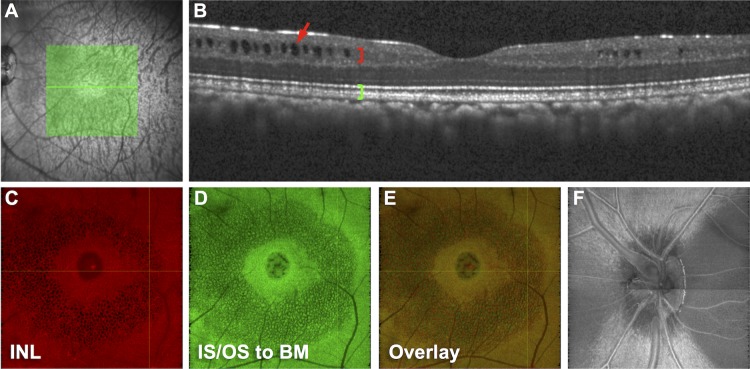
“Microcystic” degeneration of the INL may also cause OCT reflectivity banding of the outer retina. An example of microcystic degeneration of the INL, in this case from the left eye of a non-human primate with bilateral idiopathic optic atrophy, causing reflectivity banding of the outer retina. OCT horizontal raster scan pattern consisting of 290 B-scans over a 10° × 10° area of the macula (green lines) shown overlaid onto the SLO infrared reflectance image (A). OCT B-scan through the fovea (B) from the location corresponding to the bright green line in A; note numerous “microcysts” present throughout the INL (red arrow) as well as the reflectivity banding pattern present throughout the portions of the outer retinal layers corresponding to microcystic degeneration of the INL. (C) En face slab projection image of the INL (corresponding to the red bracket in B), showing microcysts distributed throughout the areas of the macula where the RGC layer is thickest. (D) En face slab projection image of the outer retina (from the inner segment/outer segment junction, IS/OS, to BM; note how the center of each area posterior to an INL microcyst exhibits more intense reflectivity (is brighter) than the surrounding retina. (E) Overlay of C and D to demonstrate spatial correspondence of microcysts with brighter areas of outer retinal reflectivity (and possibly darker areas representing attenuation by retina immediately surrounding each microcyst). (F) En face slab projection image for a separate 290-B-scan pattern centered over the optic disc (produced as the sum of 30 voxels, ∼115 μm in depth, beginning 6 voxels, ∼23 μm, below the ILM) shows the characteristic “butterfly” pattern of axon loss affecting the temporal and nasal quadrants; microcysts of the macular INL are visible on the temporal side.

References

    1. Sauer CG, Gehrig A, Warneke-Wittstock R,et al. . Positional cloning of the gene associated with X-linked juvenile retinoschisis. Nat Genet. 1997; 17: 164– 170. - PubMed
    1. Mooy CM, Van Den Born LI, Baarsma S,et al. . Hereditary X-linked juvenile retinoschisis: a review of the role of Müller cells. Arch Ophthalmol. 2002; 120: 979– 984. - PubMed
    1. Byrne LC, Ozturk BE, Lee T,et al. . Retinoschisin gene therapy in photoreceptors, Müller glia or all retinal cells in the Rs1h-/- mouse. Gene Ther. 2014; 21: 585– 592. - PMC - PubMed
    1. Molday RS, Kellner U, Weber BH. . X-linked juvenile retinoschisis: clinical diagnosis, genetic analysis, and molecular mechanisms. Prog Retin Eye Res. 2012; 31: 195– 212. - PMC - PubMed
    1. Byer NE. . Clinical study of senile retinoschisis. Arch Ophthalmol. 1968; 79: 36– 44. - PubMed

Publication types

MeSH terms