. 2018 Oct 15;84(8):555-562.
doi: 10.1016/j.biopsych.2018.04.013. Epub 2018 May 3.

Connective Tissue Growth Factor Is a Novel Prodepressant

Affiliations

Connective Tissue Growth Factor Is a Novel Prodepressant

Cortney A Turner et al. Biol Psychiatry. .

Abstract

Background: While downregulation of several growth factors in major depressive disorder is well established, less attention has been paid to the upregulation of other growth factors. Yet, upregulated growth factors may offer better therapeutic targets. We show that connective tissue growth factor (CTGF) represents a target based on its upregulation in major depressive disorder and studies in animal models implicating it in negative affect.

Methods: CTGF gene expression was first evaluated in the postmortem human amygdala. The findings were followed up in outbred rats and in two rat lines that were selectively bred for differences in novelty-seeking and anxiety behavior (bred low responders and bred high responders). We studied the impact of social defeat and early-life treatment with fibroblast growth factor 2 on CTGF expression. Finally, we assessed the ability of an anti-CTGF antibody (FG-3019) to alter CTGF expression and emotionality.

Results: In the human amygdala, CTGF expression was significantly increased in major depressive disorder compared with control subjects. CTGF expression was also significantly increased in the dentate gyrus of adult bred low responders compared with bred high responders. Social defeat stress in bred low responders significantly increased CTGF expression in the dentate gyrus. Early-life fibroblast growth factor 2, a treatment that reduces anxiety-like behavior throughout life, decreased CTGF expression in the adult dentate gyrus. In outbred rats, CTGF administration increased depression-like behavior. Chronic treatment with FG-3019 decreased CTGF expression, and acute and chronic treatment was antidepressant.

Conclusions: This study is the first to implicate CTGF as a prodepressant molecule that could serve as a target for the development of novel therapeutics.

Keywords: Amygdala; Dentate gyrus; Depression; FGF2; Hippocampus; Stress.


Conflict of interest statement

The authors report no biomedical financial interests or potential conflicts of interest.

Figures
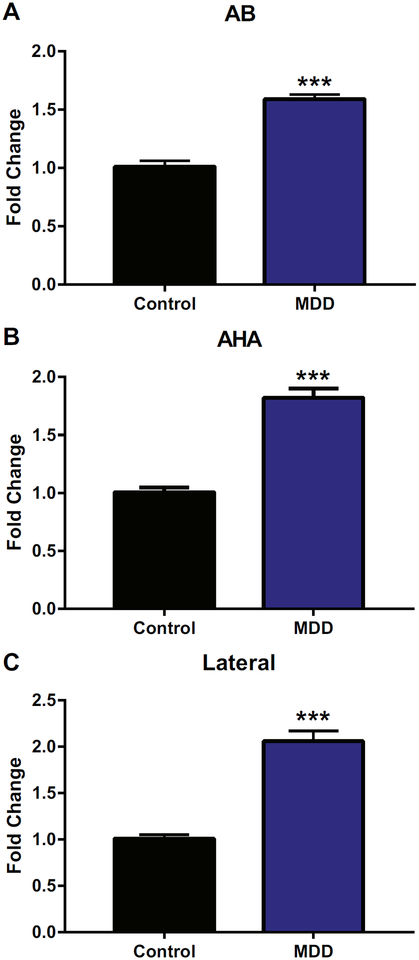
Figure 1.
Figure 1.
Connective tissue growth factor expression was significantly increased in three amygdala nuclei in individuals with major depressive disorder (MDD) compared with control subjects. Fold changes are shown for the (A) accessory basal (AB), (B) amygdalohippocampal (AHA), and(C) lateral nuclei, all of which were significantly increased in individuals with MDD compared with control subjects. n = 10 per group. All values are mean ± SEM. ***p < .001.
Figure 2.
Figure 2.
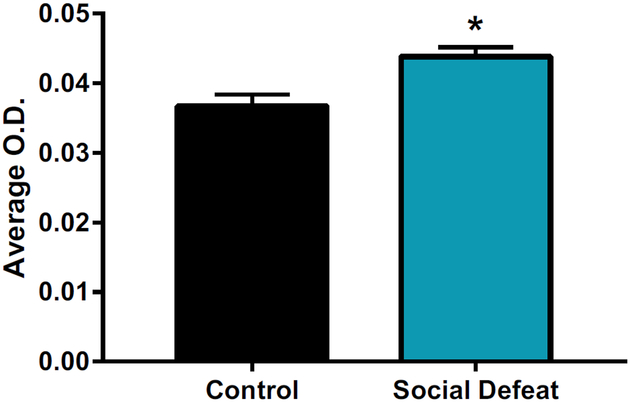
Stress in bred low responders increased connective tissue growth factor gene expression. Four days of social defeat stress increased connective tissue growth factor expression in the dentate gyrus compared with control animals. n = 5–6 per group. All values are mean ± SEM. *p < .05. O.D., optical density.
Figure 3.
Figure 3.
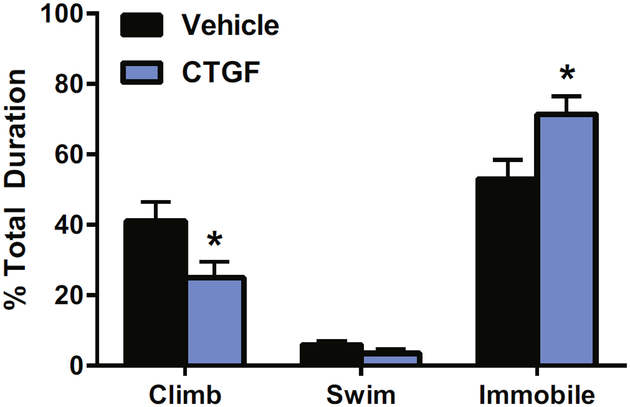
Connective tissue growth factor (CTGF) increased depression-like behavior. Acute administration of CTGF to outbred rats increased time spent immobile and decreased the time spent climbing in the forced swim test. n = 10–13 per group. All values are mean ± SEM. *p > .05.
Figure 4.
Figure 4.
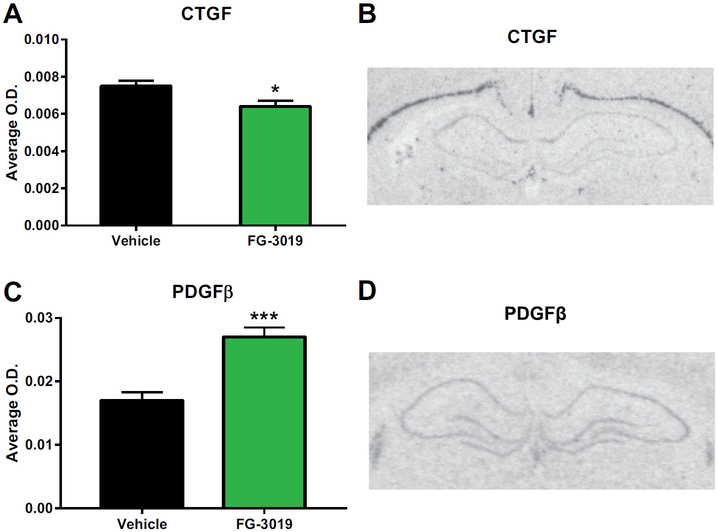
FG-3019, an anti–connective tissue growth factor (CTGF) antibody, altered gene expression in the CTGF pathway in the dentate gyrus. (A) Chronic treatment with FG-3019 decreased CTGF gene expression in the dentate gyrus. n = 7–8 per group. All values are mean ± SEM. *p < .05. (B) Representative CTGF messenger RNA expression at the level of the hippocampus. (C) Chronic treatment with FG-3019 increased platelet-derived growth factor-β (PDGFβ) in the dentate gyrus. n = 7 per group. All values are mean ± SEM. ***p = .001. (D) Representative PDGFβ messenger RNA expression at the level of the hippocampus. O.D., optical density.
Figure 5.
Figure 5.
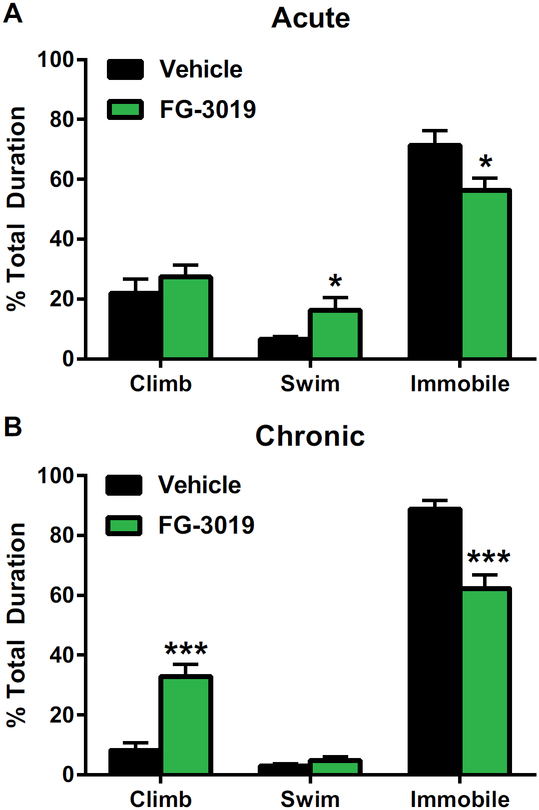
FG-3019, an anti–connective tissue growth factor antibody, decreased depression-like behavior. (A) Acute administration of FG-3019 decreased time spent immobile and increased time spent swimming in the forced swim test. n = 11–12 per group. All values are mean ± SEM. *p < .05. (B) Chronic administration of FG-3019 decreased time spent immobile and increased time spent climbing in the forced swim test. n = 7–8 per group. All values are mean 6 SEM. ***p < .001.

References

    1. Duman RS, Monteggia LM (2006): A neurotrophic model for stress-related mood disorders. Biol Psychiatry 59:1116–1127. - PubMed
    1. Krishnan V, Nestler EJ (2010): Linking molecules to mood: New insight into the biology of depression. Am J Psychiatry 167:1305–1320. - PMC - PubMed
    1. Turner CA, Watson SJ, Akil H (2012): The fibroblast growth factor family: Neuromodulation of affective behavior. Neuron 76:160–174. - PMC - PubMed
    1. Aurbach EL, Inui EG, Turner CA, Hagenauer MH, Prater KE, Li JZ, et al. (2015): Fibroblast growth factor 9 is a novel modulator of negative affect. Proc Natl Acad Sci U S A 112:11953–11958. - PMC - PubMed
    1. Malik AR, Liszewska E, Jaworski J (2015): Matricellular proteins of the Cyr61/CTGF/NOV (CCN) family and the nervous system. Front Cell Neurosci 9:237. - PMC - PubMed

Publication types

MeSH terms