. 2018 May 26;10(6):286.
doi: 10.3390/v10060286.

Post-Exposure Protection in Mice against Sudan Virus by a Two Antibody Cocktail

Affiliations

Post-Exposure Protection in Mice against Sudan Virus by a Two Antibody Cocktail

Jeffrey W Froude et al. Viruses. .

Abstract

Sudan virus (SUDV) and Ebola viruses (EBOV) are both members of the Ebolavirus genus and have been sources of epidemics and outbreaks for several decades. We present here the generation and characterization of cross-reactive antibodies to both SUDV and EBOV, which were produced in a cell-free system and protective against SUDV in mice. A non-human primate, cynomolgus macaque, was immunized with viral-replicon particles expressing the glycoprotein of SUDV-Boniface (8A). Two separate antibody fragment phage display libraries were constructed after four immunogen injections. Both libraries were screened first against the SUDV and a second library was cross-selected against EBOV-Kikwit. Sequencing of 288 selected clones from the two distinct libraries identified 58 clones with distinct VH and VL sequences. Many of these clones were cross-reactive to EBOV and SUDV and able to neutralize SUDV. Three of these recombinant antibodies (X10B1, X10F3, and X10H2) were produced in the scFv-Fc format utilizing a cell-free production system. Mice that were challenged with SUDV-Boniface receiving 100µg of the X10B1/X10H2 scFv-Fc combination 6 and 48-h post-exposure demonstrated partial protection individually and complete protection as a combination. The data herein suggests these antibodies may be promising candidates for further therapeutic development.

Keywords: Ebola; Sudan virus; antibody; biodefense; cell-free production; phage display; protection.


Conflict of interest statement

The authors declare no conflict of interest. J.W.F. now serves in a science and technology management role at the Defense Threat Reduction Agency but this assignment was after the design and completion of the work in this manuscript. The funding sponsors had no role in the design of the study; in the collection, analyses, or interpretation of data; in the writing of the manuscript, or in the decision to publish the results.

Figures
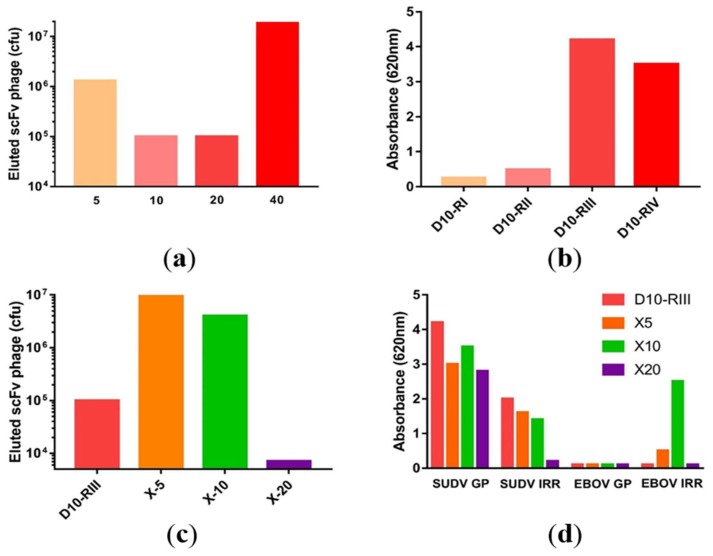
Figure 1
Figure 1
Clones which were reactive to both EBOV and SUDV irradiated virus: (a) scFv phage elution titers and (b) scFv phage reactivity following consecutive panning rounds for the multi-step library panning. (c) Phage elution titers from the third round of the parent library (D10-RIII) with each of the parallel panning rounds to Ebola GP at 5, 10, and 20 washes. (d) Reactivity to the whole irradiated antigen (IRR) or glycoprotein (GP) for the parental and cross paining of the SUDV phage against EBOV.
Figure 2
Figure 2
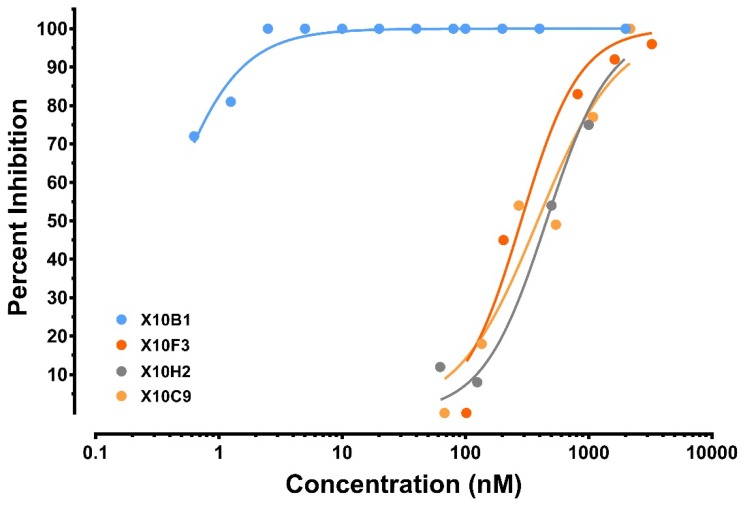
Down-selected antibodies neutralizing activity was evaluated by PRNT. Serially diluted mAbs were mixed in complete MEM supplemented with 10% FBS with SUDV at a constant viral titer of 65 pfu prior to adding in to Vero cells for a 1 h incubation. Wells were overlaid with 1% agarose in Eagle’s basal medium (EBME) with 10% FBS and 0.1% gentamicin and returned to the incubator On day 7, a 1% agarose secondary overlay containing 4% neutral red was added and after one more day at 37 °C, plaques were counted.
Figure 3
Figure 3
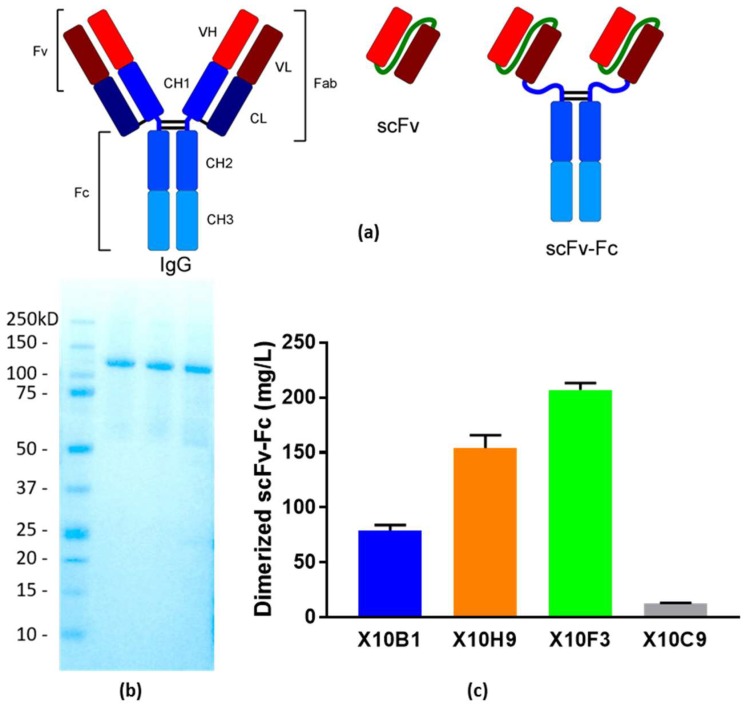
Cell-free expression of candidate scFv-Fc antibody fragments. (a) Representation of the structure of the three antibody fragments utilized in this study. The typical IgG format is shown on the left, the scFv format utilized for binding and neutralization in the center, and the scFv-Fc format utilized in neutralization and protection studies on the right. (b) Coomassie stained SDS-PAGE Gel of purified scFv-Fcs. Precision Plus Protein™ Standards (BioRad, Hercules, CA, USA); Lane 2: X10F3; Lane 3: X10H2; Lane 4: X10B1. (c) Titers from the cell-free expression of the candidate scFv-Fcs.
Figure 4
Figure 4
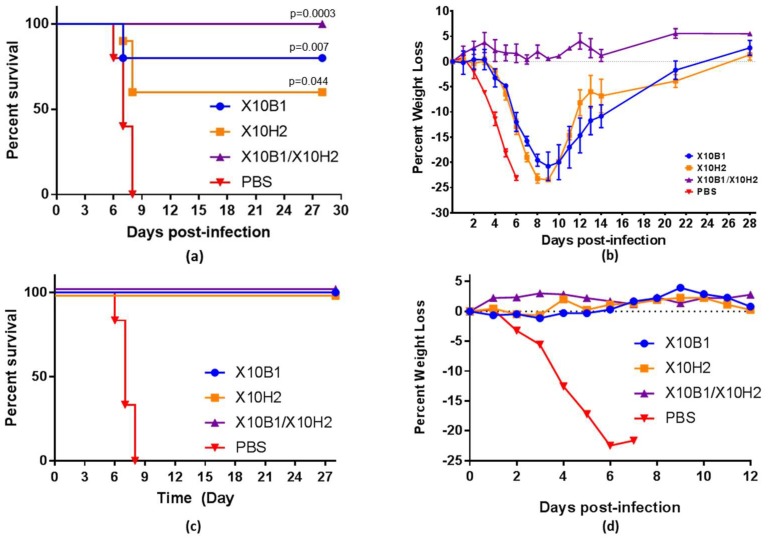
(a) Percent survival following the challenge of IFNAR-/- mice administered SUDV GP specific antibodies in the scFv-Fc format. Each mouse (n = 10 per antibody group or n = 5 for the PBS control) was challenged with 1000 pfu SUDV Boniface on D0; (b) weight loss of IFNAR-/- mice administered SUDV GP specific antibodies. Each mouse (n = 10 per antibody group) was administered 100 μg of total antibody (100 µg for single administration or 50 µg/antibody for the combination groups) the indicated treatment or PBS (n = 5) on days 0 (1 h post) and 2. Mice were challenged with 1000 pfu SUDV Boniface on D0; (c) percent survival; and (d) weight loss following the re-challenge of IFNAR-/- mice administered SUDV GP specific antibodies. Each mouse (n remaining from challenge study group or n = 5 for the PBS control) was rechallenged with 1000 pfu SUDV Boniface on D35 of the original study, indicated as D0 above. All p-values are assessed against irrelevant controls.

References

    1. Kuhn R. Togaviridae: The Viruses and Their Replication. In: Knipe D.M., editor. Fields Virology. 5th ed. Lippincott Williams & Wilkins; Philadelphia, PA, USA: 2007.
    1. Feldmann H., Geisbert T.W. Ebola haemorrhagic fever. Lancet. 2011;377:849–862. doi: 10.1016/S0140-6736(10)60667-8. - DOI - PMC - PubMed
    1. Feldmann H., Bugany H., Mahner F., Klenk H.D., Drenckhahn D., Schnittler H.J. Filovirus-induced endothelial leakage triggered by infected monocytes/macrophages. J. Virol. 1996;70:2208–2214. - PMC - PubMed
    1. Lee J.E., Saphire E.O. Ebolavirus glycoprotein structure and mechanism of entry. Future Virol. 2009;4:621–635. doi: 10.2217/fvl.09.56. - DOI - PMC - PubMed
    1. Qiu X., Wong G., Audet J., Bello A., Fernando L., Alimonti J.B., Fausther-Bovendo H., Wei H., Aviles J., Hiatt E., et al. Reversion of advanced Ebola virus disease in nonhuman primates with ZMapp. Nature. 2014;514:47–53. doi: 10.1038/nature13777. - DOI - PMC - PubMed

Publication types

Substances

LinkOut - more resources