Review
. 2018 May 21:13:2973-2987.
doi: 10.2147/IJN.S154743. eCollection 2018.

Properties and applications of nanoparticle/microparticle conveyors with adjuvant characteristics suitable for oral vaccination

Affiliations
Review

Properties and applications of nanoparticle/microparticle conveyors with adjuvant characteristics suitable for oral vaccination

Lei Zhang et al. Int J Nanomedicine. .

Abstract

Vaccination is one of the most effective approaches in the prevention and control of disease worldwide. Oral vaccination could have wide applications if effective protection cannot be achieved through traditional (eg, parenteral) routes of vaccination. However, oral administration is hampered by the difficulties in transferring vaccines in vivo. This has led to the development of materials such as carriers with potential adjuvant effects. Considering the requirements for selecting adjuvants for oral vaccines as well as the advantages of nanoparticle/microparticle materials as immune effectors and antigen conveyors, synthetic materials could improve the efficiency of oral vaccination. In this review, nanoparticles and microparticles with adjuvant characteristics are described with regard to their potential importance for oral immunization, and some promising and successful modification strategies are summarized.

Keywords: NP/MP conveyors; antibody; immune response; intestine; oral vaccine.


Conflict of interest statement

Disclosure The authors report no conflicts of interest in this work.

Figures
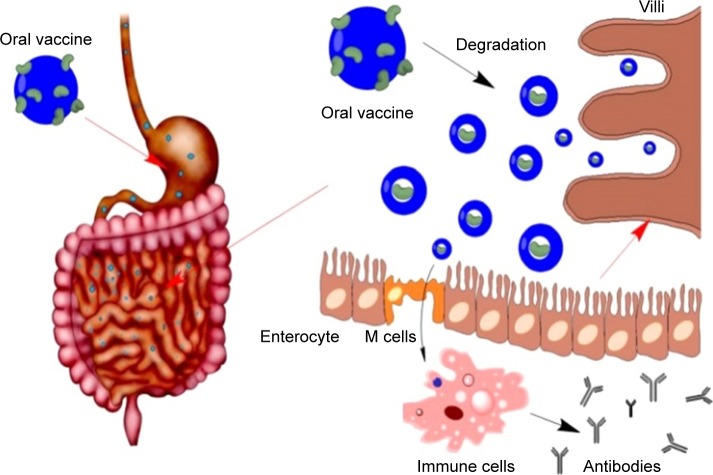
Figure 1
Figure 1
A representative strategy for small intestine-targeted oral vaccination with adjuvants. Notes: The oral vaccine based on acid-resistant adjuvants keeps integral in stomach. Partial adjuvants are degraded to small particles in the small intestine. The microparticles or nanoparticles, consisted of adjuvants and antigens, can be generated with partial degradation of the adjuvants. The antigens can be delivered to immune cells by M cells which locate besides the enterocytes.
Figure 2
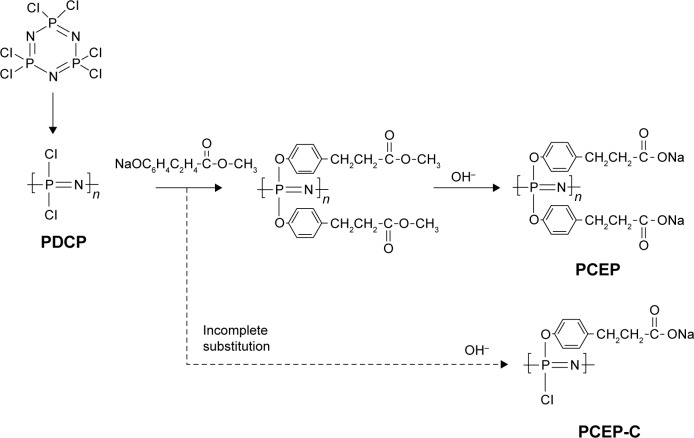
Figure 2
Synthesis of PCEP. Notes: Adapted with permission from Andrianov et al, Synthesis, properties, and biological activity of poly[di(sodium carboxylatoethylphenoxy)phosphazene]. Biomacromolecules. 2006;7:394–399. Copyright 2006 American Chemical Society. Abbreviation: PCEP, poly(di(sodium carboxylatoethylphenoxy) phosphazene).
Figure 3
Figure 3
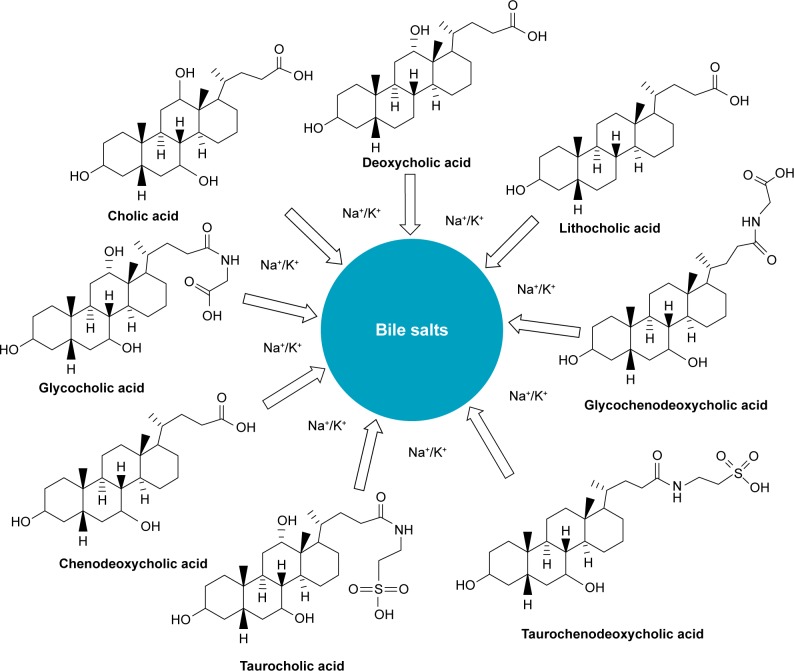
Various bile salts applied in oral drug delivery systems.
Figure 4
Figure 4
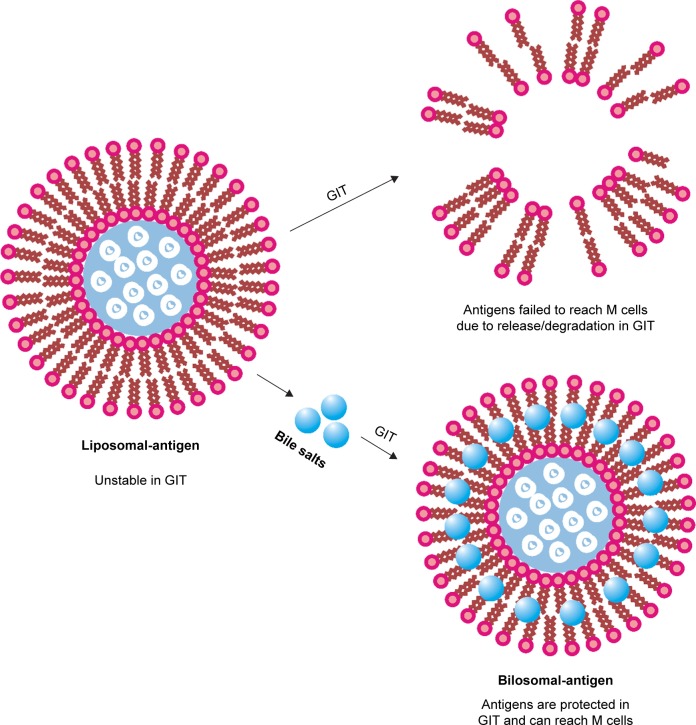
Bilosome-based adjuvants for oral vaccination. Notes: Assembly of the bilosome-based oral vaccines comprising liposome, bile salts, and the hydrophilic antigens. Protection of bilosome on the antigens enhance their resistance against the harsh environment in GIT. Abbreviation: GIT, gastrointestinal tract.
Figure 5
Figure 5
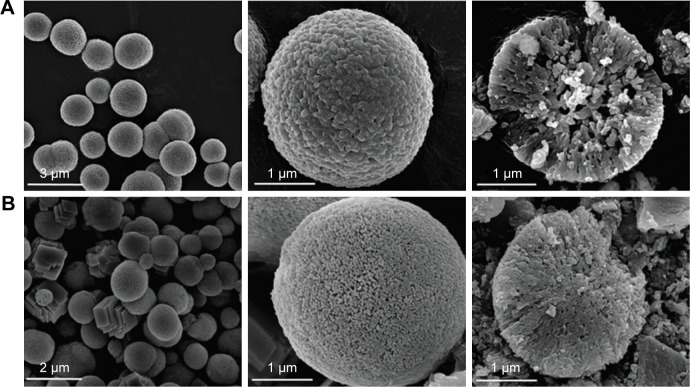
SEM scanning analysis. Notes: (A) SEM micrographs of control CaCO3 microparticles depicting spherical morphology and a highly porous interior. (B) OVA-KFE8 nanofiber-loaded composite microparticles with a denser surface and core. Adapted from Snook JD, Chesson CB, Peniche AG, et al. Peptide nanofiber-CaCO composite microparticles as adjuvant-free oral vaccine delivery vehicles. J Mater Chem B. 2016;4:1640–1649, http://pubs.rsc.org/en/content/articlelanding/2016/tb/c5tb01623a#!divAbstract, with permission of the Royal Society of Chemistry. Abbreviation: OVA-KFE8, chicken egg ovalbumin peptide linked to self-assembling peptide KFE8 (Ac-FKFEFKFE-Am).
Figure 6
Figure 6
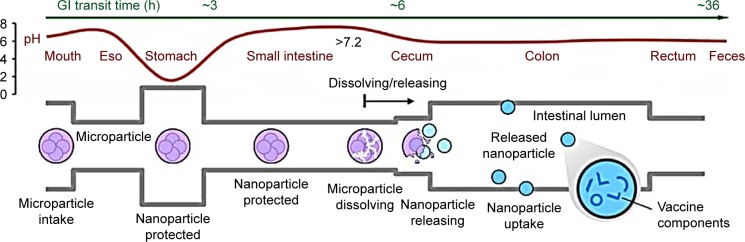
Design for oral vaccines targeting the large-intestinal mucosa. Notes: Microparticles are expected to start releasing the nanoparticles enveloping antigens in the terminal ileum for absorption in the large intestine. Reprinted by permission from Springer Nature: Nature Publishing Group. Nature Medicine, Large intestine-targeted, nanoparticle-releasing oral vaccine to control genitorectal viral infection, Zhu Q, Talton J, Zhang G, et al, Copyright 2012. Abbreviations: Eso, esophagus; GI, gastrointestinal.
Figure 7
Figure 7
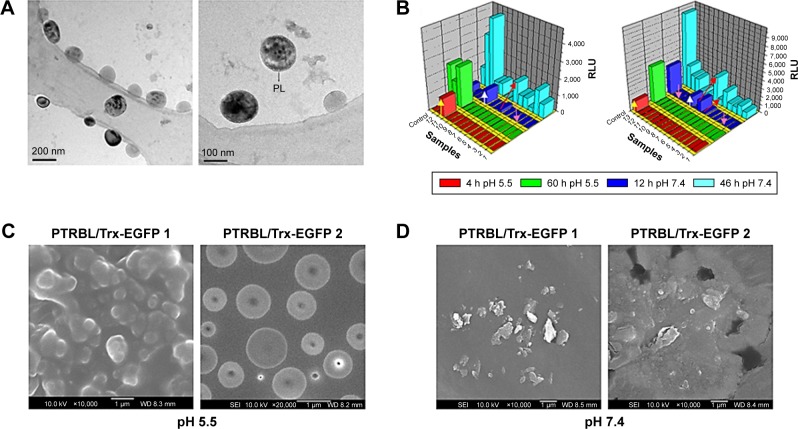
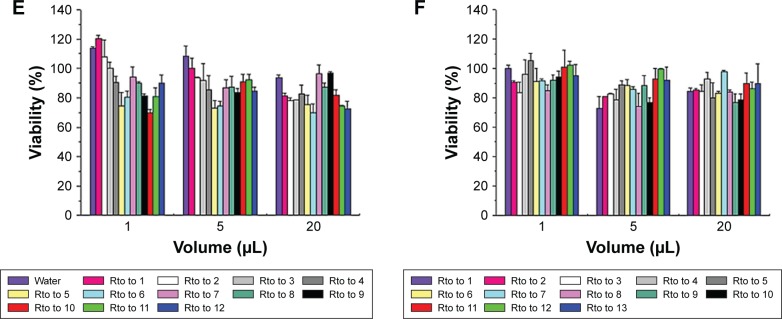
Screening of PTRBL/Trx-SIP nanoparticles with pH-sensitive release characteristics and biocompatibility. Notes: (A) Morphology of the samples (FEI Tecnai G2 F20 S-TWIN TEM at 200 kV). PL, PMMMA shielding layer. (B) Screening of the pH-responsive PMMMA-PLGA/Trx-EGFP nanoparticles. PMMMA synthesized with two series of ratios (Rto) of precursors were determined. A gradual increased release at pH 7.4 is indicated by arrows in red. Release retarded in the first 12 h at pH 7.4 is shown by pink arrows. Cessation of release at pH 7.4 by 46 h is indicated by white arrows. The yellow arrows indicate increased release at pH 5.5. Suspensions of PLGA/Trx-EGFP nanoparticles were set as controls. (C) Morphology of representative samples under pH 5.5. (D) Morphology of representatives at pH 7.4. Trypsin is supplemented to the samples. (E, F) Screening of biocompatible PTRBL/Trx-SIP from series 1 and 2 with PMMMA synthesized with varied ratios of precursors. Adapted from Biomaterials, 77, Zhang et al, Controlled and targeted release of antigens by intelligent shell for improving applicability of oral vaccines, 307–319, Copyright 2016, with permission from Elsevier. Abbreviations: EGFP, enhanced green fluorescent protein; PLGA, poly(lactic-co-glycolic acid); PTRBL, pH and trypsin responsive bilayer; RLU, relative light unit; SIP, surface immunogenic protein.
Figure 7
Figure 7
Screening of PTRBL/Trx-SIP nanoparticles with pH-sensitive release characteristics and biocompatibility. Notes: (A) Morphology of the samples (FEI Tecnai G2 F20 S-TWIN TEM at 200 kV). PL, PMMMA shielding layer. (B) Screening of the pH-responsive PMMMA-PLGA/Trx-EGFP nanoparticles. PMMMA synthesized with two series of ratios (Rto) of precursors were determined. A gradual increased release at pH 7.4 is indicated by arrows in red. Release retarded in the first 12 h at pH 7.4 is shown by pink arrows. Cessation of release at pH 7.4 by 46 h is indicated by white arrows. The yellow arrows indicate increased release at pH 5.5. Suspensions of PLGA/Trx-EGFP nanoparticles were set as controls. (C) Morphology of representative samples under pH 5.5. (D) Morphology of representatives at pH 7.4. Trypsin is supplemented to the samples. (E, F) Screening of biocompatible PTRBL/Trx-SIP from series 1 and 2 with PMMMA synthesized with varied ratios of precursors. Adapted from Biomaterials, 77, Zhang et al, Controlled and targeted release of antigens by intelligent shell for improving applicability of oral vaccines, 307–319, Copyright 2016, with permission from Elsevier. Abbreviations: EGFP, enhanced green fluorescent protein; PLGA, poly(lactic-co-glycolic acid); PTRBL, pH and trypsin responsive bilayer; RLU, relative light unit; SIP, surface immunogenic protein.

References

    1. Han S. Clinical vaccine development. Clin Exp Vaccine Res. 2015;4:46–53. - PMC - PubMed
    1. Silin DS, Lyubomska OV, Jirathitikal V, et al. Oral vaccination: where we are? Expert Opin Drug Del. 2007;4:323–340. - PubMed
    1. Mitragotri S, Lahann J. Physical approaches to biomaterial design. Nat Mater. 2009;8:15–23. - PMC - PubMed
    1. Shah PK, Chyu KY, Fredrikson GN, Nilsson J. Immunomodulation of atherosclerosis with a vaccine. Nat Clin Pract Cardiovasc Med. 2005;2:639–646. - PubMed
    1. Singh S, Yang G, Schluns KS, Anthony SM, Sastry KJ. Sublingual vaccination induces mucosal and systemic adaptive immunity for protection against lung tumor challenge. PLoS One. 2014;9:e90001. - PMC - PubMed